Section 01
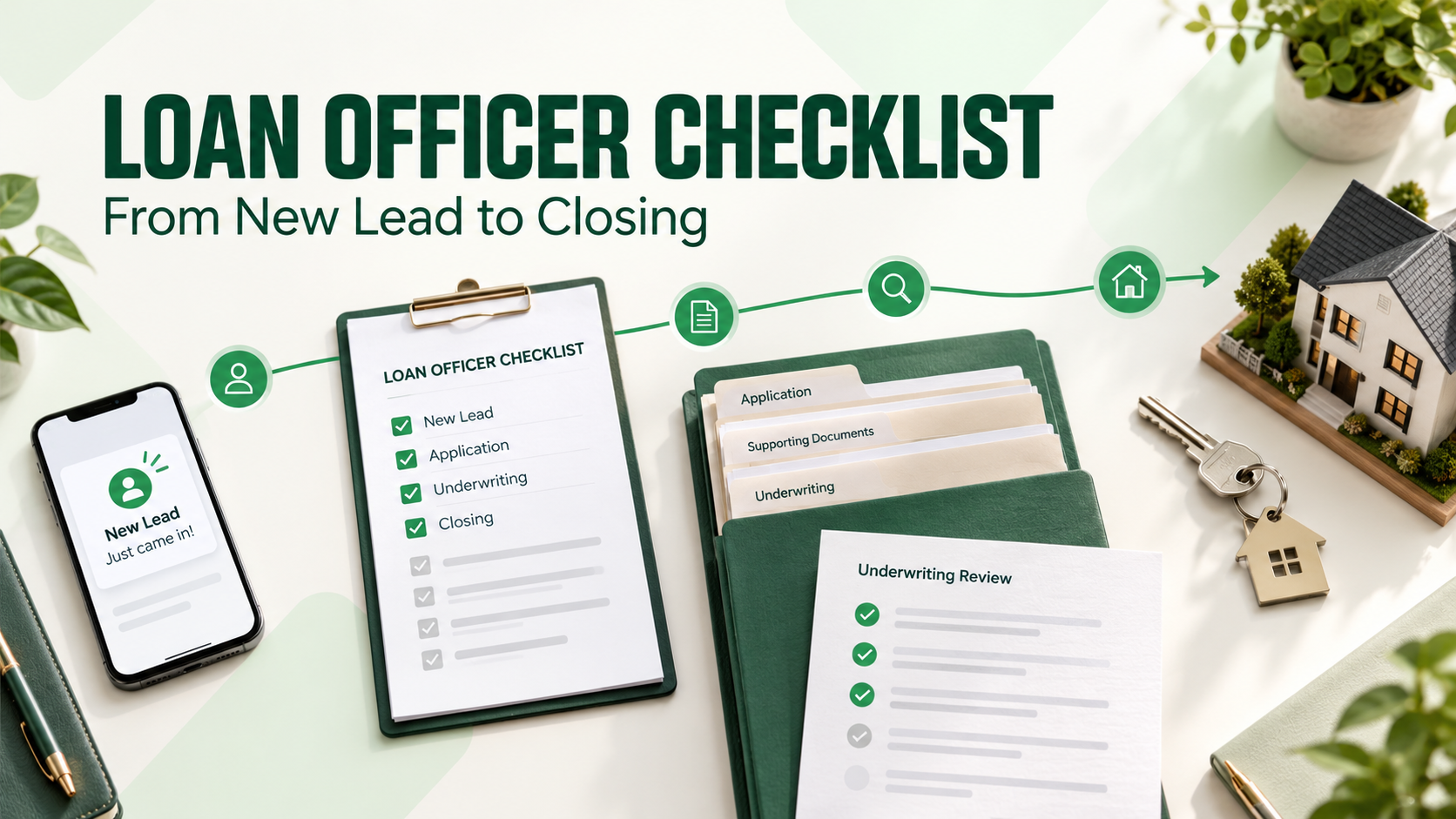
A loan officer checklist gives you a consistent way to manage each mortgage file from the first borrower conversation through closing and post-closing follow-up. It helps you track the next step, identify missing information, communicate with the right people, and reduce preventable delays.
The checklist is not a promise that a loan will be approved or close on a specific date. It also does not replace lender guidelines, automated underwriting findings, company procedures, compliance review, or an underwriter’s decision. Every transaction is different. The purpose is to create a repeatable workflow while leaving eligibility decisions to the people authorized to make them.
Section 02
Why Every Loan Officer Needs a Consistent Checklist
A busy loan officer may be speaking with new leads, collecting documents, reviewing active files, answering Realtor questions, and preparing borrowers for closing on the same day. This workload can be especially challenging during your first year as a loan officer. Without a consistent system, small tasks can disappear inside email threads, text messages, and handwritten notes.
A practical loan officer checklist creates one place to confirm:
- What has already been completed.
- What is still missing.
- Who owns the next action.
- When the next follow-up should happen.
- Which information must be verified.
- Which questions require an underwriter or compliance professional.
The checklist should work with your CRM and loan origination system, not compete with them. Each important conversation, document request, deadline, and status change should be recorded through the approved company process. If another team member opens the file, that person should be able to understand its current status without reconstructing the story from scattered messages.
Section 03
Loan Officer Checklist Stage 1: New Lead Intake
The first stage begins when a lead enters your system. Speed matters, but accurate documentation matters too. Before jumping directly into loan options, collect enough information to understand why the person contacted you and what should happen next.
Record the following:
- Borrower’s full name and preferred name.
- Phone number and email address.
- Preferred language and communication method.
- Lead source and referral partner, when applicable. If Realtor relationships are part of your pipeline, use a consistent process for building Realtor referral partnerships.
- Purchase, refinance, or general planning goal.
- Property state or target market.
- Expected timeline.
- Whether the borrower is already working with a Realtor.
- Date and purpose of the next conversation.
Follow your company’s requirements for consent, calling, texting, email, record retention, and do-not-contact requests. A lead entering a CRM does not automatically mean every type of marketing communication is permitted. Review these principles of loan officer marketing compliance before building automated outreach into your workflow.
End the first contact with a clear next step. That may be scheduling a discovery call, sending a secure application link, or explaining which basic information will be helpful during the next conversation. Avoid asking the borrower to send Social Security numbers, bank statements, or other sensitive records through an unapproved channel.
Section 04
Stage 2: Hold the Initial Borrower Conversation
The initial conversation should help you understand the borrower’s objective before discussing a specific product. Keep the discussion organized, but do not turn it into an interrogation.
Cover the main areas:
- Is the borrower purchasing or refinancing?
- Will the property be a primary residence, second home, or investment property?
- What price range or loan amount is being considered?
- Is there a contract, closing deadline, or relocation date?
- What are the borrower’s general employment and income sources?
- What funds may be available for down payment, closing costs, and reserves?
- Does the borrower own other real estate?
- Are there credit, debt, or documentation concerns the borrower wants to discuss?
Explain the difference between an initial conversation, a prequalification, a preapproval, and final loan approval according to your company and program. Do not tell the borrower that approval is guaranteed based on a few verbal answers. Borrowers may also benefit from reviewing the questions to ask a loan officer before selecting a mortgage professional.
At the end, summarize what you understood and identify the next action. This keeps the loan officer checklist connected to the borrower’s actual goal instead of becoming a generic form that collects information without context.
Section 05
Stage 3: Complete the Application and Document Collection
Once the borrower is ready to proceed, provide the approved application process and a document list appropriate for the transaction. Do not request every document you can imagine. Ask for items that are relevant to the selected path and current requirements.
Depending on the loan and borrower, the file may need:
- Government-issued identification.
- Employment and residential history.
- Pay statements, W-2s, tax returns, or other income records.
- Bank, retirement, investment, or other asset statements.
- Information about current housing expenses and real estate owned.
- Documentation related to support obligations or other liabilities when applicable.
- Purchase contract and amendments if the borrower is under contract.
- Gift, grant, or down payment assistance documentation when used.
- Program-specific explanations or records.
Check that every required statement includes all pages and covers the correct period. Compare the application with the documents received. Names, addresses, employers, income sources, assets, debts, occupancy, and real estate owned should tell a consistent story.
If information conflicts, ask the borrower to clarify it. Do not silently change a material fact to make the file look cleaner. Our guide to mortgage application accuracy and fraud risk explains why complete and truthful information matters throughout the process.
Section 06
Stage 4: Review the Prequalification or Preapproval File
Before issuing or communicating a prequalification or preapproval, complete the review required by your company and the selected program. The terminology and process can vary, so use only the status and language your organization authorizes.
Review:
- Whether the application is complete enough for the intended review.
- Which income sources are needed and how they may be documented.
- Available assets and estimated funds needed to close.
- Credit liabilities, housing expenses, and other known obligations.
- Intended occupancy and property type.
- Loan amount, estimated payment, and borrower objective.
- Automated underwriting findings when applicable.
- Important assumptions or items that remain unverified.
If the borrower receives a Loan Estimate, encourage a careful review of the loan terms, projected payments, and closing costs. The CFPB provides an official Loan Estimate explainer that borrowers can use to understand the form.
Do not present estimates as final figures or promise that a future rate, payment, cash-to-close amount, or approval result will remain unchanged. Clearly explain what still depends on documentation, property review, underwriting, market conditions, and other requirements.
Section 07
Stage 5: Review the Property and Purchase Contract
When a borrower identifies a property, update the file promptly. A strong borrower profile cannot fix a property or transaction that does not meet the selected program’s requirements.
Confirm:
- Property address and type.
- Intended occupancy.
- Purchase price and loan amount.
- Earnest money deposit.
- Seller credits or other concessions.
- Financing and appraisal contingencies.
- Contract and expected closing dates.
- Realtors, settlement agent, and other transaction contacts.
- Known HOA, condominium, insurance, repair, or title concerns.
- All amendments and relevant addenda.
Compare the purchase contract with the application and loan structure. If the price, deposit, credits, occupancy, or closing date changes, make sure the appropriate team members receive the update.
Escalate unusual contract terms instead of interpreting legal language beyond your role. The goal of this part of the loan officer checklist is to identify transaction-level questions early, not to provide legal advice.
Section 08
Stage 6: Prepare the File for Processing and Underwriting
Before submitting the file, perform a connected review rather than checking documents one at a time. The application, credit report, income records, asset statements, contract, and loan structure should support the same scenario.
Use this pre-submission review:
- Confirm the application is complete, current, and signed as required.
- Review identity, employment, income, assets, liabilities, and real estate owned.
- Check that required pages and statement periods are included.
- Identify large deposits, transfers, gifts, and other sources of funds.
- Review recent credit inquiries and possible new obligations.
- Confirm that the documentation supports the selected loan program.
- Compare the application, purchase contract, and loan terms.
- Flag property, occupancy, insurance, title, or project questions.
- Note any missing, inconsistent, or decision-required items.
- Document important borrower conversations and updates.
For a deeper file review, use our guide to what actually happens during mortgage underwriting. It explains why a complete submission can still produce questions or conditions during the full review.
A complete submission can reduce avoidable back-and-forth, but it cannot guarantee fewer conditions. Underwriting may identify additional questions after reviewing the full borrower, property, and transaction profile.
Section 09
Stage 7: Manage Underwriting Conditions
When conditions are issued, translate each request into a clear action without changing its meaning. Identify who is responsible, what document or explanation is required, and when the item is needed.
For each condition:
- Read the complete condition.
- Confirm whether it belongs to the borrower, loan team, property, title, insurance, or another party.
- Request the exact item through an approved communication channel.
- Explain required dates, pages, signatures, or supporting records.
- Review the response for completeness before resubmission.
- Record the status and next action in the system.
- Leave the final acceptability decision to the authorized reviewer.
Avoid telling a borrower that an item will “definitely clear” a condition. A loan officer may collect and review documents, but the underwriter or other authorized party determines whether the requirement has been satisfied.
Borrowers often become nervous when they hear the word “condition.” Explain that conditions are requests that must be addressed as part of the review, not automatically a sign of denial. A lender may also apply requirements beyond broader program standards, so loan officers should understand why one mortgage lender may say yes while another says no.
Section 10
Stage 8: Prepare for Clear to Close
“Clear to close” is an important milestone, but the transaction may still have final steps. Use the loan officer checklist to confirm the status before telling anyone the loan is finished.
Review:
- Current underwriting status.
- Any prior-to-closing or funding requirements.
- Final loan terms and approved changes.
- Closing Disclosure delivery and review timeline.
- Borrower’s estimated funds to close.
- Verified wiring instructions and fraud warnings.
- Homeowners insurance and title items.
- Closing appointment, identification, and signing method.
- Final employment, credit, or asset verification when required.
The CFPB explains that the Closing Disclosure presents final loan terms and closing costs and is generally provided at least three business days before the scheduled closing. Borrowers can use the CFPB’s Closing Disclosure explainer to compare the form with what they expected.
If the borrower sees an unexpected term or cost, route the question to the appropriate team member. Do not encourage signing before a material concern has been addressed.
Section 11
Stage 9: Complete the Closing-Day Checklist
On closing day, make sure the borrower understands the logistics and knows how to reach the team if a question comes up.
Confirm:
- Closing time, location, or approved remote-signing process.
- Acceptable identification.
- Secure method for sending required funds.
- Contact information for the settlement agent.
- Status of signing, funding, and recording.
- Any final lender or property requirement.
Warn borrowers to independently verify wiring instructions using a trusted phone number. Last-minute emailed changes to wiring instructions should be treated with caution and verified through the approved process.
Keep Realtors and other transaction partners updated, but share only information you are permitted to disclose. They generally need the transaction status, outstanding transaction-level items, responsible party, and expected next update. They do not automatically need private income, credit, asset, tax, medical, or personal information.
Signing documents does not always mean funding and recording are complete. Use precise language about the current milestone, especially in states where funding, recording, and key delivery may happen at different times.
Section 12
Stage 10: Complete the Post-Closing Follow-Up
The relationship should not disappear once the transaction closes. A structured post-closing process helps borrowers know where to direct questions and gives the loan officer a responsible way to maintain the relationship.
Post-closing actions may include:
- Thanking the borrower and referral partner.
- Confirming the borrower knows where to find payment and servicing information.
- Updating the CRM with the final status and relevant dates.
- Scheduling an annual mortgage review when appropriate.
- Recording communication preferences and opt-out requests.
- Requesting a review or referral in line with company policy.
- Providing general educational resources without suggesting that refinancing or another transaction is automatically beneficial.
Be careful with gifts, co-marketing, and referral arrangements. Section 8 of RESPA restricts kickbacks and referral fees involving settlement services. HUD explains that payments must not include prohibited referral fees or unearned fees. Review the official HUD RESPA guidance, then use the Wonder Rates Realtor referral partnerships guide as a practical starting point. Obtain compliance or legal guidance before creating an arrangement with a referral partner.
This final stage completes the loan officer checklist, but it also starts the long-term client relationship. Useful follow-up should have a reason, provide context, and respect the borrower’s communication preferences.
Section 13
Loan Officer Checklist at a Glance
| Stage | Main responsibility | Desired outcome |
|---|---|---|
| New lead | Record the need, source, consent, and next action | Lead is organized in the CRM |
| Initial conversation | Understand the borrower’s objective | Appropriate next step is identified |
| Application | Collect accurate information and relevant documents | File is complete enough for review |
| Preapproval | Review the scenario and disclose assumptions | Borrower understands the current status |
| Property | Match the contract and property to the file | Transaction details are consistent |
| Underwriting | Submit a connected, documented file | Questions and conditions are clear |
| Clear to close | Verify final requirements and disclosures | Borrower is prepared for closing |
| Closing | Track signing, funding, and recording | Status is communicated accurately |
| Post-closing | Update records and maintain the relationship | Follow-up is timely and compliant |
Section 14
Frequently Asked Questions
What should be included in a loan officer checklist?
It should cover lead intake, borrower goals, application completion, document collection, preapproval review, property and contract details, underwriting submission, conditions, closing preparation, closing status, and post-closing follow-up. It should also identify the next action, responsible person, deadline, and items requiring an authorized decision.
When should a loan officer follow up with a new lead?
Follow the timing and communication standards established by your company. The first response should acknowledge the inquiry and establish a clear next step. Additional follow-up should have a useful purpose and comply with consent, calling, texting, email, and opt-out requirements.
Can a checklist guarantee mortgage approval?
No. A checklist can improve organization and reduce preventable omissions, but approval depends on the borrower’s qualifications, documentation, property, loan program, lender requirements, underwriting review, and other applicable conditions.
Can a loan officer clear underwriting conditions?
A loan officer can request, collect, and review documents, but only an authorized underwriter or reviewer can determine whether a condition is satisfied. Avoid representing a submitted document as accepted before that decision is made.
What should a loan officer do after closing?
Update the CRM, thank the borrower and referral partner, confirm where the borrower can find servicing information, document communication preferences, and schedule useful follow-up. Any request for reviews, referrals, or future business should follow company and legal requirements.
Section 15
The Bottom Line
A strong loan officer checklist creates consistency from the first inquiry through post-closing follow-up. It gives the loan team a clearer view of the file, helps borrowers understand their next step, and makes it easier to identify missing or inconsistent information before it creates a delay.
The best checklist is not the longest one. It is the one your team uses consistently, updates accurately, and adapts to the actual lender, loan program, borrower, property, and company process. Use this framework as a starting point, then align it with your organization’s current procedures and compliance requirements.
Duc Pham, Mortgage Broker | NMLS# 844897
Wonder Rates, Inc. | NMLS# 1518655
Equal Housing Lender.
AZ, CA, CO, FL, GA, LA, MI, OK, PA, SC, TX, VA, WA, OH, AL, OR, NC
This article is for general education only and is not a commitment to lend, legal advice, or compliance advice. Loan approval is subject to creditworthiness, income verification, property eligibility, documentation, and current underwriting guidelines. Requirements, procedures, loan programs, rates, and fees may change without notice. Loan officers should follow their company’s policies and obtain guidance from authorized compliance, legal, processing, and underwriting professionals for the specific transaction.