
Section 01
Most mortgage mistakes don’t happen because buyers are unqualified. They happen after pre-approval, during the home buying process.
They save for a down payment. They watch their credit score. Then, they get pre-approved before looking at homes. They do everything they are supposed to do going in.
Then somewhere between pre-approval and closing, something goes wrong.
A deal falls apart. A closing gets delayed. An underwriter sends back a condition that takes two weeks to resolve. And the buyer is left wondering what happened when they thought they had done everything right.
The mistakes that cause most of these problems are not complicated. They are the same ones Duc sees repeatedly, and almost all of them are avoidable if you know about them before they happen.
Section 02
Mortgage Mistakes 1: Making Large Purchases Between Pre-Approval and Closing
Closing is only a few days away. You finance a new couch because you’ll need it when you move in. The lender pulls your credit one final time. Now your loan needs another underwriting review.
This is the most common one, and it still surprises people every time it happens.
After pre-approval, buyers feel like the hard part is done. Buyers often get loans for furniture, appliances, or a new car before closing. They believe their mortgage is approved.
Every one of those decisions changes the financial picture that underwriting approved.
Lenders pull credit again before funding, often the day before closing. A new account, a new inquiry, or a higher balance that was not there at pre-approval triggers a re-review of the file. If the new debt pushes your DTI above the qualifying threshold, the loan gets restructured or delayed. In some cases it does not close at all.
The rule between pre-approval and closing is simple: buy nothing on credit. Nothing. Not furniture, not a car, not a mattress on a payment plan.
Section 03
Mortgage Mistakes 2: Changing Jobs Without Telling Your Loan Officer
Job changes feel personal. Mortgage applications feel financial. Most buyers do not immediately connect the two.
But lenders verify employment throughout the process, including right before closing. A job change during the process isn’t always a problem. However, it’s important that your loan officer is involved before it happens, not after.
Changing jobs within the same industry may be manageable, but it depends on timing, income structure, and lender guidelines. Changing industries, going from a salaried job to self-employment, or starting a new role can cause problems. These issues may take time to fix. The earlier your loan officer knows, the more options exist for handling it cleanly.
The mistake is not the job change. The mistake is making it without a conversation first.
| Employment Change | Risk Level | What Helps |
|---|---|---|
| Same industry, higher salary | Low | Offer letter, start date confirmation |
| Different industry, similar role | Moderate | Full documentation of new position |
| Salaried to self-employed | High | May need to wait for 2-year history |
| New role with probation period | Moderate to High | Depends on lender and loan program |
| Change after closing | No impact | Timing matters significantly |
Risk levels are general guidelines. Actual underwriting decisions depend on the full borrower profile and lender requirements.
Section 04
Mortgage Mistakes 3: Not Shopping More Than One Lender
Most buyers talk to one lender, get a rate, and take it.
The fear behind this decision is usually that shopping multiple lenders will hurt their credit. Mortgage inquiries made within 14 to 45 days count as one inquiry in FICO models. So, if you shop with two or three lenders, the credit impact is small.
What is not minimal is the difference in rate and fees between lenders. Freddie Mac research has shown that borrowers who shop multiple lenders can save significantly over the life of the loan. See the research published by Freddie Mac for additional details. Even small differences in rates and fees can add up over time, especially on larger loan amounts.
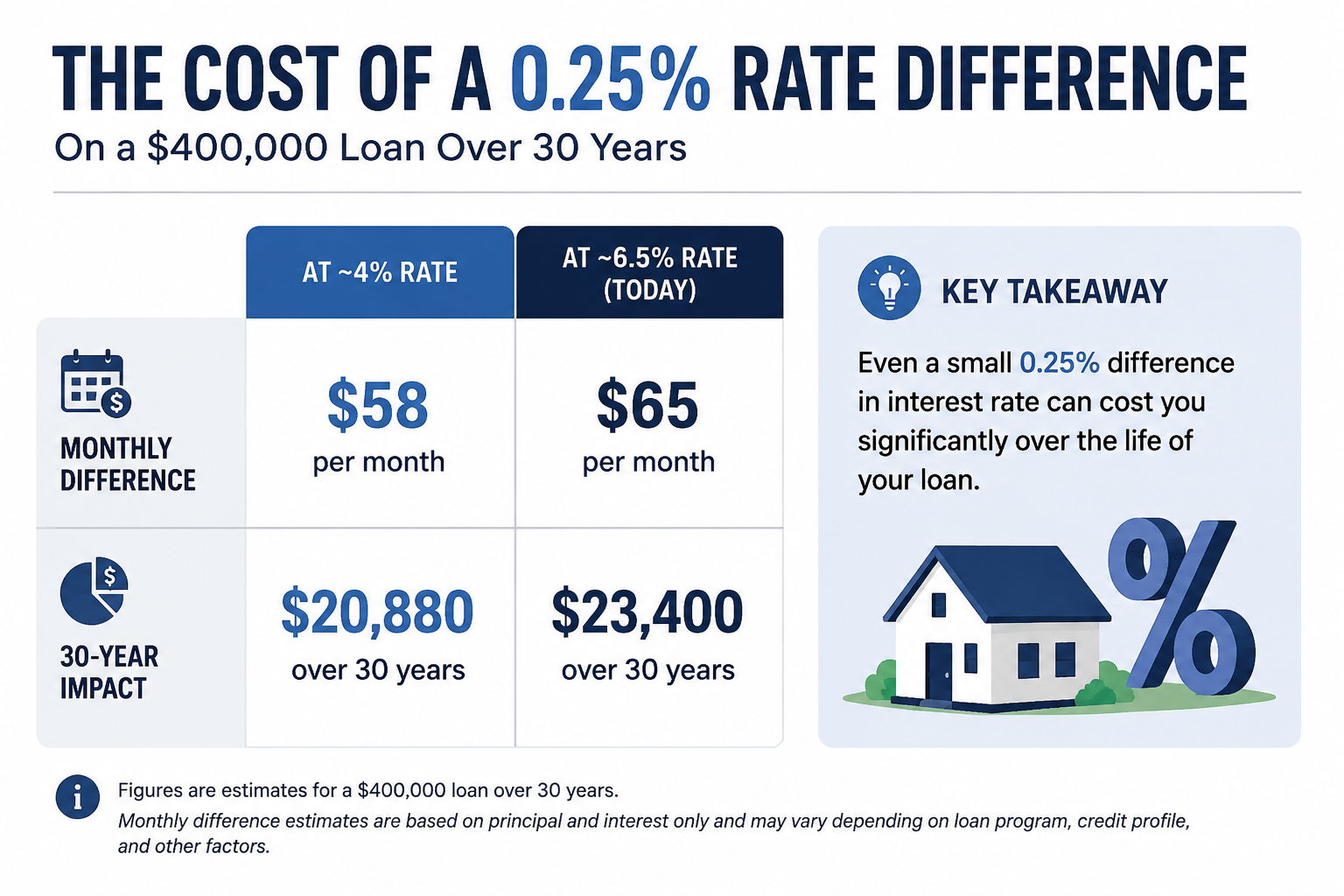
On a larger loan, the difference compounds. A 0.25% difference in rate on a $400,000 loan is approximately $65 per month (based on current ~6.5% rate assumptions), or about $23,400 over 30 years.
The small effort of comparing multiple lenders can translate into meaningful savings over the life of your loan.
The Freddie Mac figures referenced reflect findings from their research on the value of shopping for mortgages. Buyers should verify current research directly with Freddie Mac’s website for the most recent data.
Section 05
Mortgage Mistakes 4: Depositing Large Sums of Cash Without Documentation
Underwriters check where every big deposit in your bank statements comes from. They usually look back two months before you apply.
A large cash deposit without a paper trail is one of the most common conditions underwriters issue. It does not matter that the money is legitimately yours. If you cannot document where it came from, the underwriter cannot count it toward your qualifying assets.
What counts as large depends on the lender. However, a typical rule is that any deposit over 50% of your gross monthly income is considered large. This applies if the deposit isn’t a regular paycheck or a documented transfer.
The fix requires planning. Avoid cash deposits in the 60 to 90 days before you apply. If you expect gift funds or plan to sell something valuable, get your documents ready. Do this before the money arrives in your account.
Section 06
Mortgage Mistakes 5: Assuming Pre-Qualification and Pre-Approval Are the Same Thing
They are not, and in a competitive market the difference can cost you the deal.
Learn the full difference between pre-qualification vs pre-approval before you start house hunting.
Pre-qualification is a self-reported estimate based on information you provide with no verification. It takes 15 minutes and tells a seller that you had a conversation with a lender.
Pre-approval is a verified credit decision. The lender has reviewed your documents, pulled your credit, and had an underwriter look at the file. The letter from that process tells the seller that a lender has reviewed your finances. It confirms you can close.
In a busy market, sellers get many offers. A pre-qualification letter is weaker than a full pre-approval letter. Listing agents know the difference and communicate it to their sellers.
| Pre-Qualification | Pre-Approval | |
|---|---|---|
| Documentation required | None | Full income, asset, and credit review |
| Credit pull | Usually no hard pull | Hard pull required |
| Underwriting review | No | Yes |
| Seller confidence | Low | High |
| Time to obtain | Same day | 5 to 10 business days |
| Best use | Early budgeting | Making competitive offers |
Section 07
Mortgage Mistakes 6: Ignoring the Loan Estimate
Your lender must give you a Loan Estimate. This happens within three business days after you apply for a mortgage. This requirement comes from the TRID rule (TILA-RESPA Integrated Disclosure), which combines disclosures under TILA and RESPA. It shows your estimated interest rate. It also includes your monthly payment, closing costs, and loan terms.
Most buyers glance at it and file it away. That is a mistake.
The Loan Estimate is the document you use to compare lenders accurately, because it uses a standardized format. It is also the document that tells you whether the rate you were quoted verbally matches what is actually being offered in writing. Fees differ a lot between lenders. Comparing the APR gives you a clearer view of the total cost than just looking at the interest rate.
If anything on the Loan Estimate does not match what you were told, ask before you proceed.
Section 08
Mortgage Mistakes 7: Skipping the Final Walkthrough
The final walkthrough typically happens 24 to 48 hours before closing. Its purpose is to check if the property is in the right condition. It also makes sure any agreed repairs are finished. Finally, it confirms that nothing has changed since your last visit.
Buyers occasionally skip it because the closing feels imminent and they do not want to introduce complications. That is exactly the wrong instinct.
If a repair was agreed but not done, find out before you sign. If something got damaged during the seller’s move-out, know that before signing too. Once you close, the property is yours along with every problem in it. The final walkthrough is your last contractual opportunity to address anything that is not right.
Section 09
Frequently Asked Questions
What happens if my loan is denied right before closing?
A loan denial right before closing is rare, but it can happen. It often comes from changes in your finances. This can include new debt or job changes. Large unexplained deposits may also be a factor. Property issues found during appraisal can lead to problems too.
In many cases, the issue can be fixed with additional documentation or a different loan program. In some situations, switching lenders may still allow the deal to close. It’s stressful, but not always the end of the transaction.
Can I lock my rate after I find a home, or should I lock earlier?
You can usually lock your rate once you have a signed contract. Some lenders also offer early lock options.
Standard rate locks last 30–60 days. Locking too early can risk expiration if closing is delayed, while locking too late exposes you to rate increases. The right timing depends on your closing timeline and market conditions, so your loan officer should guide the decision.
What is the difference between the interest rate and the APR on my Loan Estimate?
The interest rate is the cost of borrowing money. The APR includes the interest rate plus most loan fees, giving a more complete picture of total loan cost.
When comparing lenders, APR is more useful than interest rate alone because it reflects both rate and fees. Two loans with the same interest rate can still cost very differently over time.
Section 10
Conclusion
Most mortgage delays aren’t caused by bad credit. They’re caused by small, preventable mistakes that happen after pre-approval.
Before you start making offers, send Duc or the Wonder Rates team a message. We’ll review your mortgage readiness, identify potential underwriting issues early, and help you avoid surprises that could delay your closing.
All figures, guidelines, and examples in this article are for illustrative and educational purposes only and do not constitute an offer of credit or financial advice. Mortgage processes, underwriting guidelines, and lender requirements vary and are subject to change. The Freddie Mac research referenced reflects findings published prior to this article’s publication date; readers should verify current research directly. Consult your loan officer for guidance specific to your situation.
Duc Pham, Mortgage Broker | NMLS# 844897 | Wonder Rates, Inc. | NMLS# 1518655 | DRE# 02047445 | DFPI# 60DBO-59134 | Equal Housing Opportunity. Equal Housing Lender. | Licensed in: AL, AZ, CA, CO, FL, GA, LA, MI, NC, OH, OK, OR, PA, SC, TX, VA, WA.