

Section 01
A mortgage with unpermitted work may still be possible, but the lender must evaluate the property’s safety, marketability, legal use, appraisal, insurance, and loan-program requirements. The buyer should not assume that an addition, garage conversion, bedroom, bathroom, or accessory unit is acceptable simply because it already exists.
The correct response depends on what was built, whether permits were required, the quality of the work, local enforcement, the property’s current use, and the proposed financing. Buyers should investigate the issue before contract and loan deadlines expire.
Section 02
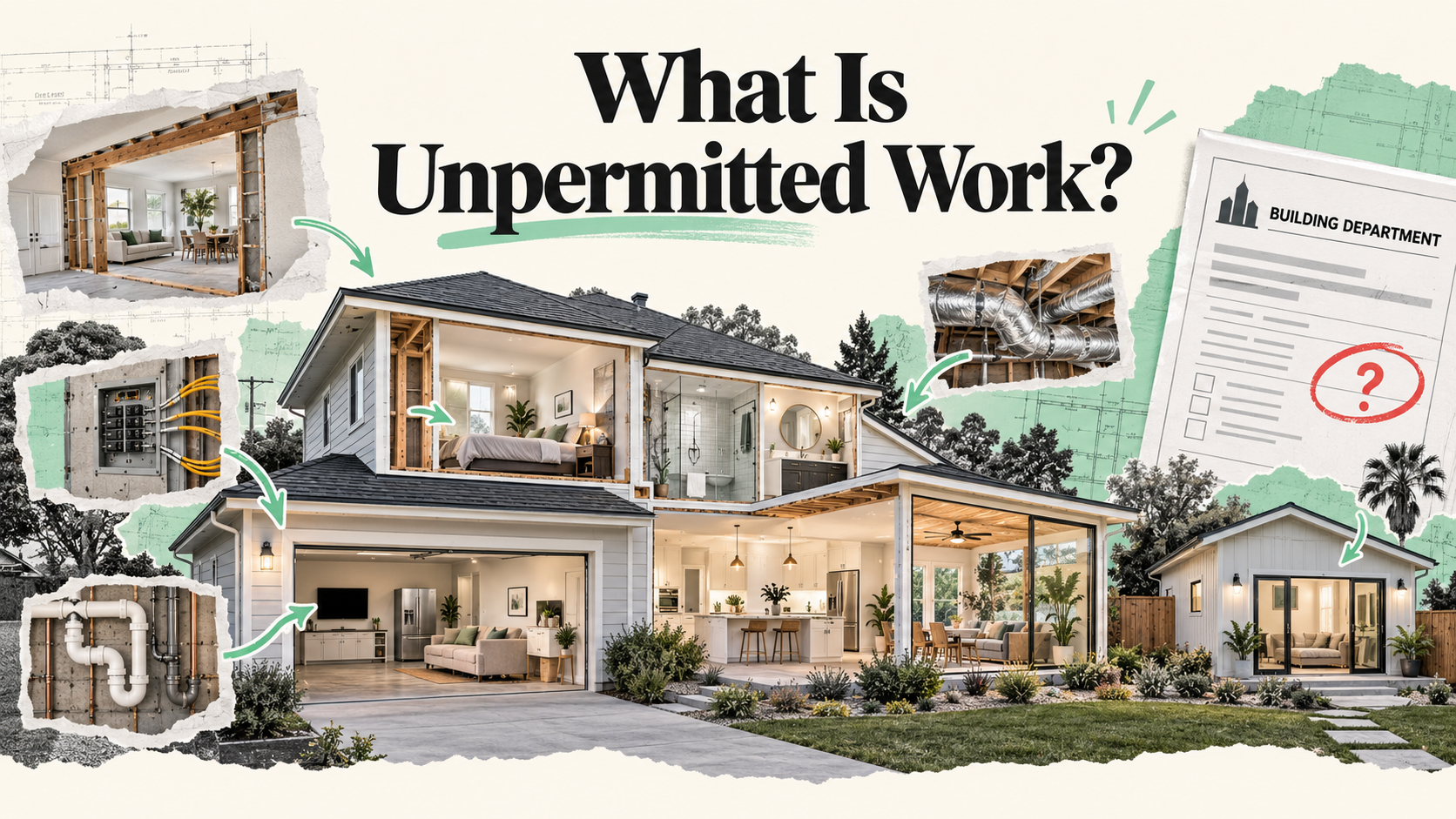
What Is Unpermitted Work?
Unpermitted work generally refers to construction, conversion, installation, or alteration completed without a permit or final approval that the local authority required. Requirements vary by city, county, state, project type, and date of construction.
Common examples include:
- A garage converted into living space.
- An added bedroom or bathroom.
- A detached or attached accessory dwelling unit.
- An enclosed patio or expanded kitchen.
- Electrical-panel, plumbing, structural, or HVAC changes.
- A finished basement or attic.
- A wall removed or added.
Not every improvement requires a permit, and an old improvement may have been completed under different rules. Confirm the facts with the appropriate local building or planning department rather than relying on a listing description.
Section 03
Can You Get a Mortgage With Unpermitted Work?
Possibly. Unpermitted work is not one universal loan category with one result. The lender reviews the complete property and transaction under the selected program.
Fannie Mae’s current appraisal guidance states that when an appraiser identifies an addition without a required permit, the appraiser must comment on the quality and appearance of the work and any effect on market value. The official improvements section of the appraisal guidance illustrates that the analysis requires more than checking whether a permit exists.
Other programs, investors, lenders, insurers, and jurisdictions may apply different requirements. A property may raise concern because the work is unsafe, creates an illegal unit, changes the property type, cannot be insured, or harms marketability. The lender decides eligibility for the actual loan.

Section 04
7 Risks of Buying a Home With Unpermitted Work
1. Public records may not match the listing
The listing may advertise more square footage, bedrooms, bathrooms, or units than the assessor or building records recognize. That difference can affect valuation, taxes, insurance, occupancy, and the buyer’s expectations.
Ask which features are included in the official records and appraisal. Do not value the home solely by multiplying the advertised area by a neighborhood price per square foot.
2. The appraiser may treat the space differently
An appraiser considers physical characteristics, quality, legal use, market reaction, and comparable sales. The unpermitted area may not receive the same treatment as permitted living area. Its effect can be positive, neutral, or negative depending on the facts.
The appraisal is not a permit audit or building-code inspection. It also does not make the work legal. Wonder Rates’ guide to appraisal versus inspection explains why the two reports serve different purposes.
3. Safety concerns can require further review
Visible electrical, structural, plumbing, heating, moisture, egress, or sanitation problems may require repair or inspection by a qualified professional. Fannie Mae’s property-condition guidance illustrates how certain deficiencies can lead to additional inspection or correction requirements.
Do not treat cosmetic finishes as proof that hidden work is safe. A renovated room can still contain improper wiring, ventilation, framing, or drainage.
4. The work may change the property classification
A second kitchen, separate entrance, utility meters, bathroom, sleeping area, or rental arrangement can raise questions about whether the property is one unit with an accessory area, a home with an ADU, or a two-unit property.
Classification can affect appraisal forms, zoning, occupancy, insurance, rental-income treatment, and loan eligibility. The lender and appraiser must evaluate the actual layout and use, not only the seller’s label.
Buyers interested in an accessory unit should also review the planning issues in buying a home for a multigenerational family before assuming every converted space fits long-term family needs.
5. Insurance may be difficult or limited
An insurer may ask about renovations, electrical systems, roof work, occupancy, rental use, square footage, or additional structures. Incomplete or inaccurate information can create coverage concerns.
Obtain an insurance quote based on the property’s actual condition and use before removing relevant contingencies. A quote is not the same as a bound policy. If insurance cannot be secured on acceptable terms, the mortgage may not close.
6. The local authority may require correction
A future complaint, inspection, sale, renovation, rental registration, or permit application can bring prior work to the authority’s attention. Possible outcomes depend on local law and may include inspections, plans, professional certifications, fees, retroactive permits, modification, or removal.
Do not assume retroactive approval is available or inexpensive. Contact the jurisdiction or a qualified local professional before relying on that path.
7. Resale and refinancing can become harder
The next buyer, appraiser, lender, insurer, or title company may raise the same questions. Market conditions and loan guidelines can also change. A problem accepted in one transaction may delay another.
Buyers should evaluate the exit, not only the current approval. Wonder Rates explains why mortgage decisions can differ between lenders, but a different lender is not a substitute for resolving a material property issue.

Section 05
Appraisal, Inspection, Permit Search, and Title Review
These reviews overlap but are not interchangeable.
| Review | Main question |
|---|---|
| Appraisal | What are the value, condition, marketability, and collateral characteristics? |
| Home inspection | What observable property conditions should the client understand? |
| Permit search | What approvals and final records does the local authority show? |
| Title review | What recorded interests, exceptions, or other title matters affect the property? |
| Insurance review | Can the property and its actual use be covered on acceptable terms? |
The buyer may need specialized electrical, structural, plumbing, roofing, environmental, or zoning advice. No single report answers every question.
Section 06
Documents to Request From the Seller
Ask for documents connected with the improvement:
- Permits, plans, inspection cards, and final approvals.
- Contractor contracts, invoices, licenses, and warranties.
- Architectural or engineering records.
- Property disclosures and prior inspection reports.
- Insurance claims or coverage correspondence.
- Utility and tax records.
- Rental permits or certificates, if applicable.
- Notices from the building or zoning department.
- Appraisals showing how the area was treated.
Missing records do not prove the work is defective, but they increase uncertainty. Verify important information independently.
Section 07
Possible Options Before Closing
The appropriate response depends on the contract and professional advice. Options may include:
- Ask the seller to obtain permits or final approval.
- Require repairs or removal of unacceptable work.
- Obtain specialist inspections and estimates.
- Renegotiate the price or credits when permitted.
- Change the loan structure if an eligible alternative exists.
- Extend deadlines through a written contract amendment.
- Exercise a contractual cancellation right when available.
Do not complete major work on a property the buyer does not own without legal guidance. Do not assume a seller credit solves eligibility, safety, or insurance concerns.
If repairs are extensive, the buyer can learn about the FHA 203(k) renovation-loan framework, but eligibility, contractor, appraisal, property, and project requirements still apply.
Section 08
Buyer Checklist
- Compare listing details with public records.
- Ask what work was completed and when.
- Request permit and final-approval documents.
- Inform the loan officer before appraisal or underwriting.
- Obtain appropriate inspections.
- Verify the actual property classification and use.
- Request an insurance quote using accurate information.
- Estimate repair, approval, or removal costs.
- Protect contract and financing deadlines.
- Keep funds available for unexpected property issues.
First-time buyers may also use 10 questions to ask a loan officer when discussing property review and financing timelines.
Section 09
Frequently Asked Questions
Does unpermitted work automatically fail an appraisal?
No. The appraiser reports relevant facts and analyzes value and marketability under the assignment. The lender applies the loan requirements and decides whether additional review or correction is needed.
Can the seller get a retroactive permit?
Possibly, depending on the jurisdiction and work. The process may require plans, inspections, opening walls, corrections, fees, or removal. Confirm locally.
Will a home inspection find every code issue?
No. A general inspection has a defined scope and limitations. Specialized evaluation or a permit review may be needed.
Can the buyer accept the property as is?
Contract acceptance does not make the property eligible for a mortgage or insurance. The lender, insurer, and local authority apply their own requirements.
Section 10
Investigate Before the Deadline
A mortgage with unpermitted work is a property question, a financing question, and sometimes a legal and insurance question. The safest approach is to identify the improvement, verify available records, evaluate the physical condition, and submit accurate information early.
Do not let attractive finishes replace due diligence. The buyer should understand what exists, what is legal, what is safe, what the lender will accept, and what may need to change before closing or resale.
Duc Pham, Mortgage Broker | NMLS# 844897
****Wonder Rates, Inc. | NMLS# 1518655
Equal Housing Lender.
AZ, CA, CO, FL, GA, LA, MI, OK, PA, SC, TX, VA, WA, OH, AL, OR, NC
This article is for educational purposes only and is not legal, appraisal, engineering, insurance, tax, or building-code advice and is not a commitment to lend. Permit, zoning, property, insurance, and loan requirements vary by jurisdiction and transaction. Loan approval is subject to the complete application, property eligibility, and current underwriting guidelines. Consult qualified professionals before making a decision.