
Section 01
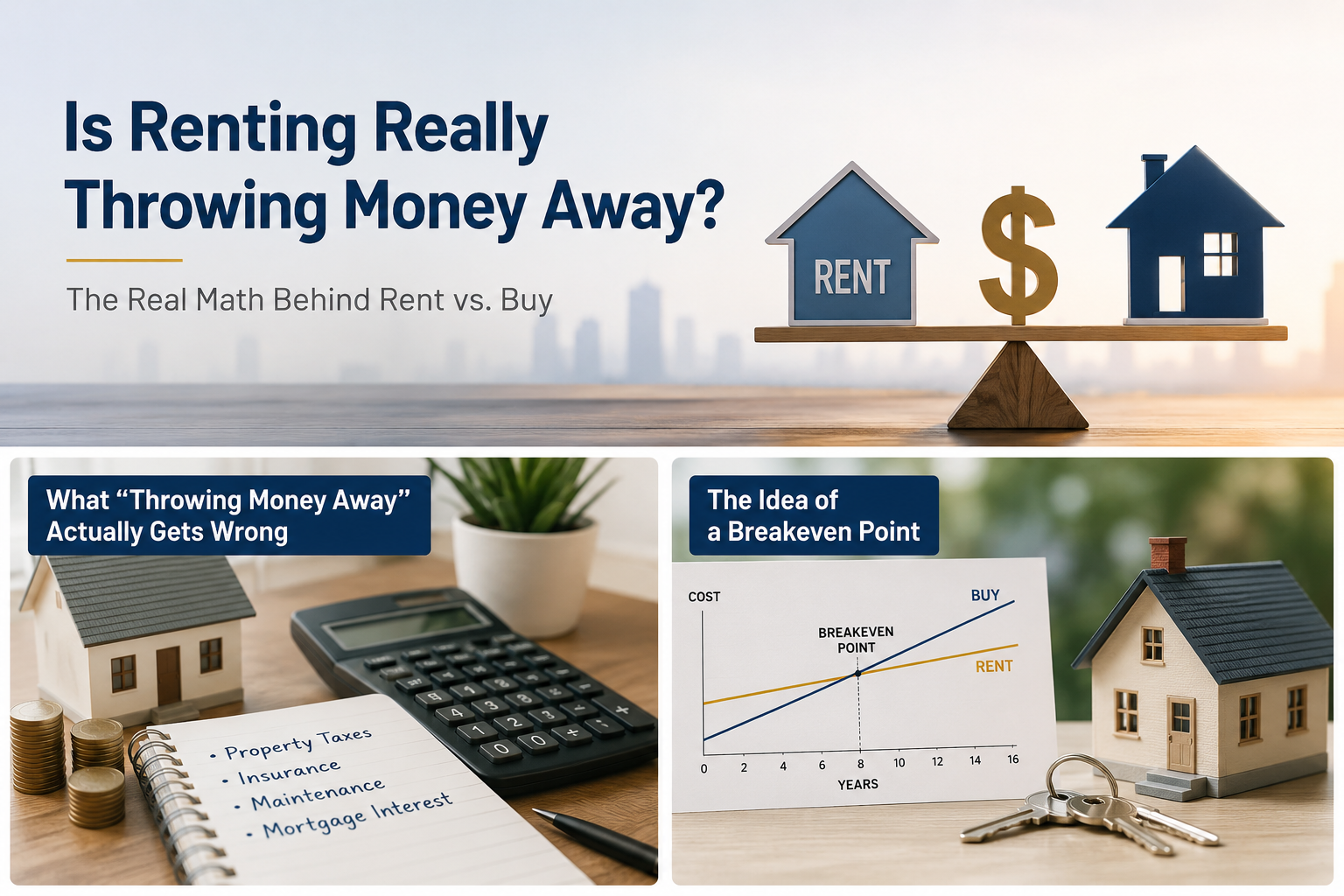
“Renting is throwing money away” is one of the most repeated pieces of financial advice in the country. It is also one of the most incomplete. Buying a home comes with its own version of money that does not build wealth either, and the honest comparison depends on numbers that are different for every household. This guide walks through the real math, not the slogan.
Section 02
What "Throwing Money Away" Actually Gets Wrong
The argument against renting usually goes like this: a rent payment disappears every month, while a mortgage payment builds equity in something you own. That part is true. What it leaves out is that a large share of a mortgage payment is not equity either.
Property taxes, homeowners insurance, maintenance, and mortgage interest do not build equity. They are ongoing costs of owning, in the same way rent is an ongoing cost of renting. Several 2026 market analyses estimate these non-equity ownership costs at somewhere around 4% to 5% of a home’s value per year, though this varies significantly by location, since property tax rates alone can range from under 0.5% to more than 2% depending on the state.
A more accurate way to frame the comparison is not “rent vs. mortgage payment.” It is “the total cost of renting vs. the total cost of owning,” with equity and appreciation counted as the payoff for the owning side.
Section 03
The Idea of a Breakeven Point
Most financial planners use the concept of a breakeven point. This is the number of years you need to stay in a home before buying costs less overall than renting. It accounts for upfront costs, ongoing costs, and the equity you build along the way.
Here is the part that gets oversimplified online. There is no single breakeven number that applies to everyone. Multiple 2026 analyses of this question use different assumptions. They factor in mortgage rates, home appreciation, and investment returns differently. The resulting breakeven estimates range from roughly 5 years on the short end to well over a decade on the long end. The gap between these estimates is not a disagreement about facts. It reflects how sensitive this decision is to a few key assumptions.
Section 04
Why the Breakeven Estimate Varies So Much
The rate you assume your down payment could earn if invested instead. This is often the single biggest factor. If you assume the money you would have used for a down payment could earn a high return elsewhere, renting and investing the difference looks stronger for longer. If you assume a more conservative return, buying tends to look better sooner.
Home price appreciation in your specific market. National averages are not your local market. Some areas have appreciated well above the national average in recent years, while others have been flat. This single variable can move a breakeven estimate by several years in either direction.
Mortgage rates at the time you buy. Higher rates increase the monthly cost of financing, which extends the breakeven period. Several 2026 sources point to 30-year mortgage rates generally in the 6% range through much of the year, well above the levels seen in 2020 and 2021.
Transaction costs on both ends. Buying involves closing costs, typically a few percent of the home price. Selling involves agent commissions and other fees. These costs are only recovered over time, which is part of why very short ownership periods almost always favor renting.
Section 05
A Simple Rule of Thumb Some Financial Planners Use
Several personal finance sources reference a rough heuristic sometimes called the “5% rule.” Multiply a home’s price by roughly 5% to estimate its annual cost of ownership beyond the mortgage principal, covering an estimated 1% for property taxes, 1% for maintenance, and around 3% for the opportunity cost of the money tied up in the home. Divide that number by 12, and compare it to the monthly rent for a similar home.
If comparable rent is meaningfully below that number, renting may be the stronger financial choice for now. If rent is close to or above that number, buying starts to look more competitive. This is a simplification, not a precise calculation. The 3% opportunity cost assumption in particular can vary widely. It depends on what you assume your money would otherwise earn.
Section 06
What Renting Actually Does Well
Renting is not simply the inferior option while you wait to buy. It has real advantages that are easy to undervalue.
Renting offers flexibility to move for a job, a relationship, or a lifestyle change without the transaction costs of selling a home. It also avoids the unpredictable costs of ownership, such as a major roof or HVAC repair, since those responsibilities sit with the landlord. For someone who is not confident they will stay in one place for several years, renting can be the more financially sound choice, not just the more convenient one.
Section 07
What Buying Actually Does Well
Buying offers something renting cannot: a payment that, on a fixed-rate mortgage, does not change over the life of the loan, while rent has historically tended to rise over time. Buying also forces a form of savings. A portion of every payment builds equity. This requires no separate discipline, unlike investing the difference on your own as a renter.
Owning also comes with potential tax considerations. This can include the mortgage interest deduction in some situations. It depends on your specific tax situation and whether you itemize deductions.
Section 08
Questions Worth Answering Before You Decide
How many years do you realistically expect to stay in this home. What would you actually do with the money if you did not use it for a down payment, and would you consistently invest it. How does your local market’s rent-to-price ratio compare to national averages. How stable is your income and job situation over the next several years.
These questions matter more than any single national breakeven statistic, since the right answer depends entirely on your own numbers, not a headline.
Section 09
How This Connects to Your Own Financial Picture
If a down payment feels out of reach right now, it is worth looking into what actually exists rather than assuming you need to wait years. See our guide to first-time home buyer programs in California for programs that may reduce the amount you need upfront.
If your credit needs some work before you are ready to apply, our 12-month plan to rebuild your credit score before applying for a mortgage walks through a realistic timeline.
If you are weighing this decision against another major financial choice, such as whether to prioritize debt payoff over investing, our guide on paying off your mortgage early vs. investing the difference covers a closely related tradeoff.
And if you are already leaning toward buying and deciding between a newly built home and an existing one, see our comparison of new construction vs. existing homes in 2026.
Section 10
Frequently Asked Questions
Is renting really throwing money away?
Not entirely. Renting pays for housing without building equity. But a significant portion of a mortgage payment does not build equity either. This includes interest, taxes, insurance, and maintenance. The honest comparison is total cost versus total cost, not rent versus mortgage payment alone.
What is the breakeven point in rent vs. buy?
It is the number of years you need to stay in a home before buying costs less overall than renting. Estimates for 2026 vary widely across sources. They generally range from around 5 years to over a decade. The exact number depends on assumed investment returns, local appreciation, and mortgage rates.
Is it ever smarter to rent long-term instead of buying?
Yes, particularly for people who expect to move within a few years, who live in markets where rent is low relative to home prices, or who would consistently invest the difference between renting and owning rather than spending it.
Does a bigger down payment always make buying better?
Not automatically. A larger down payment can shorten the breakeven period and avoid PMI, but it also means more money is tied up in the home rather than available for other goals. The right amount depends on your full financial picture.
Section 11
This Article Is for General Education
This article is for general educational purposes and does not constitute financial or investment advice. Breakeven estimates referenced here vary by source. They depend heavily on assumptions about interest rates, home appreciation, and investment returns. None of these can be predicted with certainty. Consider speaking with a financial advisor about your specific situation.
Section 12
Next Steps
If you want to see what buying might actually look like for your specific numbers and market, Wonder Rates can walk through it with you.
[Talk to a loan officer about your options →]
Duc Pham, Mortgage Broker | NMLS# 844897 | Wonder Rates, Inc. | NMLS# 1518655 | DRE# 02047445 | DFPI# 60DBO-59134 | Equal Housing Opportunity. Equal Housing Lender.
This article is for educational purposes only and is not a commitment to lend. Loan approval is subject to creditworthiness, income verification, property eligibility, and current underwriting guidelines. Loan programs, interest rates, and lender fees may change without notice. Always review your official Loan Estimate before making a financing decision.