
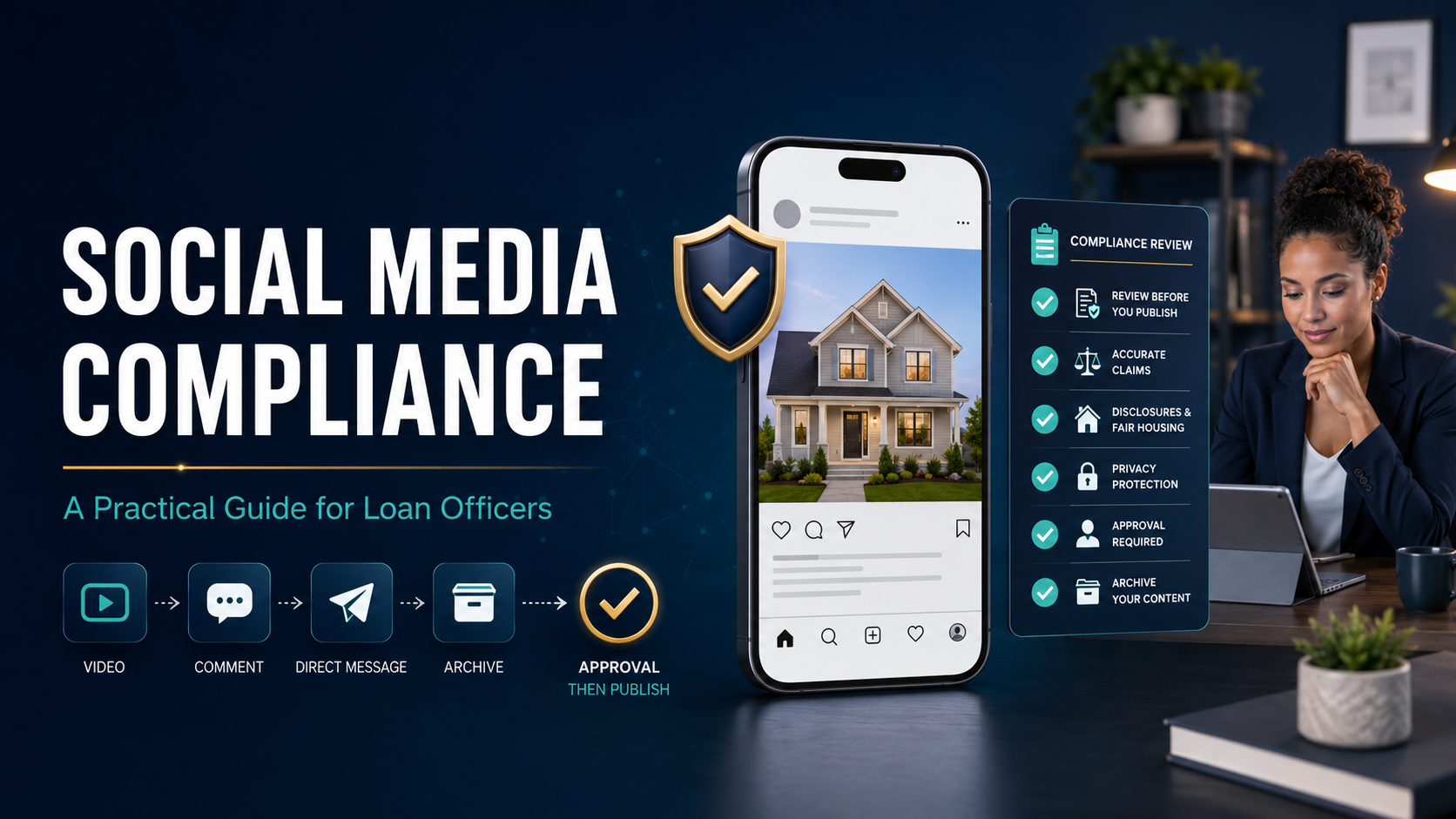
Section 01
Social media compliance for loan officers means making sure every post, video, comment, direct message, and paid advertisement is accurate, properly identified, fairly distributed, and reviewed under applicable federal, state, company, and platform rules. A post can create compliance risk even when it feels informal, disappears after 24 hours, or appears on a personal account.
Social media can educate borrowers and support referral relationships, but short formats make missing context more likely. A repeatable review process should treat professional social content as business communication.
This article provides general educational information, not legal advice. Requirements vary by jurisdiction, company, product, audience, and communication method. Loan officers should follow their company’s compliance process before publishing or sending marketing content.
Section 02
Why Social Media Creates Different Compliance Risks
Mortgage advertising rules are not limited to traditional television, print, or email campaigns. A Reel, Story, livestream, boosted post, profile biography, comment, or direct message may function as an advertisement depending on its content and context.
The format creates practical problems. Disclosures may be hidden below a platform’s “more” button, video text may disappear too quickly, and a quick reply can sound like a personalized approval. Old posts can also continue circulating after terms or policies change.
The complete message, the audience’s likely understanding, and the surrounding facts matter.
Loan officers who need a broader overview should first review mortgage marketing compliance requirements. The sections below focus on how those principles apply to social media workflows.
Section 03
Treat Business Content as Advertising, Even on a Personal Account
Labeling an account “personal” does not automatically remove business or advertising obligations. If the account promotes mortgage services, requests applications, discusses available loan products, displays contact information, or is used to generate leads, company policies and applicable advertising rules may apply.
Before using an account for mortgage content, confirm whether the company permits business posts there, which licensing and company information must appear, where disclosures belong, what requires approval, and how communications will be retained.
Do not assume an NMLS number in the profile is sufficient for every post. State rules, licensing requirements, company policy, and the advertisement type can add obligations.
Section 04
Use Accurate Claims and Avoid Promises
A short social media caption still needs to convey an accurate overall message. The federal Mortgage Acts and Practices Advertising Rule, commonly called Regulation N or the MAP Rule, prohibits material misrepresentations in commercial communications about mortgage credit products. Regulation Z also governs advertising for consumer credit, including rules for specific credit terms and required disclosures.
Avoid claims such as “everyone qualifies,” “guaranteed approval,” “lowest rate,” “no closing costs,” “buy with no money,” or “your payment will be lower” when the statement lacks accurate support and context.
Replace promises with precise educational language. A possible program feature should not become a promised result.
Testimonials do not cure an inaccurate claim or establish what another borrower will receive. A review describing speed, savings, approval, or another outcome needs careful context.
Section 05
Be Careful When Mentioning Rates, Payments, or Loan Terms
Specific credit terms create additional risk because one attractive number rarely tells the full story. Under the CFPB’s current Regulation Z advertising rule, an advertisement that states specific credit terms may state only terms that are actually available. Certain statements can also trigger additional disclosures.
Before posting any rate, APR, payment, down payment, repayment period, or financing charge, send the entire creative package through compliance review. That package should include the caption, image, video, spoken audio, on-screen text, landing page, audience settings, and planned publication date.
Disclaimers do not repair misleading headlines. Disclosures should be clear and conspicuous, not hidden among hashtags, spoken too quickly, or shown in unreadable text.
Rate content also becomes outdated quickly. A documented expiration process should identify when the post must be removed, updated, or replaced. If the platform allows sharing or reposting, consider how an expired creative could continue circulating without its original context.
Section 06
Keep Educational Content Educational
Educational posts can build trust, but the label does not protect an inaccurate statement. Avoid presenting flexible underwriting considerations as universal rules. Do not state that every borrower needs one minimum credit score, one fixed DTI, or one exact documentation package unless the statement is accurately limited to a specific program and current source.
If a follower asks whether they qualify, move the discussion into the company’s approved process. Do not collect income, credit, immigration, account, or other sensitive information in a public thread. Explain that qualification depends on a complete review and that pre-approval is not a final commitment to lend.
Section 07
Apply Fair Housing Principles to Copy, Images, and Targeting
The Fair Housing Act prohibits discrimination in housing-related activities, including mortgage advertising and mortgage broker services. HUD identifies protected characteristics that include race, color, national origin, religion, sex, familial status, and disability.
Review the copy, images, geographic settings, exclusions, lookalike audiences, and automated delivery features. Consider whether any element expresses a preference, discourages eligible consumers, or suggests that services are intended only for one type of household.
Platform tools do not transfer responsibility away from the advertiser. Before launching paid housing content, confirm that the campaign is placed in the correct special advertising category, where applicable, and that both the creative and targeting have been approved. HUD’s Fair Housing Act overview provides a useful federal starting point, but state protections may be broader.
Section 08
Review Testimonials, Reviews, and Influencer Content
Before reposting a borrower review, confirm that it is genuine, authorized, accurately attributed, and presented without changing its meaning. Do not edit it to make the experience appear certain or broadly applicable.
If a customer, Realtor, employee, influencer, or other person receives compensation or another material benefit for an endorsement, the relationship may require clear disclosure. The disclosure should be easy to notice and understand in the same content, not buried on a profile or after a long group of hashtags.
Closing photos, screenshots, approval messages, addresses, loan amounts, and testimonials may expose nonpublic information. Obtain appropriate permission and follow company requirements. Permission from one party does not authorize disclosure of another party’s information.
For referral relationships, social media collaboration does not create an exception to RESPA. Joint videos, event sponsorships, giveaways, shared advertising costs, lead exchanges, and other benefits should be reviewed before either party publishes the promotion. The Realtor referral partnerships guide explains why useful collaboration must remain separate from paying for referrals.
Section 09
Do Not Ignore Comments and Direct Messages
Compliance review should continue after a post is published. Replies written quickly from a phone can make claims that were intentionally removed from the approved caption.
Create response boundaries for common situations:
| Situation | Safer response approach |
|---|---|
| “Can you guarantee I will qualify?” | Explain that approval depends on a complete application, verification, program requirements, and underwriting. |
| “What rate can you give me?” | Move the conversation into an approved channel and gather the information required for an accurate discussion. |
| A follower posts private financial details | Ask them not to share sensitive information publicly and direct them to a secure approved process. |
| A user asks about another borrower’s file | Do not confirm, deny, or discuss the transaction. |
| Someone requests no further contact | Follow the applicable opt-out process and update company records. |
Do not delete a legitimate complaint merely to make a page look cleaner. Follow the company’s escalation and retention process. Prohibited content may be handled under a documented moderation policy.
Direct messages may feel private, but they are still business communications when used for mortgage activity. Avoid requesting documents or sensitive personal information through an unapproved channel. Transfer the conversation to the company’s secure system and preserve required records.
Section 10
Archive the Complete Version of Every Post
A caption screenshot may not capture the full advertisement. Records may need to show the creative, audio, video, disclosures, links, landing page, targeting, approval, publication date, edits, material replies, and removal date. The process should cover paid and organic posts, Stories, livestreams, business DMs, testimonials, permissions, and targeting settings.
Do not assume the platform will preserve content for the period required by applicable law or company policy. Use the company’s approved archiving method. If a post must be corrected, retain the original version, document the change, and follow the escalation process rather than quietly replacing it.
Section 11
Build a Social Media Review Workflow
A practical workflow reduces last-minute judgment calls:
- Draft and classify: Prepare the full caption, creative, audio, links, and landing page. Identify product, testimonial, paid, and referral content.
- Check claims and disclosures: Confirm accuracy, support, required identifiers, fair housing review, and product disclosures.
- Review the audience: Examine targeting, geography, language, exclusions, and platform category settings.
- Obtain approval: Submit the complete package through the company’s compliance process.
- Publish unchanged: Do not improvise a new caption, crop, soundtrack, or call to action.
- Archive and monitor: Retain the final version and manage comments, complaints, edits, expirations, and opt-outs.
Section 12
Social Media Compliance Checklist Before Posting
Before selecting “Publish,” confirm:
- The account is approved for business use.
- The licensed company name and required identifiers are accurate.
- The post does not promise approval, savings, speed, or a particular result.
- Any specific credit terms have received full compliance review.
- Disclosures are clear, readable, audible, and close to the relevant claim.
- Copy, images, and audience settings have been reviewed for fair housing concerns.
- Testimonials are genuine, authorized, and not misleading.
- No private borrower or transaction information appears in the content.
- Referral-partner involvement has been reviewed, including any exchanged benefit.
- The call to action routes users into an approved and secure process.
- The final version matches the approved version.
- The post and its approval record will be archived.
- A person is responsible for comments, complaints, corrections, and expiration.
This checklist is a starting framework, not a substitute for company-specific procedures. A multistate loan officer may need different disclosures or approvals based on the states in which the content appears or the borrowers it targets.
Section 13
Frequently Asked Questions
Does every post need an NMLS ID?
Requirements depend on the content, jurisdiction, company policy, account structure, and licensing rules. Do not assume that an identifier in the profile satisfies every requirement.
Are Stories and livestreams exempt because they disappear?
No automatic exemption applies merely because content disappears. Business content should follow the company’s approval and archiving process. Livestreams may also need approved talking points and moderation.
Can I repost a Realtor’s mortgage content?
Reposting can make the loan officer appear to adopt the message. Review the claims, disclosures, fair housing concerns, privacy issues, and any referral-related benefit before sharing it.
The Bottom Line
Effective social media compliance for loan officers is a system, not a disclaimer added at the end of a caption. The strongest process reviews the claim, format, audience, disclosure, referral relationship, publication method, and record before the content goes live.
Educational content can still be engaging. Clear explanations, careful examples, and realistic next steps often create more durable trust than promises that cannot be supported. When a post touches specific terms, personal qualification, protected classes, testimonials, referral benefits, or borrower information, pause and use the company’s compliance process.
Duc Pham, Mortgage Broker | NMLS# 844897
Wonder Rates, Inc. | NMLS# 1518655
Equal Housing Lender.
AZ, CA, CO, FL, GA, LA, MI, OK, PA, SC, TX, VA, WA, OH, AL, OR, NC
This article is for educational purposes only and is not legal advice or a commitment to lend. Requirements may vary by jurisdiction, company policy, product, platform, and communication type. Loan approval is subject to creditworthiness, income verification, property eligibility, and current underwriting guidelines. Loan programs, interest rates, and lender fees may change without notice. Always review your official Loan Estimate before making a financing decision.