
Section 01
What is a Rapid Rescore?
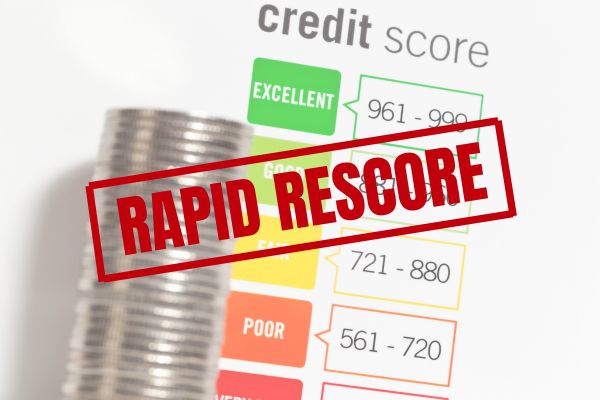
A rapid rescore is a process used by mortgage professionals to update a borrower’s credit report more quickly than waiting for the normal reporting cycle.
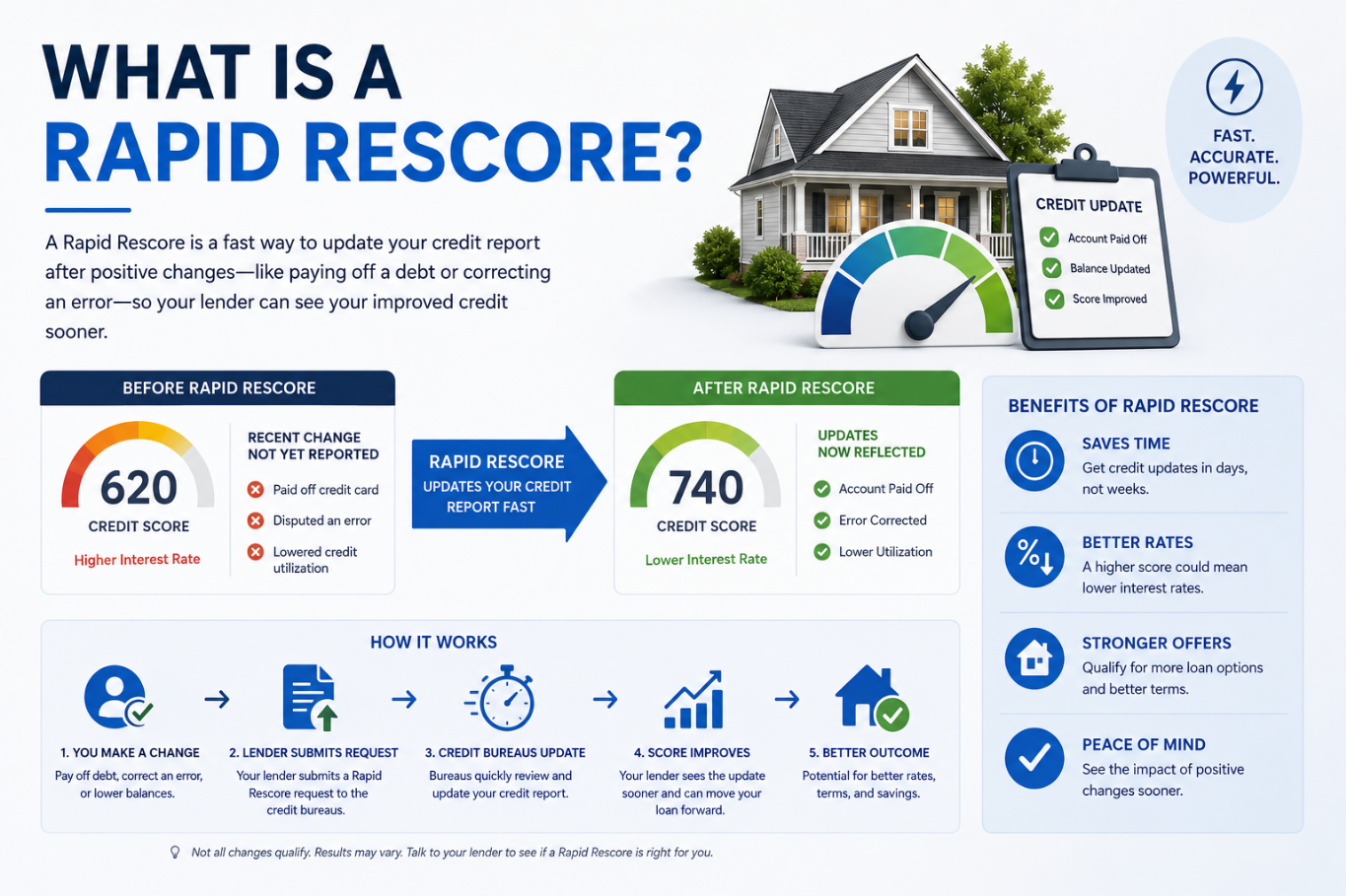
Typically, creditors report account updates to credit bureaus once per month. Depending on timing, it may take several weeks before changes appear on a credit report.
With a rapid rescore, verified account updates can be submitted to the credit bureaus through approved channels, allowing certain changes to be reflected much faster.
The goal is not to alter accurate information. The goal is to accelerate the reporting of legitimate updates that have already occurred.
Section 02
Why Rapid Rescore Matters in Mortgage Lending
Mortgage pricing often depends on credit score ranges.
For example, a borrower with a score of 679 may receive different pricing than a borrower with a score of 680.
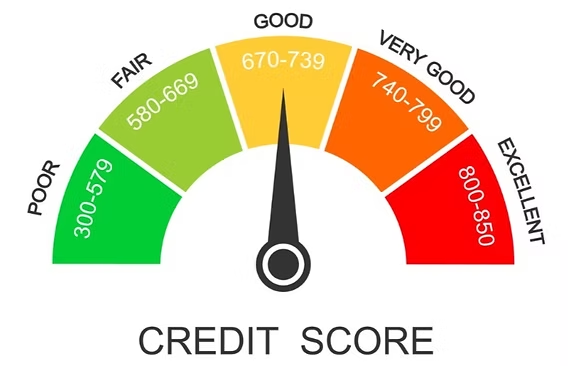
Similarly, moving from:
- 619 to 620
- 639 to 640
- 659 to 660
- 679 to 680
- 719 to 720
- 739 to 740
can sometimes affect loan eligibility, pricing adjustments, or available mortgage options.
In these situations, a small score improvement may produce meaningful financial benefits over the life of the loan.
Section 03
When Rapid Rescore Works Best
High Credit Card Utilization
This is one of the most common and effective rapid rescore scenarios.
Suppose a borrower has:
- Credit limit: $10,000
- Current balance: $8,500
The utilization ratio is 85%.
If the borrower pays the balance down to $1,000, utilization falls to 10%.
Because credit utilization is a major scoring factor, the score may improve significantly once the updated balance appears on the report.
A rapid rescore can help lenders reflect that change before the next reporting cycle.
Recently Paid-Off Debt
Rapid rescore may help when borrowers have recently:
- Paid off credit cards
- Paid off installment loans
- Resolved collection accounts that were inaccurately reported as unpaid
- Reduced revolving balances substantially
If the creditor can provide acceptable documentation showing the update, the information may be reflected faster than normal.
Correcting Reporting Errors
Sometimes a creditor has already corrected an error, but the credit report has not yet been updated.
Examples include:
- Incorrect account balances
- Duplicate accounts
- Accounts incorrectly shown as delinquent
- Paid accounts reported as outstanding
When supporting documentation exists, rapid rescore can help update the report more quickly.
Borrowers Near an Important Credit Threshold
Rapid rescore tends to be most valuable when a borrower is only a few points away from a significant mortgage pricing tier.
For example:
- Qualifying for a better conventional loan adjustment
- Meeting minimum score requirements
- Improving mortgage insurance pricing
- Accessing additional loan options
In these cases, even a modest score increase may justify the effort
Section 04
When Rapid Rescore Often Fails
No Actual Credit Improvement Exists
One of the biggest misconceptions is that rapid rescore creates score increases automatically.
It does not.
If no meaningful change has occurred in the borrower’s credit profile, there may be little or no score movement.
Rapid rescore accelerates reporting. It does not manufacture positive credit history.
Paying Collections Does Not Always Raise Scores
Many borrowers assume paying off collections immediately improves their scores.
The reality is more complicated.
Depending on the scoring model and account type, paying a collection account may produce:
- A small increase
- No increase
- Occasionally less impact than expected
The result varies significantly from one credit profile to another.
Closing Credit Cards Can Backfire
Some borrowers attempt to improve credit by closing unused credit cards.
This can reduce available credit limits and increase utilization ratios.
In certain situations, the score may actually decline rather than improve.
A rapid rescore cannot overcome the underlying scoring impact.
Thin Credit Files
Borrowers with limited credit history may see minimal results.
If there are very few accounts reporting, paying down one balance may not generate substantial score movement.
The scoring model simply has less information available to evaluate.
Expectations Are Unrealistic
A borrower hoping to move from a 620 score to 740 within a few days is likely to be disappointed.
Rapid rescore is designed to reflect legitimate updates faster.
It is not a shortcut to rebuilding credit.
No Actual Credit Improvement Exists
One of the biggest misconceptions is that rapid rescore creates score increases automatically.
It does not.
If no meaningful change has occurred in the borrower’s credit profile, there may be little or no score movement.
Rapid rescore accelerates reporting. It does not manufacture positive credit history.
Paying Collections Does Not Always Raise Scores
Many borrowers assume paying off collections immediately improves their scores.
The reality is more complicated.
Depending on the scoring model and account type, paying a collection account may produce:
- A small increase
- No increase
- Occasionally less impact than expected
The result varies significantly from one credit profile to another.
Closing Credit Cards Can Backfire
Some borrowers attempt to improve credit by closing unused credit cards.
This can reduce available credit limits and increase utilization ratios.
In certain situations, the score may actually decline rather than improve.
A rapid rescore cannot overcome the underlying scoring impact.
Thin Credit Files
Borrowers with limited credit history may see minimal results.
If there are very few accounts reporting, paying down one balance may not generate substantial score movement.
The scoring model simply has less information available to evaluate.
Expectations Are Unrealistic
A borrower hoping to move from a 620 score to 740 within a few days is likely to be disappointed.
Rapid rescore is designed to reflect legitimate updates faster.
It is not a shortcut to rebuilding credit.
Section 05
Common Misunderstandings About Rapid Rescore
Myth #1: It Removes Negative Information
Rapid rescore cannot legally remove accurate negative information from a credit report.
Late payments, collections, charge-offs, and other legitimate derogatory items generally remain according to credit reporting rules.
Myth #2: Anyone Can Order a Rapid Rescore
Rapid rescore is typically initiated through a mortgage lender or authorized mortgage professional as part of the lending process.
Consumers generally cannot order one directly through the credit bureaus.
Myth #3: It Guarantees Approval
Even if the score increases, loan approval still depends on factors such as:
- Income
- Employment
- Assets
- Debt-to-income ratio
- Property qualification
- Overall underwriting review
Credit score is only one piece of the mortgage puzzle.
Section 06
A Real-World Example
Consider a borrower applying for a mortgage with a middle credit score of 678.
The lender identifies that two credit cards are reporting balances above 80% utilization.
The borrower pays both balances down below 10%.
Instead of waiting several weeks for the next reporting cycle, a rapid rescore is requested using updated documentation.
The revised report produces a score of 684.
That six-point improvement may be enough to move into a more favorable pricing tier and potentially reduce long-term borrowing costs.
This is the type of situation where rapid rescore can provide meaningful value.
Section 07
Questions to Ask Before Pursuing a Rapid Rescore
Before moving forward, borrowers should ask:
- What specific action is expected to improve the score?
- How many points is the lender projecting?
- Is there a meaningful pricing benefit if the score increases?
- What documentation is required?
- How quickly is closing scheduled?
- Is there another strategy that may produce better results?
The best mortgage professionals typically analyze potential outcomes before recommending a rapid rescore.
Section 08
Final Thoughts
Rapid rescore can be an effective mortgage tool when there is a documented credit improvement waiting to be reported. It is particularly useful for borrowers who are close to an important credit score threshold and need updated information reflected quickly.
However, rapid rescore is not a magic solution. It cannot erase accurate negative history, create new credit strength overnight, or guarantee a higher score.
The most successful outcomes occur when borrowers understand what drives credit scoring and use rapid rescore to accelerate legitimate improvements that have already taken place.
Want to know what your monthly housing payment might be so you can estimate your DTI? Try the Wonder Rates team’s mortgage calculator before you talk to a loan officer.
Disclaimer: Wonder Rates NMLS #1518655, Duc Pham NMLS #844897 Equal Housing Lender Rates and terms subject to change. This article is for educational purposes only and should not be considered financial, tax, or legal advice.
Sources
- Fannie Mae Selling Guide: sections on DTI and installment debt.
- HUD (hud.gov)