
Section 01
What Is HMDA?
Ask most homebuyers what determines whether a mortgage gets approved, and you’ll probably hear answers like credit score, income, debt-to-income ratio, or down payment.
Those factors certainly matter.
But behind every mortgage application is another system that most borrowers never see. It doesn’t calculate your debt ratio. It doesn’t issue loan approvals. It doesn’t set interest rates.
Instead, it watches the mortgage market itself.
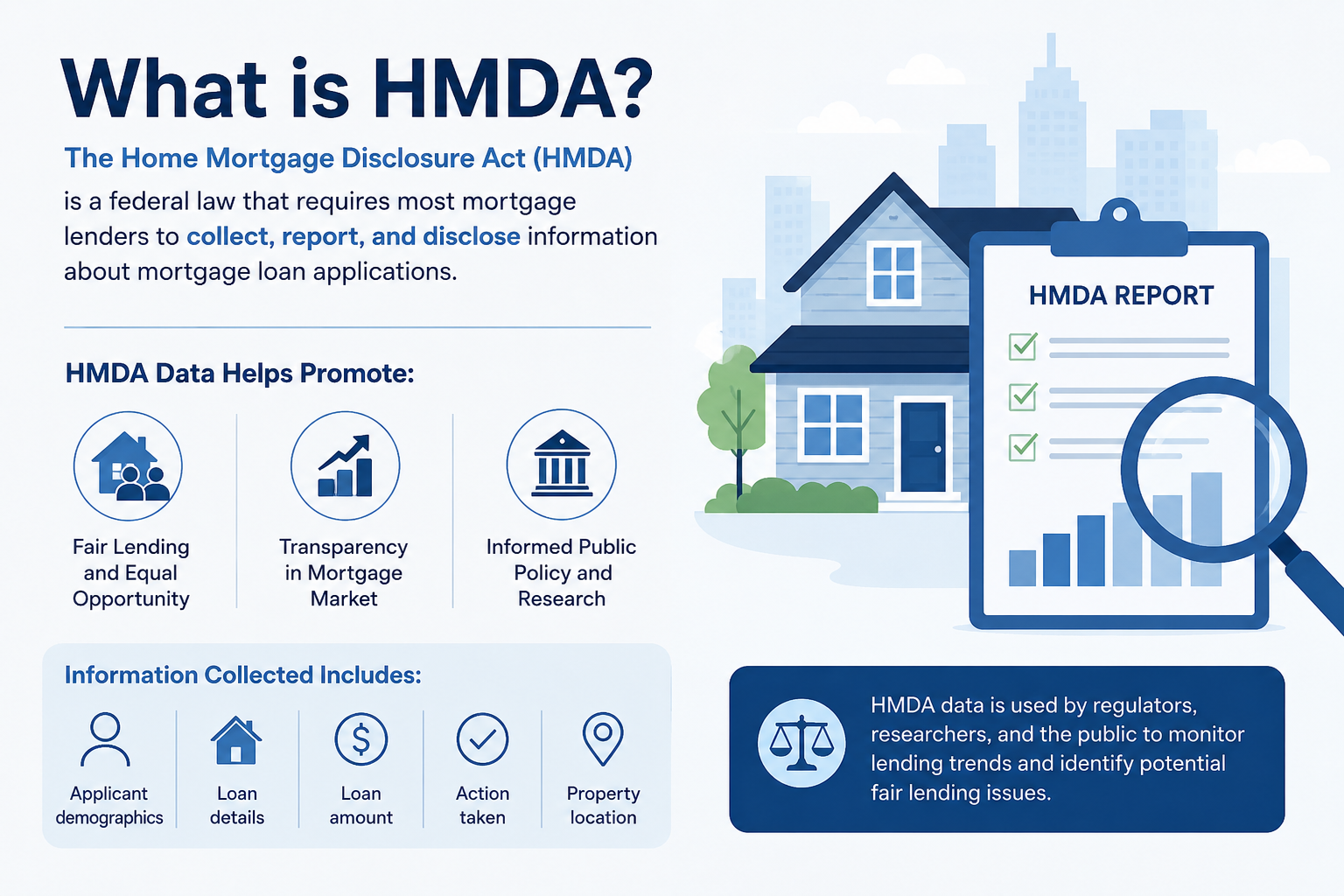
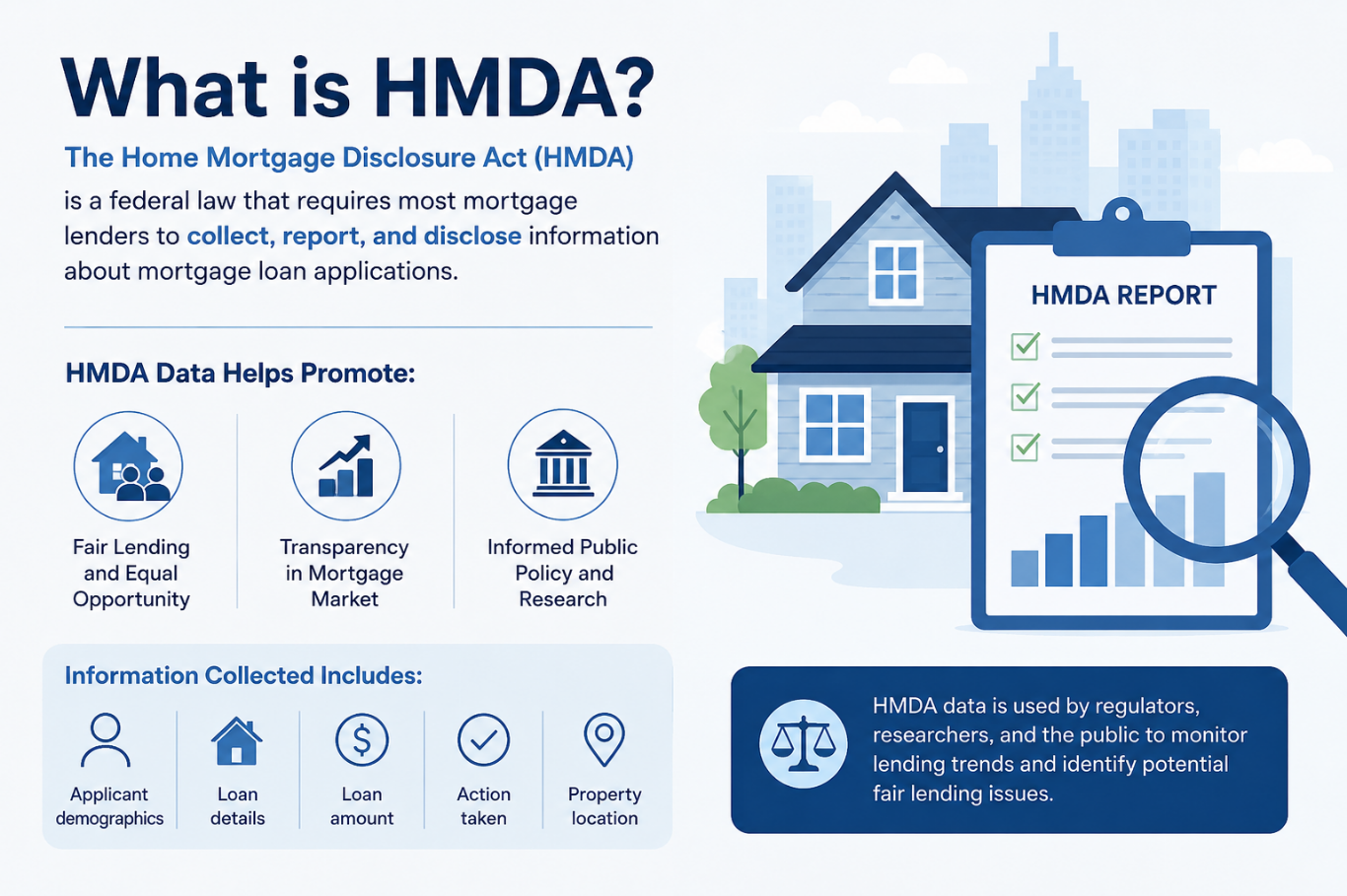
That system is called the Home Mortgage Disclosure Act (HMDA).
Understanding HMDA isn’t about learning another regulation. It’s about understanding how today’s mortgage industry measures itself.
Section 02
HMDA is Not an Underwriting Rule It's a Transparency Law
HMDA doesn’t decide who gets approved
One of the biggest misconceptions about HMDA is that it affects underwriting decisions.
It doesn’t.
HMDA is not a loan program like FHA or VA. It isn’t an underwriting framework like the Ability-to-Repay (ATR) Rule, and it doesn’t tell lenders which borrowers to approve.
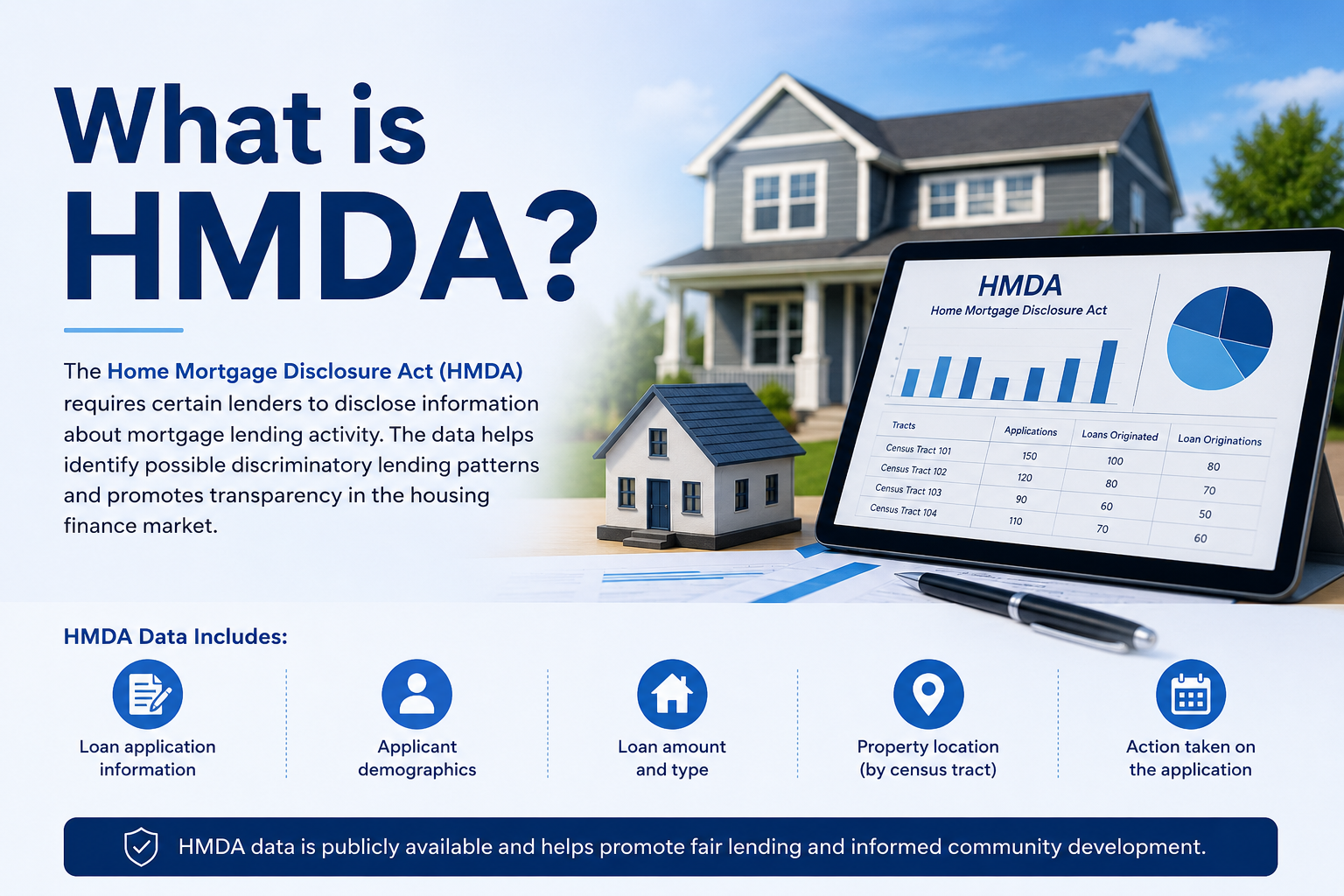
Instead, HMDA requires many financial institutions to report information about the mortgage applications they receive each year. Regulators then use that data to understand how mortgage lending is happening across the country.
Think of it this way.
ATR asks:
“Can this borrower reasonably repay the loan?”
HMDA asks:
“How is this lender making lending decisions across thousands of borrowers?”
Those are two very different questions.
Why was HMDA created?
Congress passed HMDA in 1975 during a period when concerns about redlining were growing.
At the time, many communities believed banks were avoiding certain neighborhoods when making mortgage loans. However, there was very little data available to prove whether those concerns reflected isolated incidents or broader lending patterns.
HMDA changed that by creating a standardized reporting system. Instead of relying on assumptions, regulators could now compare mortgage activity across neighborhoods, cities, and lenders using consistent data.
Over time, HMDA evolved far beyond its original purpose. Today, it serves as one of the largest public mortgage databases in the country and plays a central role in fair lending oversight.
Section 03
What Information Does HMDA Collect?
HMDA records much more than loan approvals
Many borrowers assume HMDA only tracks approved and denied loans.
The database is much more comprehensive than that.
Depending on the transaction, lenders report information such as:
- loan purpose;
- loan amount;
- occupancy type;
- property type;
- applicant income;
- loan type;
- action taken on the application;
- census tract;
- lender identification;
- certain pricing information.
This allows regulators to examine lending activity from multiple perspectives instead of looking only at approval rates.
For example, they can compare whether one lender originates significantly fewer loans in a particular neighborhood than its competitors or whether denial rates differ across similar borrower groups.
HMDA protects borrower privacy
Although HMDA contains millions of mortgage records, it is not designed to expose personal information.

The public dataset generally excludes details such as:
- borrower names;
- Social Security numbers;
- exact property addresses;
- account numbers.
Instead, the focus is on identifying lending trends while protecting individual privacy.
This balance allows researchers and regulators to study the mortgage market without revealing confidential borrower information.
Section 04
HMDA Looks for Patterns Not Individual Loans
One denied application rarely tells the full story
Suppose a borrower with a 640 credit score is denied for a mortgage.
That denial alone tells regulators very little.
Now imagine a lender receives 20,000 applications in a year. If borrowers with similar financial profiles receive dramatically different outcomes depending on where they live, regulators may want to understand why.
HMDA makes this type of analysis possible because every lender reports data using the same standards.
The goal isn’t to review one file.
The goal is to understand whether patterns exist across thousands of files.
Fair lending reviews focus on consistency
Consider the following example.
| Market | Approval Rate |
|---|---|
| Metropolitan Area A | 84% |
| Metropolitan Area B | 61% |
These numbers don’t automatically prove discrimination. A lower approval rate may simply reflect differences in borrower income, debt levels, credit profiles, or local housing market conditions. However, when the gap is large enough, regulators may take a closer look by comparing borrower characteristics, loan amounts, underwriting decisions, and lending patterns across similar markets.
The key point is that HMDA is not designed to accuse lenders of wrongdoing. Its purpose is to identify unusual lending patterns that warrant further review and determine whether lending decisions were based on legitimate financial factors and applied consistently across similar borrowers.
Section 05
HMDA Quietly Shapes How Lenders Operate
Every lender studies its own HMDA data
Many borrowers assume HMDA reports are created only because regulators require them.
In reality, lenders often analyze their own data long before regulators do.
Compliance teams review metrics such as:
- approval rates;
- denial reasons;
- pricing trends;
- geographic distribution;
- loan product mix;
- market share.
Suppose a lender notices that approval rates for first-time homebuyers have dropped sharply in one county while remaining stable in neighboring markets. Before expanding further into that area, management will likely investigate what is driving the change rather than making assumptions.
The cause could be rising home prices outpacing local incomes, stricter underwriting overlays, or competitors offering more flexible loan programs. By analyzing HMDA data, lenders can identify these trends using real market data instead of relying on guesswork, allowing them to make more informed business and lending decisions.
Expansion decisions often begin with HMDA
Imagine two neighboring counties.
| County | Annual Mortgage Originations |
|---|---|
| County A | 12,000 |
| County B | 3,400 |
At first glance, County A appears to be the stronger market because it generates more mortgage originations. However, HMDA data may tell a different story. If only five lenders actively serve County B while twenty compete in County A, the smaller market may actually present a better growth opportunity despite its lower loan volume.

This is one reason lenders analyze HMDA before opening new branches or expanding into new markets. The data doesn’t just describe where loans are being made—it helps companies identify underserved markets, evaluate competitive pressure, and build long-term business strategies based on real lending activity.
Section 06
HMDA Has Become a Competitive Intelligence Tool
Lenders study each other’s performance
One of the least discussed aspects of HMDA is that competitors study it carefully.
Because HMDA data is publicly available, lenders can analyze:
- which markets competitors entered;
- where market share increased;
- which loan products became more popular;
- how lending volume changed over time.
Suppose a regional lender suddenly doubles its mortgage volume in one metropolitan area. Competitors will often turn to HMDA data to understand what changed before assuming it was simply a strong sales year.
The increase could be driven by partnerships with local builders, the launch of a new affordable housing program, or the addition of experienced loan officers with strong referral networks. While HMDA doesn’t explain every business decision, it often reveals where meaningful market shifts are happening and which lenders are gaining momentum.
HMDA can reveal strategic shifts before press releases do
Imagine a lender that has traditionally focused on refinance loans. Over the course of two years, its HMDA data begins to show a steady decline in refinance activity while purchase mortgage originations increase significantly. On the surface, this may look like a simple shift in loan volume, but industry professionals often see it as a sign that the company’s long-term strategy is changing.
The lender may be investing more heavily in purchase business by expanding relationships with real estate agents, hiring loan officers with strong purchase experience, or developing programs aimed at first-time homebuyers. In many cases, HMDA data reveals these strategic changes months before the company officially announces them. For competitors, investors, and market analysts, HMDA often serves as an early indicator of where a lender is heading and how its business priorities are evolving.
Section 07
What Borrowers Can Learn from HMDA
Documentation matters because consistency matters
Many borrowers wonder why lenders ask for updated bank statements, employment verification, or explanations for large deposits, especially when they feel they’ve already provided enough information. These requests can seem repetitive, but they are an important part of the underwriting process.
Lenders operate in a highly regulated environment where every underwriting decision must be supported by clear, objective documentation. While HMDA doesn’t require these individual documents, it works alongside other mortgage regulations that promote consistency, transparency, and fair lending. The goal is to ensure that similar borrowers are evaluated under the same standards and that every lending decision can be properly documented if reviewed later.
Approval rates don’t tell the whole story
It’s common to see articles ranking lenders based on their mortgage approval rates, but those comparisons can be misleading without proper context. Imagine one lender primarily serves borrowers with credit scores above 780 and large down payments, while another focuses on first-time homebuyers using low-down-payment loan programs. Even if both lenders apply the same underwriting standards, their approval rates will likely look very different because they serve different types of borrowers.
This is why HMDA data should never be viewed in isolation. Without understanding the borrower mix, loan programs, and local market conditions, the numbers can easily be misinterpreted. When analyzed correctly, however, HMDA becomes one of the most valuable tools for understanding lending patterns and the broader mortgage market.
Section 08
Transparency builds confidence in the housing market
A healthy mortgage market depends on trust from every participant. Borrowers need confidence that lending decisions are made fairly and consistently. Investors need confidence in the quality of the loans they purchase, while regulators need assurance that financial institutions are following established lending standards.
HMDA helps strengthen that trust by replacing assumptions with measurable data. Instead of relying on isolated complaints or anecdotal evidence, regulators and industry experts can analyze lending patterns across thousands of mortgage applications to identify trends that deserve closer attention.
It’s important to understand that HMDA is not designed to eliminate every difference in lending outcomes. Different borrower profiles and market conditions naturally produce different results. Its purpose is to create a transparent framework where those differences can be reviewed, understood, and supported by legitimate underwriting decisions and sound business practices.
Section 09
Final Thoughts
HMDA isn’t an underwriting rule, and it doesn’t determine whether a borrower receives a loan. Its real purpose is much broader. It creates transparency across the mortgage industry by allowing regulators, lenders, researchers, and policymakers to study lending patterns using consistent data.
For lenders, HMDA influences compliance reviews, expansion strategies, competitive analysis, and fair lending practices. For borrowers, it offers a better understanding of why modern mortgage lending places such a strong emphasis on documentation, consistency, and accountability.
Thinking about buying a home or refinancing? Try the Wonder Rates team’s mortgage calculator to estimate your monthly payment, then connect with Duc Pham and the Wonder Rates team for guidance on the loan options that fit your situation.
Sources
- Fannie Mae Selling Guide: sections on DTI and installment debt.
- HUD (hud.gov): Handbook 4000.1, sections on installment debt and collections for FHA loans.
Disclaimer: This article is for educational purposes only and should not be considered financial, tax, or legal advice.
Duc Pham, Mortgage Broker | NMLS# 844897,
Wonder Rates, Inc. | NMLS# 1518655 | DRE# 02047445 | DFPI# 60DBO-59134 |
Equal Housing Opportunity. Equal Housing Lender. |
Licensed in: AL, AZ, CA, CO, FL, GA, LA, MI, NC, OH, OK, OR, PA, SC, TX, VA, WA.