
Section 01
Is It Really Harder for a 1099 Borrower to Qualify for a Mortgage Than a W2 Employee?
Many people believe that lenders simply prefer W2 employees over self-employed borrowers. In reality, the issue isn’t whether your income comes from a W2 or a 1099. The real question is how predictable and sustainable that income appears under mortgage underwriting guidelines.
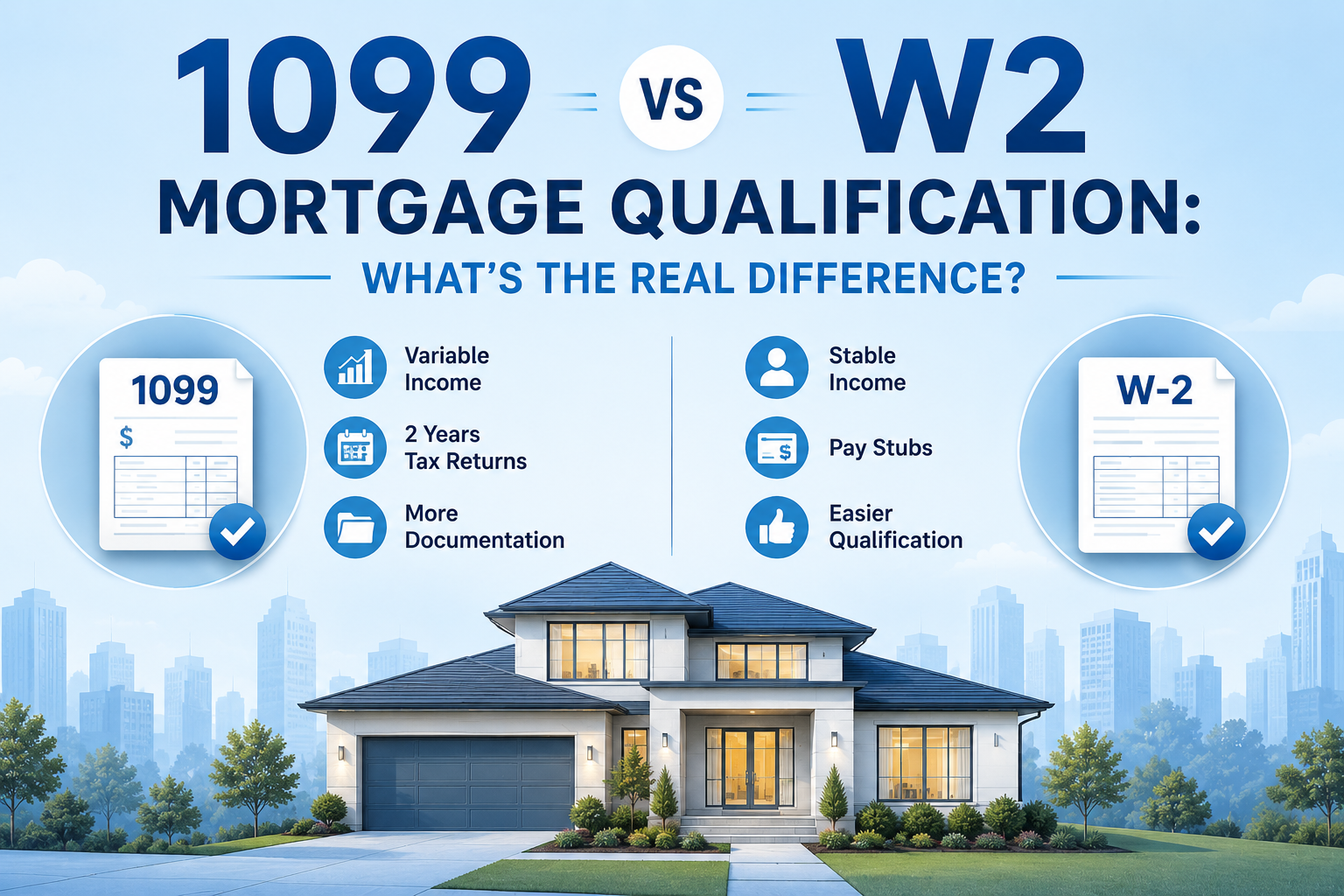
A W2 employee may earn less than a self employed borrower but qualify more easily because the income is stable and easy to verify. Meanwhile, a successful business owner earning twice as much may qualify for less than expected after the lender reviews tax returns.
This is why qualifying for a mortgage as a 1099 borrower often feels more difficult, even when your income is much higher.
Section 02
Mortgage Underwriting Doesn't Use Gross Income
One of the biggest surprises for self-employed borrowers is that lenders usually don’t qualify them based on business revenue.
Instead, underwriting focuses on qualifying income, which starts with taxable income reported on federal tax returns. From there, the underwriter may add back certain non-cash expenses, such as depreciation, depending on the loan program. However, many business deductions still reduce the income available for mortgage qualification.
Consider these two borrowers.
| Borrower A | Borrower B | |
|---|---|---|
| Annual business revenue | $300,000 | $300,000 |
| Business expenses | $70,000 | $170,000 |
| Approximate taxable income | $230,000 | $130,000 |
Although both businesses generated the same revenue, Borrower B may qualify for a significantly smaller mortgage because the business claimed more deductible expenses.
This illustrates an important point. Lower taxes today can sometimes reduce borrowing capacity tomorrow.
Section 03
Income Stability Often Matters More Than Income Size
Mortgage underwriting is designed to evaluate whether income is likely to continue after the loan closes. That is why consistency often matters more than having one exceptional year.
Imagine a freelance software developer whose income looks like this:
| Tax Year | Net Income |
|---|---|
| 2024 | $120,000 |
| 2025 | $185,000 |
Most people would assume the borrower is now earning $185,000 per year. However, the underwriter may want to understand why income increased by more than 50% in a single year. Was it a one-time contract? Did the borrower add new long term clients? Is the higher income expected to continue?
The same review works in the opposite direction. If income declines over consecutive years, the lender may qualify the borrower using the lower figure because it better reflects the current earning trend.
Section 04
Business Deductions Can Change Your Borrowing Power
Many self-employed borrowers work with their CPA to legally reduce taxable income. While this strategy may lower taxes, it can also reduce the income recognized during mortgage underwriting.
For example, a consultant earns $250,000 before expenses but deducts vehicle costs, office expenses, equipment purchases, travel, and other eligible business costs. After deductions, taxable income falls to $145,000.
From a tax perspective, that may be beneficial. From a lending perspective, however, the borrower may qualify based on income that is much closer to $145,000 than $250,000.
This is one reason many self-employed borrowers speak with both their CPA and mortgage professional before filing taxes if they expect to purchase a home in the near future.
Section 05
Why 1099 Files Usually Receive More Underwriting Review
A W-2 employee can often verify income with recent pay stubs and W-2 forms.
A 1099 borrower usually requires a broader financial review because the lender needs to understand how the business generates income and whether that income is sustainable.
Depending on the loan program, the lender may request:
- Personal tax returns
- Business tax returns
- Year-to-date profit and loss statements
- Business bank statements
- CPA letters or business licenses
- Explanations for significant income changes
This doesn’t mean the borrower is considered higher risk. It simply means the income calculation requires more analysis.
Section 06
Does Being Self-Employed Mean Higher Mortgage Rates?
Not necessarily.
Mortgage pricing is generally driven by factors such as credit score, loan-to-value ratio, occupancy, property type, and overall loan risk. Simply receiving 1099 income does not automatically result in a higher interest rate.
The challenge is usually qualifying for the loan, not the pricing itself. Once income has been properly documented and meets underwriting guidelines, a qualified 1099 borrower may receive the same interest rate as a W-2 borrower with a similar credit profile.
Section 07
Final Thoughts
Being a 1099 borrower doesn’t make mortgage approval impossible, but it does make income analysis more detailed. Underwriters are looking beyond revenue to determine whether your earnings are stable, well documented, and likely to continue after closing.
The best time to prepare is before you submit a mortgage application. Understanding how your tax returns, business deductions, and income trends affect qualifying income can help you make better financial decisions and avoid unexpected surprises during underwriting.
Disclaimer: This article is for educational purposes only and should not be considered financial, tax, or legal advice.
Duc Pham, Mortgage Broker | NMLS# 844897,
Wonder Rates, Inc. | NMLS# 1518655 | DRE# 02047445 | DFPI# 60DBO-59134 |
Equal Housing Opportunity. Equal Housing Lender. |
Licensed in: AL, AZ, CA, CO, FL, GA, LA, MI, NC, OH, OK, OR, PA, SC, TX, VA, WA.