
Section 01
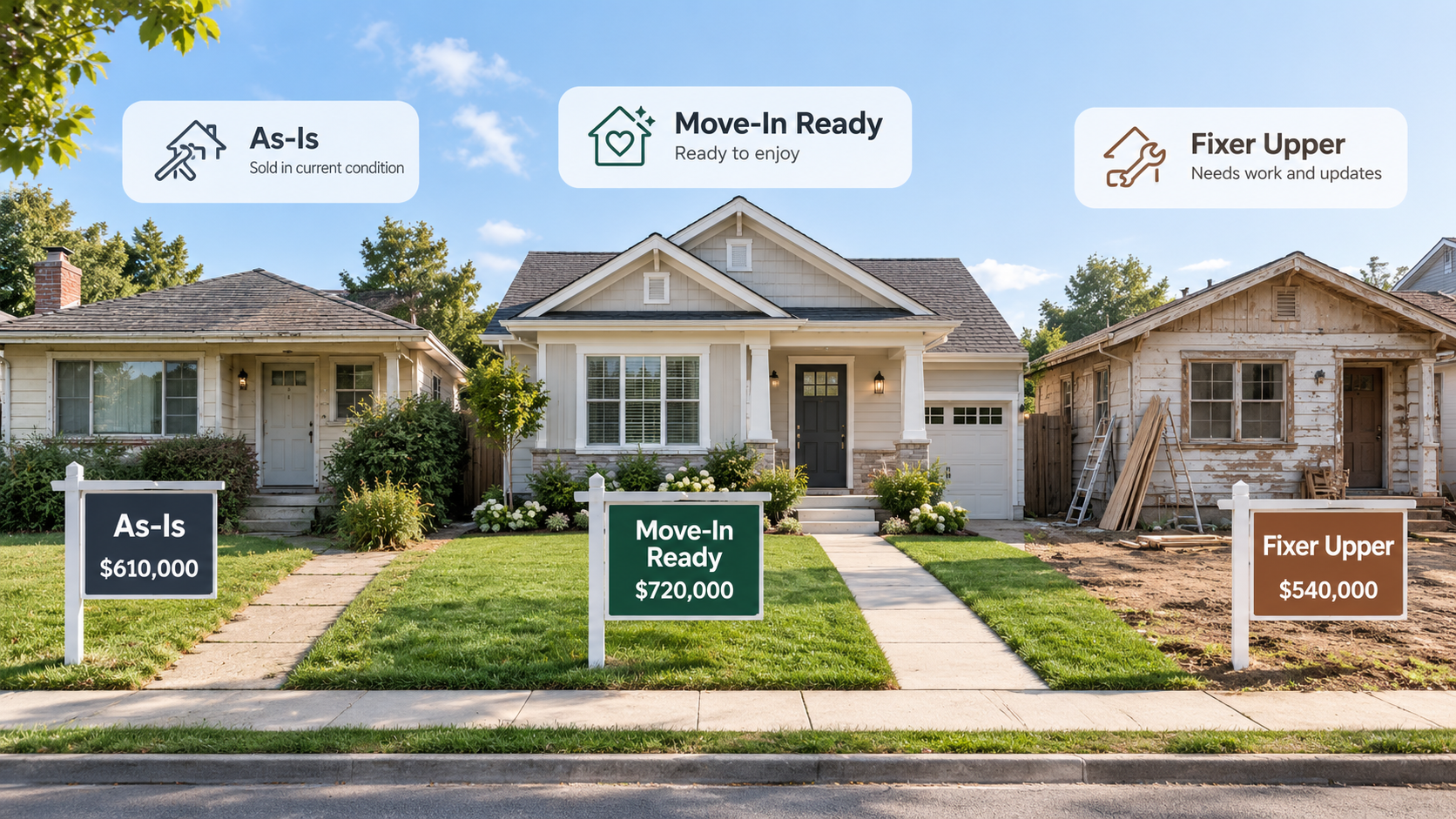
Three homes. Same neighborhood. Similar square footage. Yet one is listed for $650,000, another for $720,000, and another for $540,000.
Why?
The answer often has less to do with location and more to do with the home’s condition. Real estate listings commonly include terms like As-Is, Move-In Ready, and Fixer Upper, but these labels don’t simply describe a house. They can also influence your budget, financing options, repair timeline, and long-term homeownership costs.
Understanding what these terms generally mean can help you make more informed decisions before scheduling a showing or submitting an offer.
Section 02
Why property descriptions matter more than many buyers realize
Many buyers focus most of their attention on price, number of bedrooms, number of bathrooms, and school district. Those factors matter, but property condition often gets overlooked, even though it quietly affects almost every other part of the transaction.
Condition can influence your mortgage options, since some loan programs have requirements tied to a home’s habitability. It can influence your insurance costs, since insurers often price policies differently based on the age and condition of major systems like the roof or electrical wiring. It affects how much you may need to spend on repairs, how a negotiation with the seller might unfold, whether the appraisal supports the purchase price, and what your costs might look like months or years down the road as a homeowner.
In other words, a property’s condition is not just a detail buried in the listing description. It’s a thread that runs through nearly every part of the homebuying decision.
Section 03
What does As-Is mean?
An As-Is listing generally means the seller intends to sell the property in its current condition, without making repairs or improvements before closing. This does not automatically mean the home is in bad shape, unsafe, or has major hidden damage. It simply means the seller is not planning to negotiate repairs or credits based on what an inspection might find, though the specifics can still vary by seller and by state.
Illustrative example: A home is listed As-Is for $610,000. The seller inherited the property from a family member and never lived in it themselves. They list it As-Is mainly because they don’t want to manage repairs on a home they never occupied. When the buyer’s inspection comes back, it reveals only minor cosmetic issues, some worn paint and an older but functional water heater, rather than any major structural or safety concerns.
This example is illustrative only and does not represent every As-Is listing. The condition of an As-Is home can range from largely move-in ready to requiring significant repairs, and an inspection is the best way to understand the actual condition of any specific property.
Section 04
Common reasons sellers choose As-Is
Sellers list a home As-Is for a variety of reasons that often have little to do with the home actually being in poor condition. Common situations include:
- Estate sales, where heirs are selling a property they didn’t personally live in and may not have detailed knowledge of its condition or history.
- Relocation, where a seller needs to move quickly and doesn’t have time to manage repair negotiations.
- Investor-owned properties, where the owner may prefer a straightforward sale without repair contingencies.
- Older owners, who may have lived in the home for decades and prefer not to take on renovation projects before selling.
- Time constraints, such as a job change or financial situation that requires a faster closing.
- Rental properties, where a landlord selling a tenant-occupied or recently vacated unit may not want to invest further in repairs.
None of these situations necessarily point to a problem with the home itself. They’re often more about the seller’s circumstances than the property’s actual condition.
Section 05
Buying an As-Is home
An As-Is purchase comes with its own set of trade-offs worth understanding before you make an offer.
On the benefit side, As-Is homes are sometimes priced more competitively than comparable move-in ready properties, and sellers may be more flexible on other terms since they’ve already signaled they won’t be making repairs. On the risk side, buyers generally take on more responsibility for identifying and budgeting for any issues, since the seller isn’t planning to fix things discovered during the process.
A thorough inspection becomes especially important with an As-Is home. Since the seller isn’t offering to make repairs, the inspection is primarily a tool to help you understand what you’re buying, rather than a tool for negotiating fixes. That said, some buyers still use significant inspection findings to negotiate on price or to decide whether to move forward with the purchase at all, even in an As-Is sale.
On the financing side, it’s worth knowing that certain loan programs, including some FHA and VA loans, generally require a home to meet minimum property standards related to safety and habitability before the loan can close. If an As-Is home has issues that fall short of those standards, this can affect financing options or require repairs to be addressed before closing, depending on the loan program and lender. This is one more reason it helps to loop in a loan officer early when you’re considering an As-Is property.
Section 06
What does Move-In Ready mean?
A Move-In Ready listing generally signals that the home is livable without immediate major repairs or renovations. This typically means the major systems, roof, HVAC, plumbing, and electrical, are considered to be in working condition, and any cosmetic finishes are usually up to date.
It’s worth being clear that Move-In Ready is a general description used in marketing a property, not a certification or guarantee. Even with a Move-In Ready listing, buyers are still encouraged to complete a full inspection, since some issues aren’t visible during a normal showing.
Illustrative example: A home built in 2021 is listed as Move-In Ready for $735,000. The roof and HVAC system are both new, and the kitchen was recently updated. Because the major systems and finishes are all relatively recent, this kind of listing often requires little to no immediate work after closing, though buyers still typically complete a standard inspection as part of the purchase process.
This example is illustrative only. The term Move-In Ready does not guarantee the absence of issues, and inspection results can vary from property to property.
Section 07
What buyers should still check, even with a Move-In Ready home
Even when a home is marketed as Move-In Ready, it’s worth paying attention to a few key areas. The roof and foundation are two of the more expensive systems to repair, so it’s worth confirming their condition even if everything looks fine on the surface. Appliances are worth checking individually, since a kitchen can look updated while an appliance is nearing the end of its life. A full inspection remains valuable, since it can surface issues that aren’t obvious during a walkthrough.
If the property is part of an HOA (homeowners association), it’s worth reviewing the HOA’s financial health and any planned special assessments, since these can affect your costs even in a home that needs no physical repairs. Insurance is also worth confirming early, since some insurers may flag specific concerns, such as an older roof or the home’s location, that aren’t necessarily obvious from the listing itself.
Section 08
What is a Fixer Upper?
A Fixer Upper generally refers to a home that needs some level of renovation or repair before it’s fully move-in ready, or before it reaches its full potential. The scope can vary widely, from cosmetic updates like paint and flooring, to moderate projects like a kitchen or bathroom remodel, to major renovations involving structural work, roofing, or system replacements.
Because the term covers such a wide range, two homes both described as Fixer Uppers can require very different levels of investment, time, and expertise.
Illustrative example: A home is listed for $495,000 and needs a kitchen renovation estimated at $30,000, a new roof estimated at $18,000, and new flooring estimated at $12,000, for a total of roughly $60,000 or more in estimated repairs. Compare that to a Move-In Ready home in the same area listed at $560,000. On paper, the Fixer Upper appears to save money upfront, but once estimated repair costs are added to the purchase price, the total investment can end up close to, or even higher than, the Move-In Ready option, depending on how repair costs and timelines actually play out.
This example uses simplified, illustrative numbers only. Actual repair costs vary significantly based on location, contractor pricing, materials, and the specific scope of work. This is not a cost estimate for any particular property and does not represent a guaranteed outcome.
There isn’t a single right answer between these two paths. Some buyers prefer the predictability of paying more upfront for a home that’s already updated. Others prefer the potential to build equity through renovation, accepting more uncertainty and a longer timeline in exchange for that potential.
Section 09
Comparing all three property types
| Factor | As-Is | Move-In Ready | Fixer Upper |
|---|---|---|---|
| Purchase price | Often lower, though not always | Generally higher | Often lower upfront |
| Repair budget | Unknown until inspection, could be minimal or significant | Typically minimal in the near term | Often substantial, varies by scope |
| Inspection importance | Very high, since seller won’t be making repairs | Still important, though often less urgent | Very high, to scope out the full extent of work |
| Time before moving in | Depends on condition, could be immediate or delayed | Usually immediate | Often delayed until renovations are complete |
| Renovation risk | Unknown until inspected | Low in the near term | Higher, costs and timelines can shift |
| Financing considerations | May be affected by property condition standards for certain loan programs | Generally more straightforward | May involve renovation-specific loan programs |
| Insurance | Can vary depending on condition of major systems | Often more straightforward to insure | May require updates before certain coverage is available |
| Best buyer type | Buyers comfortable with some uncertainty and strong inspection due diligence | Buyers who want to move in with minimal work | Buyers with renovation experience, a contractor relationship, or a longer timeline |
Section 10
Which type of home fits different buyers?
A first-time buyer without renovation experience often leans toward a Move-In Ready home, simply to avoid the added complexity of managing repairs while also learning the ropes of homeownership for the first time. That said, some first-time buyers do pursue a Fixer Upper, particularly when paired with a renovation loan program and a clear understanding of what they’re taking on.
An investor may be drawn to a Fixer Upper or As-Is property, since the potential to add value through renovation is often central to the investment strategy. A DIY homeowner with the skills and time to handle some or all of the work themselves may find a Fixer Upper appealing for similar reasons, particularly if they can complete some renovations without hiring a contractor for every task.
A busy family juggling work and childcare often prioritizes a Move-In Ready home, since the time and disruption involved in a major renovation can be difficult to manage alongside a full schedule. A retiree may lean the same direction, often preferring the predictability of a home that doesn’t require ongoing project management. A growing family planning for the future might consider a Fixer Upper with strong bones in a desirable location, viewing renovation as a way to eventually get more space or updated features than they could otherwise afford in that area.
None of these are hard rules. They’re general tendencies, and the right choice ultimately depends on your specific finances, risk tolerance, timeline, and comfort with the renovation process.
Section 11
Hidden costs buyers sometimes overlook
Beyond the repairs themselves, a few costs tend to catch buyers off guard. Permits are often required for larger renovation projects, and permit costs and timelines vary by city and county. If a home isn’t livable during renovation, temporary housing costs can add up quickly, whether that means rent, a hotel, or staying with family for an extended period.
Insurance is another area worth watching closely. Homes with older roofs, outdated electrical systems, or other deferred maintenance can sometimes come with higher premiums, or in some cases, insurers may request updates before issuing a policy at all. Contractor costs also have a way of running higher than initial estimates, particularly once a project is underway and unexpected issues are discovered behind walls or under flooring. Finally, inspection findings themselves can reveal costs that weren’t part of the original budget, which is one reason it’s worth building some financial cushion into any renovation plan rather than budgeting to the exact estimate.
Section 12
Real-world scenarios
Scenario 1: Young family, Move-In Ready. A young family with two children under six purchases a Move-In Ready home built within the last five years. With both parents working full time, they prioritize being able to move in immediately without managing a renovation project on top of their existing schedule.
Scenario 2: Investor, Fixer Upper. An investor purchases a Fixer Upper in a growing neighborhood, planning to renovate the kitchen and bathrooms before either renting or reselling the property. Because building in value through renovation is central to their strategy, the lower purchase price and renovation potential outweigh the added complexity for this buyer.
Scenario 3: Inherited As-Is property. A buyer purchases an As-Is home that was inherited by the previous owner’s adult children after their parent passed away. Because none of the sellers lived in the home recently, they had limited firsthand knowledge of its condition and preferred a straightforward As-Is sale rather than managing repair negotiations.
Scenario 4: First-time buyer, Fixer Upper exceeds expectations. A first-time buyer chooses a lower-priced Fixer Upper over a Move-In Ready home, expecting to spend a modest amount on cosmetic updates. Once renovation begins, additional issues are discovered that weren’t apparent during the initial inspection, and the total renovation cost ends up higher than originally planned. This scenario is a useful reminder that renovation budgets can shift once work is underway, which is part of why financial cushion and realistic expectations matter when choosing a Fixer Upper.
These scenarios are illustrative only and are meant to highlight general patterns that can come up for different types of buyers. They do not represent guaranteed outcomes, specific loan terms, or actual client experiences.
Section 13
How financing may differ depending on the property's condition
A property’s condition can play a role in how it’s financed, and this is worth understanding before you fall in love with a particular listing.
Some loan programs, including certain FHA and VA loans, generally require a home to meet minimum property standards related to safety and habitability before the loan can close. This means a home with significant deferred maintenance or safety concerns may need repairs addressed before financing can be finalized under those particular programs, depending on what the appraisal identifies.
For buyers considering a Fixer Upper, renovation-specific loan programs exist that combine the purchase price and estimated renovation costs into a single loan, rather than requiring separate financing for repairs after closing. These programs, such as FHA 203(k) loans and Fannie Mae’s HomeStyle Renovation loan, generally have their own eligibility requirements, documentation, and processes, including lender oversight of the renovation funds and the contractors performing the work. Program details, credit requirements, and eligible property types can vary, so this is an area where talking with a loan officer early is particularly valuable, ideally before you’re far along in the process with a specific property.
The bottom line is that a home’s condition isn’t just a factor in your day-to-day comfort as a homeowner. It can directly shape which financing options are available to you and what the path to closing looks like.
Section 14
Conclusion
As-Is, Move-In Ready, and Fixer Upper each describe a different starting point, not a verdict on whether a home is a good or bad choice. An As-Is listing reflects a seller’s decision not to make repairs, not necessarily a home in poor condition. A Move-In Ready home offers convenience but still deserves a thorough inspection. A Fixer Upper offers potential, paired with more uncertainty and, often, a longer timeline before the home reflects its full potential.
Understanding what these labels generally mean, and how they can intersect with financing, insurance, and your own timeline, can help you approach your home search with clearer expectations and fewer surprises along the way.
If you’re weighing an As-Is home, a Fixer Upper, or want to understand how a property’s condition might affect your financing options, consider speaking with a licensed loan officer early in your search. Understanding your options ahead of time can help you make a more informed offer when you find a property that fits.
Section 15
Sources
- Fannie Mae HomeStyle Renovation
- U.S. Department of Housing and Urban Development (HUD), FHA 203(k) Rehabilitation Mortgage Insurance
- Consumer Financial Protection Bureau (CFPB), Owning a Home
- U.S. Department of Veterans Affairs (VA), Home Loans
This article is for educational purposes only and should not be considered financial, legal, tax, or lending advice. Property condition, inspection findings, repair costs, and financing eligibility vary significantly by property, location, lender, and loan program. The examples in this article are simplified and illustrative only and do not represent guaranteed costs, loan terms, or outcomes for any specific property. Minimum property standards, renovation loan eligibility, and insurance requirements are determined by the applicable lender, loan program, and insurance provider, and can change. Consult a licensed loan officer, a qualified home inspector, and, where appropriate, a licensed contractor or real estate agent before making decisions about a specific property.
Duc Pham, Mortgage Broker | NMLS# 844897 | 408-600-1900 | dp@wonderrates.com
Wonder Rates, Inc. | NMLS# 1518655 | DRE# 02047445 | DFPI# 60DBO-59134
Equal Housing Opportunity. Equal Housing Lender.
Licensed in: AL, AZ, CA, CO, FL, GA, LA, MI, NC, OH, OK, OR, PA, SC, TX, VA, WA