

Section 01
Builder incentives on new homes can make a purchase more affordable upfront, but the largest advertised credit is not automatically the strongest deal. Buyers should compare the home price, financing terms, closing costs, included features, deadlines, and long-term flexibility before choosing an incentive package.
New construction incentives are especially visible in the current market. The National Association of Home Builders reported that 66% of builders used sales incentives in September 2026. That does not mean every community, home, or buyer receives the same offer. Incentives are usually tied to inventory, construction stage, financing choices, and closing timelines.
Section 02
Why Builder Incentives on New Homes Are So Common
Builders use incentives to support sales without relying only on a visible price reduction. An incentive may help a builder move a completed home, meet a quarterly closing target, introduce a new phase, or compete with resale inventory.
Common offers include closing-cost credits, temporary or permanent financing assistance, upgrade allowances, appliance packages, lot-premium reductions, and price adjustments. Each solves a different buyer problem. A closing credit may preserve cash at settlement, while an upgrade allowance may improve the home without reducing the amount due at closing.
According to the NAHB Housing Market Index, builder incentives remained widespread in September 2026. Buyers can use that context to ask better questions, but it should not be treated as proof that a specific builder must negotiate.

Section 03
7 Hidden Tradeoffs Behind Builder Incentives on New Homes
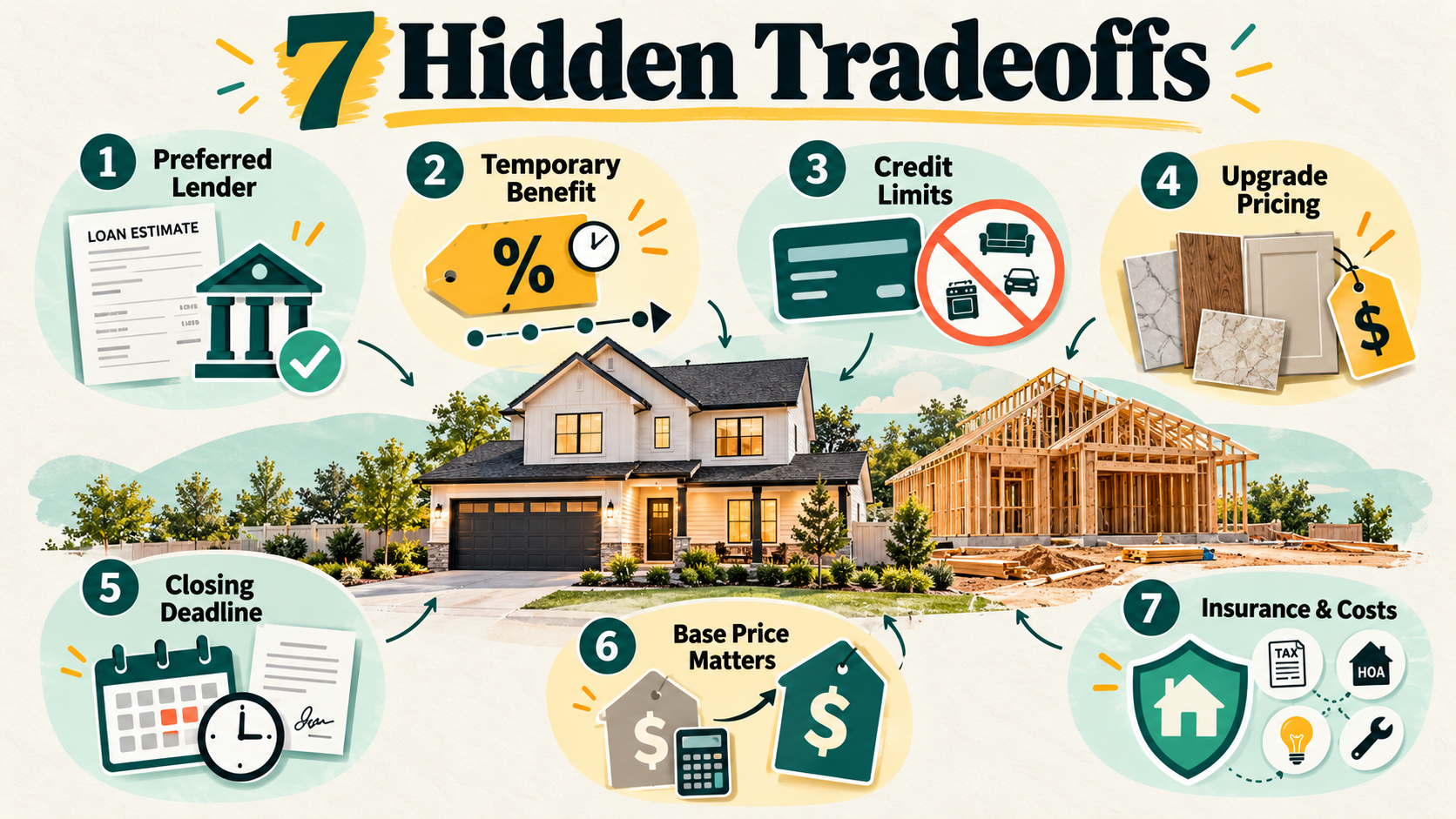
1. The incentive may require a preferred lender
A builder may condition part of its offer on using an affiliated or preferred lender. The financing may still be competitive, but the credit should be evaluated together with the loan terms and costs.
Request a Loan Estimate when available and compare the same loan type, down payment, lock assumptions, and closing date. The CFPB explains how to compare Loan Estimates across lenders. A larger credit can be offset by other costs or by terms that fit the buyer less well.
2. A temporary benefit may not solve a long-term budget issue
Some incentives reduce an expense for an introductory period. Buyers should still evaluate the obligation after that benefit ends. The household budget should be based on a sustainable scenario, not only the most attractive first-year presentation.
Ask for a written explanation of who funds the benefit, how long it applies, and what changes later. A loan officer can explain how the structure appears in the disclosures without promising future refinancing.
3. A credit cannot always be used for everything
Loan programs can limit which costs a seller or builder may pay and how unused credits are handled. A buyer should not assume that an advertised amount will become cash back or cover every expense.
Ask the lender to identify eligible uses based on the transaction and loan program. Also ask what happens if actual eligible costs are lower than the available credit.
4. Upgrades may be priced differently from outside work
Design-center credits feel tangible, but their value depends on the builder’s pricing and the buyer’s priorities. Flooring, cabinets, electrical work, and structural options may have very different markups and practical value.
Separate must-have items from cosmetic preferences. Structural changes that are difficult to add later may deserve priority. Decorative items may be easier to replace after closing, assuming the buyer retains enough reserves.
5. The closing deadline can create pressure
An incentive may require contract execution or closing by a specific date. Construction delays, appraisal issues, document updates, or a buyer’s home sale can affect that timeline.
Read the contract language governing extensions and incentive eligibility. Ask who controls the closing date and what happens if the home is not ready. Verbal assurances should not replace written terms reviewed by the appropriate professionals.
6. The contract price still matters
Buyers sometimes focus so heavily on credits that they stop comparing the underlying price. Review comparable new and resale homes, lot differences, included features, homeowners association obligations, and likely maintenance needs.
An appraisal and a home inspection serve different purposes. Cathryn’s guide to appraisal versus inspection explains why a value opinion does not replace an evaluation of the property’s condition. New construction can still have defects, incomplete items, or warranty questions.
7. Insurance and future ownership costs may change the picture
The purchase decision extends beyond the incentive. Property taxes, insurance, association dues, utilities, maintenance, and special assessments can affect affordability.
Insurance availability also varies by property and location. Cathryn’s article about what happens when home insurance is not renewed shows why coverage should be treated as an ongoing ownership issue, not a closing-day formality.
Section 04
How Preferred-Lender Incentives Should Be Compared
Start with identical assumptions. If one quote uses a different loan type, lock period, down payment, or closing date, the comparison may be misleading.
Create a simple worksheet with these fields:
| Item | Builder or preferred lender | Alternative lender |
|---|---|---|
| Purchase price | Confirm in contract | Same property price |
| Loan type | Confirm | Match if possible |
| Estimated cash to close | Review disclosure | Review disclosure |
| Points and credits | Identify separately | Identify separately |
| Lock period | Confirm | Match timeline |
| Incentive expiration | Record deadline | Not applicable or confirm |
| Future payment change | Ask for explanation | Ask for explanation |
The goal is not to reject the preferred lender automatically. It is to determine whether the full package supports the buyer’s priorities. Service, communication, underwriting readiness, and confidence in the closing timeline also matter.
Section 05
Questions to Ask Before Accepting an Incentive
Ask the builder:
- Is the offer tied to a specific home, phase, lender, or closing date?
- Can the incentive be exchanged for a price adjustment or another benefit?
- Which upgrades are included in the base price?
- What happens if construction or closing is delayed?
- Are any deposits nonrefundable, and under what conditions?
- Which warranties apply, and how are claims submitted?
Ask the lender:
- Where does each credit appear on the Loan Estimate?
- Is any portion connected to points or a temporary financing structure?
- What assumptions were used for taxes, insurance, and association dues?
- Could any credit remain unused because of program limits?
- What documentation or underwriting conditions remain outstanding?
Ask the real estate agent or attorney, as applicable:
- Which contract terms deserve special attention?
- How does the price compare with nearby new and resale homes?
- What inspection rights and completion standards are included?
- Are there transfer fees, special districts, or association obligations?
Section 06
A Practical Five-Step Comparison Process

Step 1: Define the household goal
Decide whether the priority is preserving cash, improving the home, reducing an initial cost, or negotiating the price. One incentive cannot be evaluated without knowing the problem it is meant to solve.
Step 2: Request written details
Collect the builder addendum, price sheet, upgrade list, estimated completion date, and financing disclosures. Record expiration dates and conditions.
Step 3: Compare equivalent financing scenarios
Ask for comparable assumptions and review total costs, not only one highlighted line. If the scenarios are different, request clarification before drawing a conclusion.
Step 4: Inspect the property and contract protections
Schedule appropriate inspections and document incomplete items. Confirm procedures for the final walk-through, repairs, certificates of occupancy, and warranty work.
Step 5: Preserve a post-closing cushion
New homes can still bring expenses for window coverings, landscaping, appliances, moving, repairs, and higher-than-expected utilities. Avoid measuring affordability only by the amount needed on closing day.
Section 07
Frequently Asked Questions
Are builder incentives free money?
No. They are negotiated transaction benefits with conditions and costs that must be evaluated within the complete purchase and financing package.
Can a buyer use an outside lender?
Often yes, but some incentives may be reduced or unavailable. The contract and builder offer should state the conditions.
Should a buyer choose a price cut or closing credit?
It depends on cash needs, financing, eligible costs, holding period, and the builder’s options. Buyers should compare written scenarios with their lender and advisers.
Does a new home still need an inspection?
An independent inspection can identify construction, installation, or completion concerns. Inspection rights and timing depend on the contract and local practice.
Can the buyer refinance later?
Refinancing may be possible if future eligibility, equity, property, program, and market conditions support it. It should not be treated as guaranteed. Buyers considering alternatives in the resale market may also want to understand how an assumable mortgage differs from a builder-financing offer.
Section 08
Final Takeaway
Builder incentives on new homes can be valuable when they address a real buyer need and remain competitive after every condition is considered. Compare the price, loan disclosures, credits, upgrades, deadlines, inspection rights, and continuing ownership costs before deciding. The strongest offer is the one that works as a complete financial and property decision.
Duc Pham, Mortgage Broker | NMLS# 844897
****Wonder Rates, Inc. | NMLS# 1518655
Equal Housing Lender.
AZ, CA, CO, FL, GA, LA, MI, OK, PA, SC, TX, VA, WA, OH, AL, OR, NC
This article is for educational purposes only and is not a commitment to lend. Loan approval is subject to creditworthiness, income verification, property eligibility, and current underwriting guidelines. Builder incentives, loan programs, interest rates, and lender fees may change without notice. Review your contract and official Loan Estimate before making a financing decision.