
Section 01
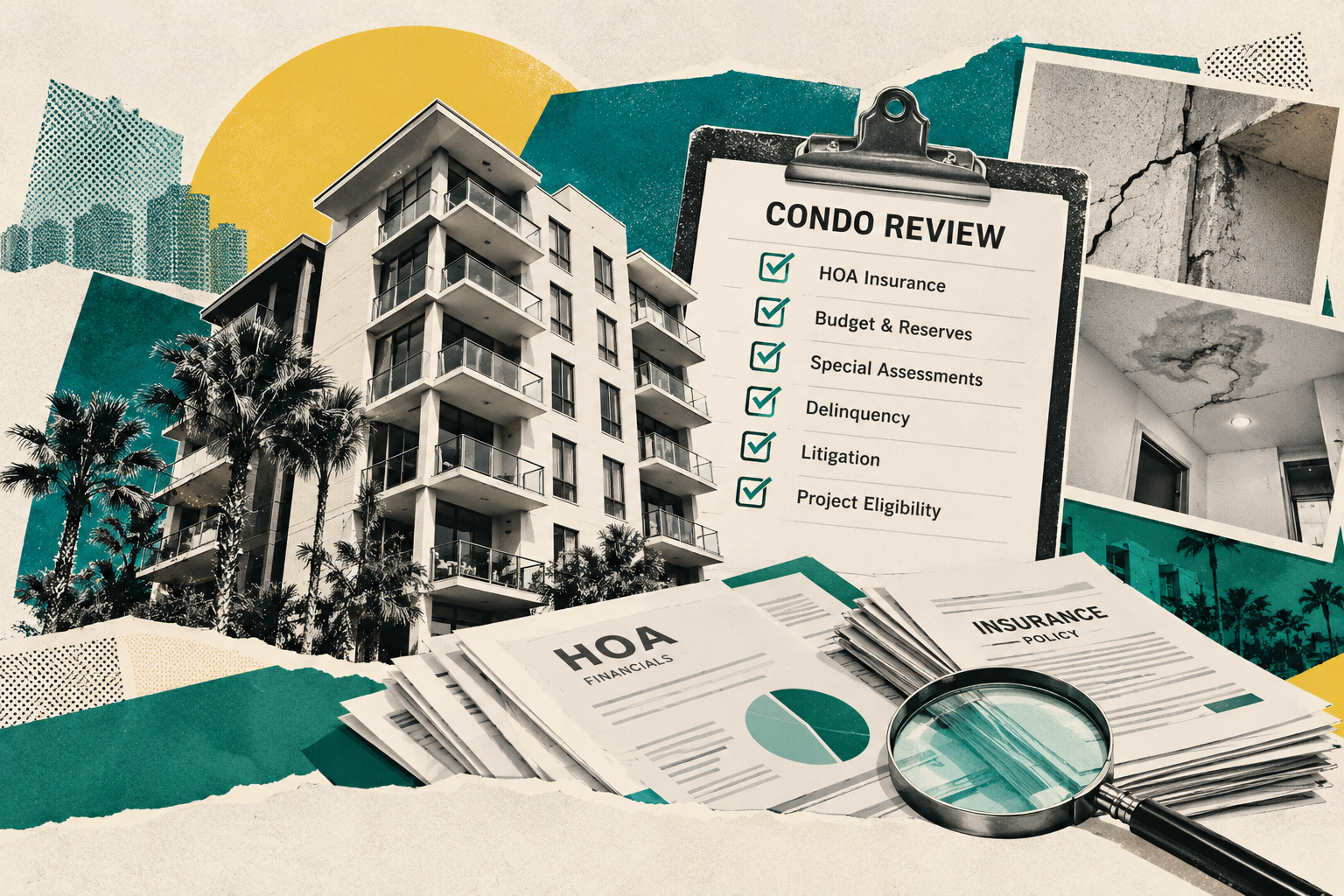
A condo may be difficult to finance even when the buyer has strong income, credit, assets, and debt-to-income ratio. With condominium lending, the lender may need to approve both the borrower and the project, including its insurance, budget, reserves, assessments, ownership structure, litigation, and physical condition.
That project-level review can affect mortgage approval, closing time, resale, and future refinancing. Buyers should begin condo due diligence early instead of assuming that an attractive unit automatically qualifies for standard financing.
Section 02
Why Is Condo Financing Different?
A single-family buyer primarily finances an individual property. A condo buyer owns a unit while sharing interests and obligations connected to common elements and an owners association.
The lender therefore considers risks outside the walls of the unit. A well-maintained interior cannot correct an association with inadequate insurance, serious deferred maintenance, significant delinquency, or unresolved structural concerns.
Project review depends on the loan program, transaction, occupancy, project characteristics, and review method. A problem under one program does not prove that every possible loan is unavailable, but alternative financing may have different requirements or costs.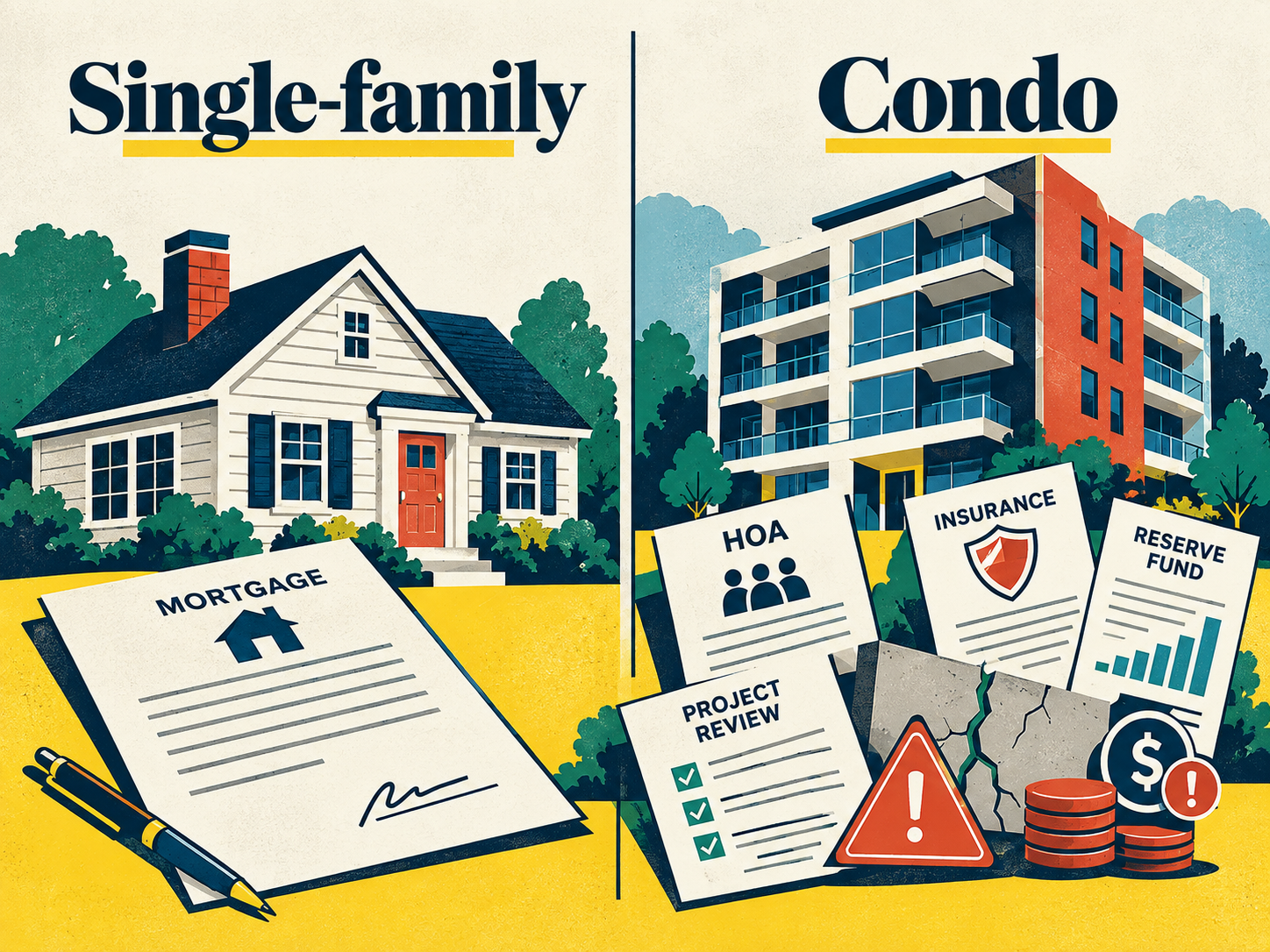
Section 03
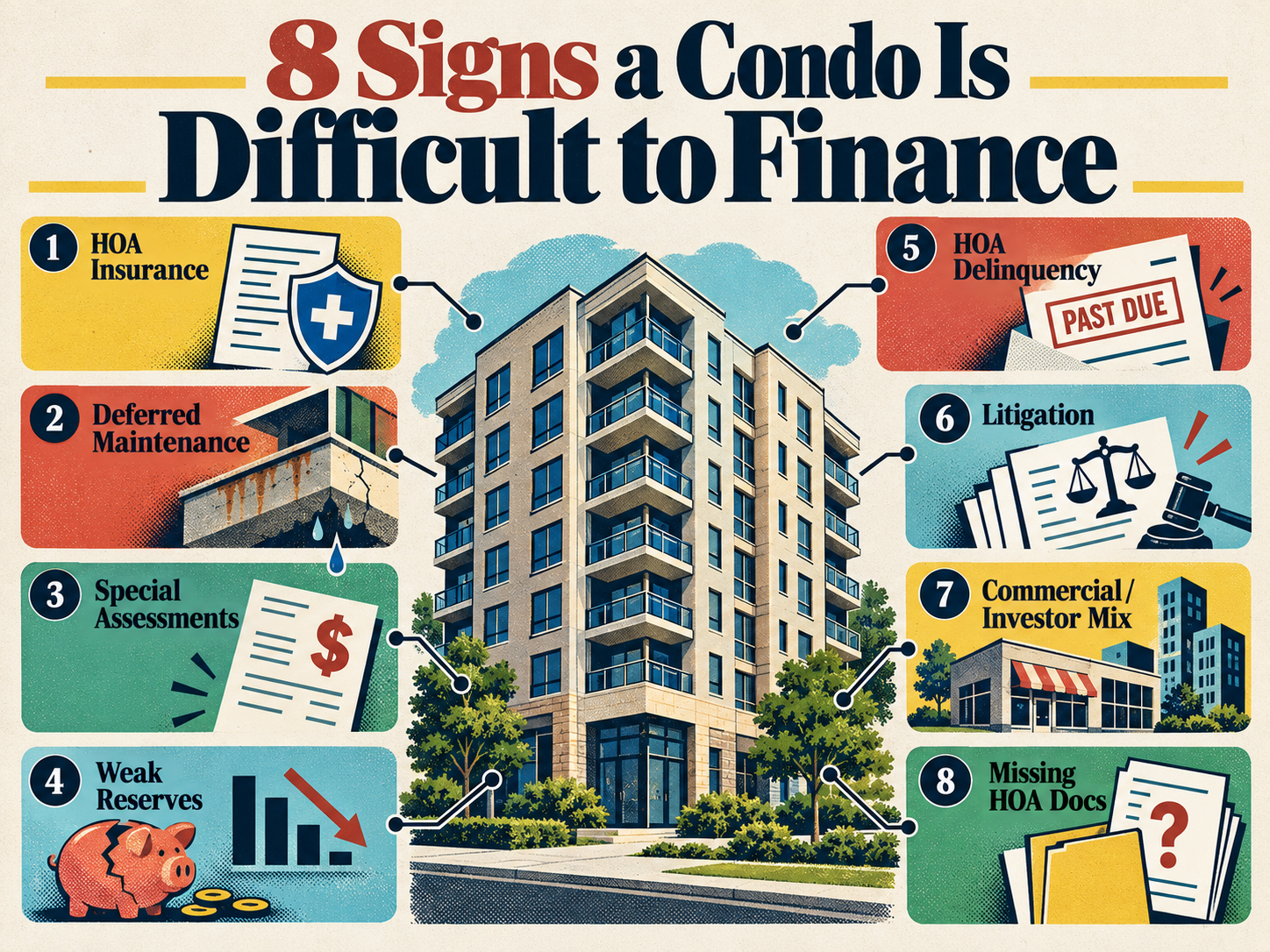
8 Signs a Condo Is Difficult to Finance
1. Inadequate HOA master insurance
The association’s master policy may not meet coverage, deductible, carrier, or documentation requirements. Insurance problems can delay underwriting even when the buyer has obtained an individual unit policy.
Cathryn’s article about home-insurance nonrenewal provides useful context for understanding carrier availability and replacement coverage.
2. Major deferred maintenance
Repeated leaks, failing roofs, damaged balconies, outdated building systems, structural deterioration, or delayed safety work can raise eligibility concerns. An association that repeatedly postpones essential work may also face higher future assessments.
3. Large or unresolved special assessments
A special assessment is an additional amount charged to owners for a project need outside ordinary dues. The lender may review its purpose, amount, payment status, remaining work, owner delinquency, and whether the assessment addresses a safety or structural issue.
An assessment is not automatically disqualifying. A fully funded, well-documented project can be viewed differently from an assessment that remains uncertain or fails to solve the underlying problem.
4. Weak reserves
Reserves help the association pay for major repairs and replacements without relying entirely on sudden owner charges. A low monthly HOA fee can look attractive while masking years of underfunding.
Freddie Mac notes in its condominium mortgage FAQ that special assessments do not replace required budget allocations to reserves under the referenced review standards.
5. Too many owners behind on HOA payments
High delinquency reduces association cash flow and may signal broader financial stress. It can also place more pressure on owners who continue paying.
Fannie Mae’s full condo project review requirement include standards addressing owners who are substantially past due on common expenses and special assessments. Requirements can change, so the lender must use current guidance.
6. Active or threatened litigation
Litigation involving construction defects, structural safety, insurance, habitability, or significant financial exposure may affect eligibility. A small routine dispute is not necessarily treated the same as a case threatening the project’s finances or condition.
7. Problematic commercial or investor concentration
Projects with substantial nonresidential activity, hotel-like operations, short-term rental characteristics, or other ineligible features can be difficult to finance. Ownership and occupancy concentration may also matter under the selected review.
8. Missing or inconsistent HOA documents
An association that cannot produce budgets, insurance policies, questionnaires, meeting minutes, reserve information, or assessment details can delay or prevent the lender from completing review.
Silence is not approval. Missing information creates uncertainty that the lender may be unable to accept.
Section 04
HOA Insurance: Master Policy vs. Unit Policy
The HOA master policy generally covers property and risks described in the association’s policy and governing documents. The buyer’s individual policy may cover the unit interior, improvements, personal property, liability, loss assessment, or other exposures depending on the contract.
The lender may need to verify both layers. A unit policy cannot always cure a deficient master policy. Buyers should ask:
- What does the master policy cover?
- What is the deductible?
- Are required perils included?
- Is replacement-cost coverage adequate?
- Does the association have flood or wind coverage when required?
- What must the individual unit policy cover?
Insurance premiums can also affect HOA dues and future assessments. A project that barely maintains coverage today may face a different renewal outcome later.

Section 05
Special Assessments and the Real Monthly Cost
Buyers often focus on the published HOA fee, but the true ownership cost may include a special assessment or planned capital project. Ask for:
- Assessment purpose.
- Total project cost.
- Unit owner’s share.
- Payment schedule.
- Amount already collected.
- Owner delinquency.
- Contractor and completion status.
- Whether additional assessments are expected.
A seller offering to pay the current assessment does not necessarily resolve the underlying property issue. The buyer still needs to understand whether the work is adequate and whether more costs could follow.
Section 06
Appraisal and Inspection Still Serve Different Roles
The appraisal may identify observable project or unit conditions relevant to value and eligibility, but it is not a substitute for inspections, engineering reports, reserve studies, or review of HOA records.
Cathryn’s guide to home appraisal versus home inspection explains the distinction. Condo buyers may also need specialized review of balconies, roofs, foundations, plumbing systems, elevators, or other common elements.
Section 07
Documents to Request Before the Contingency Expires
Depending on the state and transaction, buyers may request or receive:
- HOA budget and recent financial statements.
- Master insurance declarations and endorsements.
- Governing documents and rules.
- Meeting minutes.
- Reserve study or structural report.
- Current and planned special assessments.
- Pending litigation information.
- Owner delinquency information.
- Condo questionnaire.
- Documents addressing inspections and major repairs.
The buyer should coordinate with the lender, real estate professional, attorney when appropriate, HOA, and insurance professional. The loan officer may not have every project document at pre-approval because the specific property was not yet known.
Section 08
What Can a Buyer Do When the Project Has Problems?
Clarify the exact issue
“Non-warrantable” or “ineligible” can be used too broadly. Ask which standard is not met, which review was performed, and whether missing documentation or a substantive problem caused the result.
Determine whether the problem can be cured
An expired insurance document may be replaceable. A major structural issue or prohibited project characteristic may not be quickly resolved.
Explore permitted loan alternatives
Some lenders offer portfolio or specialized condo financing, but terms, documentation, down payment, availability, and pricing can differ. Alternative financing is not guaranteed.
Protect contract deadlines
Review financing, document, inspection, HOA, and attorney-review deadlines. Do not assume a project denial automatically returns earnest money.
Consider future resale
Even if one lender approves the purchase, ask whether the issue could reduce the future buyer pool or complicate refinancing. Easy financing today does not eliminate project risk.
An assumable loan may sometimes attract future buyers, but it does not solve project eligibility, equity-gap, or servicer-approval issues. Cathryn explains those limits in her guide to assumable mortgages.
Section 09
Frequently Asked Questions
Can I qualify but still be denied because of the condo?
Yes. Borrower eligibility and project eligibility are separate parts of the transaction.
Does a special assessment automatically make the condo ineligible?
No. The lender may review its purpose, status, funding, owner delinquency, work, and relationship to safety or structural concerns.
Is a low HOA fee a good sign?
Not always. It may reflect efficient management, but it can also indicate inadequate reserves or deferred maintenance. Review the budget and long-term obligations.
Can my individual insurance policy fix a master-policy problem?
Not necessarily. The master and individual policies cover different interests. The lender must determine whether all applicable requirements are satisfied.
Can I refinance a difficult condo later?
Possibly, but future approval depends on the project, borrower, property, lender, program, and rules at that time. Do not assume a future refinance will be available.
Should I avoid every non-warrantable condo?
That is a personal risk decision. Understand why standard financing is unavailable, what alternative terms apply, and how the issue may affect costs and resale.
Section 10
The Bottom Line
A condo difficult to finance is usually a project problem, not simply a borrower problem. Insurance, reserves, assessments, delinquency, litigation, commercial use, deferred maintenance, and missing records can all influence mortgage eligibility.
Begin the project review early, read HOA documents carefully, protect contract deadlines, and consider resale as well as today’s approval. The unit is only one part of what the buyer is purchasing.
Duc Pham, Mortgage Broker | NMLS# 844897
****Wonder Rates, Inc. | NMLS# 1518655
Equal Housing Lender.
AZ, CA, CO, FL, GA, LA, MI, OK, PA, SC, TX, VA, WA, OH, AL, OR, NC
This article is for educational purposes only and is not a commitment to lend or legal, insurance, engineering, or HOA advice. Loan approval is subject to creditworthiness, income verification, property and project eligibility, insurance, and current underwriting guidelines. Requirements may change without notice.