Section 01
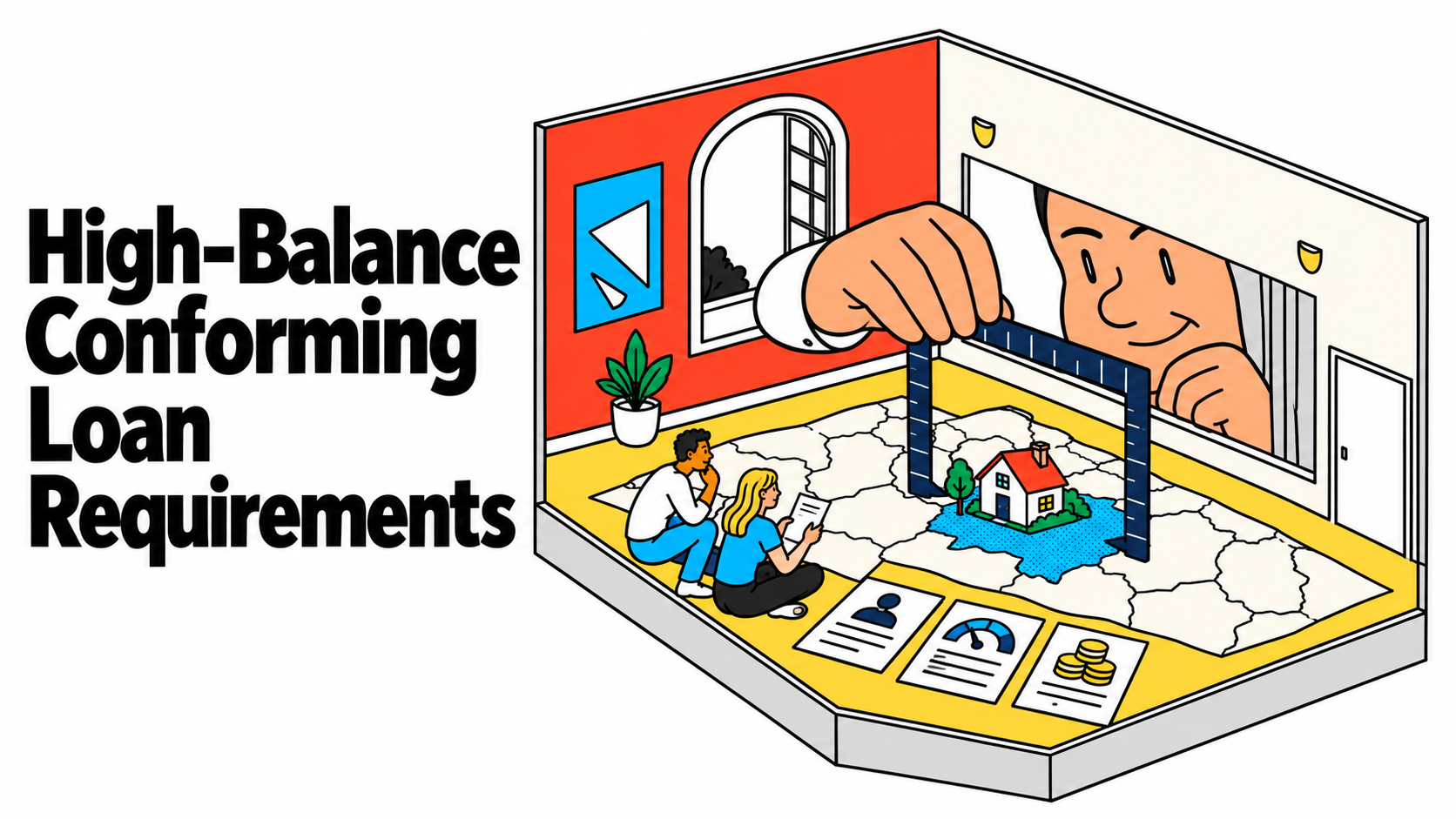
Picture a buyer in a high-cost city. She finds a home she loves. Her lender says she needs a $1,000,000 mortgage. That is more than the standard conforming loan limit. So she assumes a jumbo loan is her only choice.
That may not be true. If the home is in an eligible high-cost area, a high-balance conforming loan might fit. It is a real option, but it comes with real rules.
Three ideas will help as you read.
First, the loan amount alone does not decide your path. The county and the number of units in the home matter too.
Second, a high-balance loan is not easier to get. You still need to meet the rules for credit, income, savings, and the home.
Third, no one down payment or credit score fits every high-balance loan. The loan program, the automated review, the lender, and your own finances all play a part.
This guide covers county limits, credit, income, down payment, and reserves. It also covers mortgage insurance, pricing, and how these loans compare with jumbo loans. It uses plain words and simple numbers. It does not claim that every buyer in a high-cost market will qualify. It also does not claim that a high-balance loan always costs less than a jumbo loan. A larger loan does not come with looser rules. It comes with a closer look.
Section 02
What Is a High-Balance Conforming Loan?
A high-balance conforming loan is a conventional mortgage. That means it is not backed by FHA, VA, or another government program. It is called “conforming” because Fannie Mae or Freddie Mac can buy it. These two companies help keep mortgage money flowing.
What makes the loan “high-balance” is its size. The amount is above the standard baseline limit. But it stays within the higher limit for an eligible high-cost area.
The name depends on the company. Fannie Mae calls these loans high-balance mortgage loans. Freddie Mac calls its version super conforming mortgages. The two share the same basic goal, but their rules are not the same. So do not assume one company’s rule applies to the other.
How a High-Balance Loan Differs from a Standard Conforming Loan
Both types are conventional loans that Fannie Mae or Freddie Mac may buy. The high-balance type lets eligible buyers in certain areas borrow more. They still stay inside the conforming system. Here is how the two can differ:
- The top loan amount is higher in designated high-cost areas.
- Extra or tighter rules may apply.
- Maximum loan-to-value ratios, review rules, and pricing can differ by company and product.
- You must still meet the lender’s rules for income, credit, savings, and the home.
Fannie Mae gives a clear example. Its guide says high-balance loans must meet its standard rules, with a few exceptions. They must be first-lien conventional loans. They must meet the loan-to-value limits in its eligibility matrix. And every one must be reviewed through Desktop Underwriter, its automated system. Freddie Mac’s page says all super conforming loans must go through its own automated system. It is called Loan Product Advisor.
So a high-balance loan is not just a regular loan with a bigger number. It has its own set of rules.
Is a High-Balance Conforming Loan the Same as a Jumbo Loan?
No. The two names describe different size groups. A loan above the conforming limit for its location and unit count is generally a jumbo loan. FHFA says it plainly: loans above the conforming loan limit are known as jumbo loans.
Here is the part that surprises people. A loan can be too big for the high-balance limit, even in a high-cost county. The county’s own limit is the one that counts. A high-balance loan is still a conforming loan. A jumbo loan is not.
Do not assume jumbo loans always have tougher rules or higher rates. Jumbo rules and prices change by lender, product, and borrower.
Section 03
High-Balance Conforming Loan Limits by County
Loan limits come first, because they decide which group your loan falls into. The Federal Housing Finance Agency, or FHFA, sets conforming loan limits every year. It also sets higher limits for eligible high-cost areas.
Here are the 2026 numbers for a one-unit home, taken from FHFA’s 2026 announcement:
- The baseline limit in most of the country is $832,750. That is $26,250 higher than in 2025.
- The highest possible limit in the contiguous United States is $1,249,125. That is 150 percent of the baseline.
- Alaska, Hawaii, Guam, and the U.S. Virgin Islands follow separate rules. Their baseline is $1,249,125, and their ceiling is $1,873,675.
Please treat $1,249,125 as a ceiling, not a promise. Many high-cost counties have a limit somewhere between the baseline and the ceiling. FHFA bases each county’s limit on local home values. In some areas, 115 percent of the median home value is above the baseline. There, the limit can be higher, up to the ceiling.
These are 2026 limits. FHFA announces new ones every year. In recent years it has done so in late November. Check for updated numbers then.
Why the County and Property Location Matter
Limits follow the county, not the city name. Two homes can have the same price and the same down payment. They can still land in different groups if they sit in different counties.
Example: Two buyers each need a $1,000,000 loan for a one-unit home. Buyer A’s home is in a county with an assumed limit of $832,750, the baseline. Buyer B’s home is in a county with an assumed limit of $1,100,000. Buyer A’s loan is above that county’s limit. It would generally be a jumbo loan. Buyer B’s loan is under the limit, so it may fit the high-balance group.
Example disclaimer: This is a hypothetical illustration. Buyer B’s $1,100,000 limit is an assumed number. It is not the actual limit for any county. Real limits change by year, county, and number of units. Fitting under a limit does not guarantee eligibility or approval.
Do not rely on a city name, a ZIP code, or an old chart. Look up the real county. FHFA’s conforming loan limit page has the 2026 county list and a map. Fannie Mae also offers a Loan Limit Geocoder. Lenders can use it to check a limit by address. You can read about it on its loan limits page.
How Property Unit Count Affects the Limit
Limits also depend on the number of units. A one-unit home and a two-unit property do not share the same limit.
FHFA’s tables list four groups: one-unit, two-unit, three-unit, and four-unit properties. So never use the one-unit number for a duplex, a triplex, or a four-unit building. Look up the group that matches your property.
How to Check the Applicable High-Balance Loan Limit
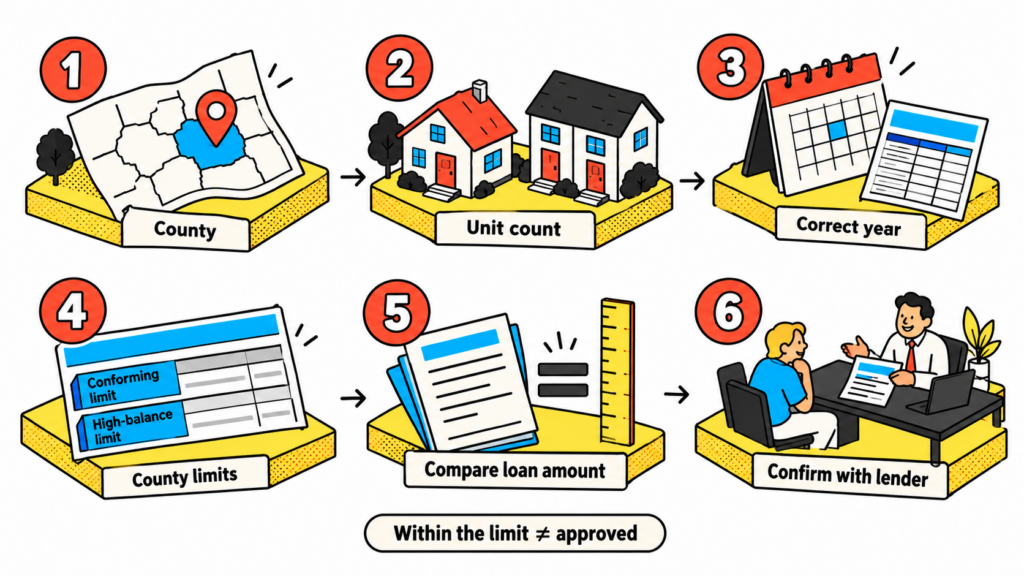
Here is a simple way to check, step by step:
- Confirm the county where the property sits.
- Confirm how many residential units the property has.
- Open the loan limit table for the right calendar year.
- Find the county’s standard limit and its high-cost limit.
- Compare your planned original loan amount with that limit.
- Ask your lender to confirm eligibility under the company’s current guidelines.
A limit is only one piece of the puzzle. Fitting under the limit is not the same as being approved.
Section 04
High-Balance Conforming Loan Requirements at a Glance
Here is a quick summary before we go deeper. Think of it as a map, not a checklist that fits every loan.
| What lenders look at | What you should know |
|---|---|
| Property location | The home must be in an area where the high-cost limit applies. |
| Loan amount | The original loan must not be above the limit for that county and unit count. |
| Loan type | Fannie Mae and Freddie Mac each have their own rules for these loans. |
| Credit | The lender reviews your credit history and score under the program’s rules. |
| Income and job | You must show you can repay the loan under the rules that apply. |
| Debt-to-income ratio | Your monthly debts are compared with your income. The limit depends on the review and the lender. |
| Down payment | The maximum loan-to-value depends on the home type, how you use it, and the loan purpose. |
| Cash reserves | Reserve rules depend on the program and your overall file. |
| The home | The property type, appraisal, and condition must meet the rules. |
| Lender rules | A lender may add rules that are stricter than the company’s minimum. |
This is a summary, not a universal rule book. For example, Fannie Mae says high-balance loans must meet its standard rules. The only exceptions are the ones its high-balance section lists. Every one must go through Desktop Underwriter. Freddie Mac asks that super conforming loans go through Loan Product Advisor.
Section 05
Credit Score and Credit History Requirements
Your credit shows how you have handled debt in the past. Lenders use it to judge risk. There is no single minimum score for every high-balance loan. Be careful with any article that gives you one number. The rules depend on the company, the loan program, the automated review, and the lender. Fannie Mae’s guide has a section on credit score requirements.
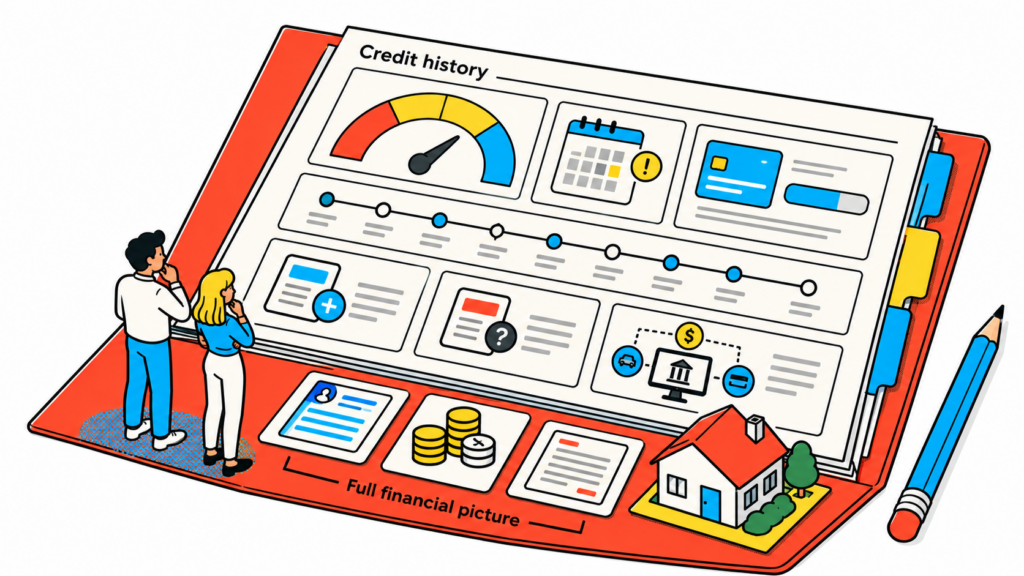
Lenders may look at these things:
- Your credit scores
- Recent late payments, collections, or charge-offs
- How much of your credit card limits you are using
- How long you have had credit
- New accounts opened while your loan is in review
- The overall risk picture that the automated system sees
Why a Higher Loan Amount Can Make Credit Strength More Important
A bigger loan means a bigger monthly bill. That makes your ability to pay it every month matter even more. So lenders look at your credit together with your income, savings, debts, and the home. A score is never the only factor. And no score guarantees approval or a certain rate.
How to Prepare Your Credit Before You Apply
Start early. Pull your credit reports and fix any mistakes you find. Pay every bill on time. Avoid opening new credit that you do not need.
Before you make a big money move, talk with your loan officer. Paying off an account or opening a new one can change your overall profile. It is not a sure way to qualify.
Section 06
Income, Employment, and Debt-to-Income Ratio Requirements
Lenders must be reasonably sure you can repay the loan. So they review your income and your monthly debts. They also check how steady your income is and what your new housing payment will be. This review is called underwriting. Fannie Mae’s guide has a section on income rules.
What Income May Be Considered
These kinds of income may count when they are well documented:
- Salary and hourly pay
- Some bonus, commission, or overtime pay
- Self-employment income
- Some retirement or Social Security income
- Some documented rental income or other steady income
Income does not count just because it appears on a bank statement. The lender must decide if it is allowed, well documented, and likely to continue.
How Debt-to-Income Ratio Affects Qualification
Debt-to-income ratio, or DTI, compares your monthly debts with your monthly income. Lenders may count your new loan payment and property taxes. They may also count homeowners insurance, mortgage insurance, and other housing costs. Then they add your other regular debts. These include car loans, student loans, and credit card payments.
Example: A household has $15,000 a month in qualifying income. Its monthly debts, including the new housing payment, add up to $6,000. Divide $6,000 by $15,000 and you get 0.40, or a 40% DTI.
Example disclaimer: This simple math shows how the ratio works. It is not a limit, a target, or a prediction of approval. Each lender and loan program has its own rules.
There is no single maximum DTI for everyone. The limit can depend on the automated review and the loan’s features. It can also depend on other strengths in your file and the lender’s own rules. Fannie Mae’s guide explains debt-to-income ratios in more detail.
Why Your Income May Need to Be Higher for a Larger Loan
A larger loan usually means a larger monthly payment. Here is the idea in numbers.
Example: Assume a 30-year fixed loan at a 7% rate. A loan of $832,750 has a principal and interest payment of about $5,540 a month. A loan of $1,000,000 has a payment of about $6,653 a month. That is about $1,113 more every month, before taxes and insurance.
Example disclaimer: The 7% rate is assumed to keep the math easy. It is not a current rate or a quote. The payments cover principal and interest only. Taxes, insurance, mortgage insurance, and HOA dues would add more.
So a borrower can have a strong credit score and still fall short. The new payment must also fit the rules.
Section 07
Down Payment and Loan-to-Value Requirements
Your down payment depends on several things. These include the company’s rules, the type of home, and how you will use it. The loan type and your lender matter too. No rule says every high-balance loan needs 10%, 15%, or 20% down.
Loan-to-value, or LTV, compares your loan with the home’s value. You divide the loan amount by the value.
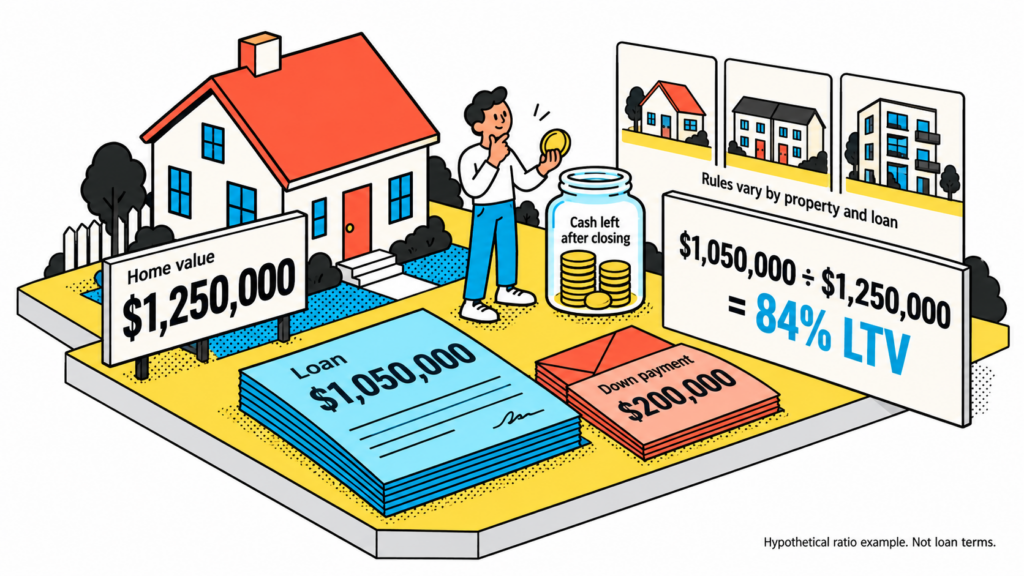
Example: On a $1,250,000 home, a $1,050,000 loan has an LTV of 84%. That is $1,050,000 divided by $1,250,000. A lower LTV means you borrow a smaller share of the home’s value.
Example disclaimer: This is a hypothetical calculation of the ratio only. It does not show how a lender would value the home. It does not promise any loan terms.
Can You Get a High-Balance Conforming Loan With 5% Down?
Maybe, but check the exact product first. Do not assume 5% down works for every high-balance loan or every home.
Freddie Mac offers one clear picture. Its published LTV table lists up to 95% for super conforming loans on a one-unit primary home. That is a 5% down payment. The same table lists lower maximums for other cases. It shows 85% for a two-unit primary home and 80% for a three- or four-unit primary home. For a one-unit investment property, it shows 85%.
Freddie Mac also rounds the ratio up to the next whole number, so 94.01% counts as 95%. And its super conforming page lists some low-down-payment programs, such as Home Possible and HomeOne, as ineligible. Other loan purposes, such as cash-out refinances, have their own limits.
Fannie Mae points to its eligibility matrix for high-balance LTV limits. All of this is an example from published company rules. It is not a promise that every lender offers a 5% down option. If you want a closer look at how loan-to-value affects mortgage eligibility and loan structure, see our guide to Loan-to-Value Ratio (LTV).
How Property Type and Occupancy Affect Down Payment Requirements
The rules can change with the kind of home and how you plan to use it. Think about these cases:
- A one-unit primary home
- A two-unit primary home
- A three- or four-unit primary home
- A second home
- An investment property
Each case can carry different maximum LTVs, mortgage insurance rules, and other conditions. So never copy the number for one case onto another.
How a Larger Down Payment Can Change the Loan Structure
A bigger down payment lowers your loan amount and your LTV. That can bring a loan under the high-balance limit. It may also change your mortgage insurance. It also lowers the cash you have left after closing.
So compare your down payment with your closing costs and your savings before you decide. Putting every available dollar into the home is not always the safest plan.
Section 08
Cash Reserve Requirements for a High-Balance Loan
Cash reserves are savings you still have after closing. They help cover future payments and surprises. Reserve rules are not the same for every high-balance loan. Fannie Mae’s guide has a section on minimum reserve requirements.
Several things can affect how much you need:
- The company’s rules and the automated review result
- How you will use the home and how many units it has
- Whether you own other financed properties
- The details of the loan
Money you use for the down payment and closing costs cannot automatically count as reserves. The lender must also check each asset and decide how to value it.
Which Assets May Count as Reserves
Depending on the rules, reserves may include checking and savings accounts. They may also include some brokerage and retirement accounts. The lender will look at your paperwork and how easily you can reach the money. It will also decide how to value the asset.
A retirement account’s full balance is not always counted as cash. The lender may use special rules or lower the value. Fannie Mae’s guide has a section on retirement accounts.
Why Reserves Matter Beyond the Minimum
You might meet the down payment rule and still need to show money for closing costs. In some cases, you also need reserves. Real life adds more costs too. Think about prepaid items such as insurance, moving, repairs, and emergencies.
So plan for the whole picture, not just the smallest cash-to-close number. And do not assume one reserve rule fits every high-balance loan. It does not. For a deeper look at how lenders evaluate money you still have available after closing, see our guide to Mortgage Cash Reserves.
Section 09
Property Requirements and Appraisal Guidelines
The home must qualify too, not just you. It secures the loan, so it must meet the rules of the company and the lender.
Eligible Property Types
Depending on the product, these kinds of homes may be eligible:
- One-unit homes
- Some two- to four-unit homes
- Eligible condominiums
- Eligible second homes and investment properties
The exact list depends on the high-balance or super conforming product. Do not assume every property type is eligible under every company’s rules.
How the Appraisal Can Affect Loan Qualification
An appraisal is a professional opinion of what the home is worth. It helps the lender judge the home as collateral. If the appraisal comes in below the price, the lender may use the lower value to figure your LTV. That can change the down payment you need or the structure of the loan.
Why Condo and Property Eligibility Should Be Checked Early
Some homes need extra review. With a condo, the lender may need to study the whole building. That includes its budget and its insurance. Fannie Mae’s guide has a section on project standards.
Ask your loan officer to review the home early. Strong finances on your side do not guarantee that the home will qualify. For exact property rules, read the Fannie Mae Selling Guide or the Freddie Mac Seller/Servicer Guide. One company’s rules are not the other’s.
Section 10
Mortgage Insurance Requirements for High-Balance Conforming Loans
Mortgage insurance protects the lender if a borrower stops paying. It is often required when the down payment is small. A high-balance loan does not skip mortgage insurance just because it is conforming.
Both companies publish their own rules. Fannie Mae covers high-balance mortgage insurance in its pricing and delivery section. Freddie Mac points to its mortgage insurance chapter in its guide.
When Mortgage Insurance May Be Required
The rules depend on the product and the LTV. Borrowers with smaller down payments often need it. Borrowers with larger down payments may face different rules. Ask your lender about your exact case. The answer can change with the loan.
How Mortgage Insurance Affects the Total Monthly Payment
When mortgage insurance applies, it adds to your housing cost. So compare the full payment, not just one piece. That includes principal and interest, property taxes, homeowners insurance, mortgage insurance, and any HOA dues.
Mortgage insurance is also not the only cost difference between high-balance and jumbo loans.
What Borrowers Should Compare
Ask for written estimates. They should show the mortgage insurance cost and how long it may last. They should also say what must happen for it to end. Then compare the interest rate, the lender fees, and the estimated cash to close.
Section 11
High-Balance Conforming Loan Interest Rates and Pricing
High-balance loans may be priced differently from standard conforming loans. But no reliable rule says they always cost more or less than jumbo loans.
Many things can move the price:
- Your credit profile and LTV
- The loan amount and the property
- A fixed rate or an eligible adjustable rate
- How you use the home and the loan purpose
- Discount points, lender credits, and fees
- Market conditions and each lender’s pricing
- Company fees and delivery rules
Why High-Balance Loans May Be Priced Differently
Being eligible does not mean every loan gets the same price. Fannie Mae has separate pricing and delivery rules for high-balance loans. Freddie Mac says super conforming loans are subject to its credit fees.
How to Compare a High-Balance Loan With a Jumbo Loan
Compare real offers, not general claims. Ask each lender to use the same loan amount, term, and rate-lock period. Use the same property type, home use, and down payment too. Then line up the results:
- Interest rate and APR
- Discount points and lender fees
- Monthly principal and interest
- Mortgage insurance, if it applies
- Estimated cash to close
- Rate-lock terms and review conditions
A lower advertised rate does not always mean a lower total cost. If you are comparing different mortgage offers, the Wonder Rates Rate Comparison Calculator can help you compare the monthly payment, total interest, upfront costs, and potential break-even point across different loan scenarios.
Section 12
High-Balance Conforming Loan vs. Jumbo Loan
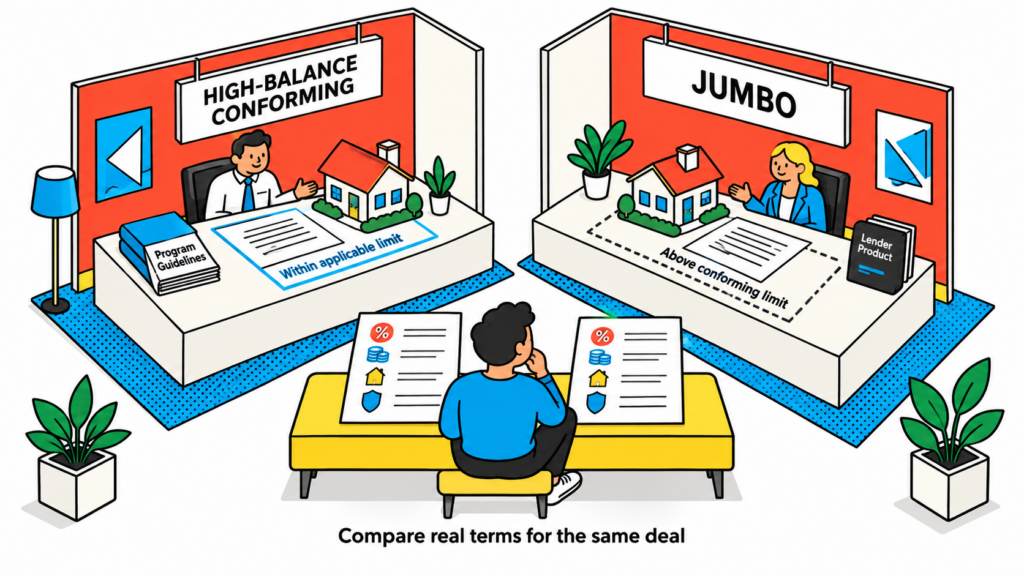
Here is the main difference. A high-balance conforming loan stays within the high-cost conforming limit and follows the company’s rules. A jumbo loan generally goes above the conforming limit. Its rules and prices depend on the lender’s own jumbo products.
| Factor | High-balance conforming loan | Jumbo loan |
|---|---|---|
| Limit | Must fit within the high-cost conforming limit | Generally goes above the conforming limit |
| Review rules | Company rules and lender rules apply | The lender’s own jumbo rules apply |
| Credit and income | Must meet company and lender rules | Depends on the jumbo program |
| Down payment | Depends on company rules, home type, use, and LTV | Depends on the lender, loan size, and property |
| Reserves | Depends on the review and the rules | Depends on the jumbo product |
| Interest rate | Depends on the market and loan features | Depends on the market and loan features |
| Mortgage insurance | May apply, depending on LTV and rules | Depends on the lender’s product |
| Best way to compare | Look at the real terms for your deal | Look at the real terms for the same deal |
When a High-Balance Conforming Loan May Be Worth Exploring
It may be worth a look when your home is in an eligible high-cost area. Your loan amount must also fit the county limit, and you must meet the company and lender rules.
When a Jumbo Loan May Be Necessary
A jumbo loan may be needed when your loan is above the high-balance limit. It may also be needed when your home does not fit the conforming product’s rules.
Why Borrowers Should Compare Both Options When Eligible
The best choice depends on real prices and real approval results. If you are close to a limit, your down payment can change which group you fit. But look at your total cash and your savings after closing before you decide. Neither option is always better.
Section 13
Practical Examples of High-Balance Conforming Loan Qualification
These examples show how limits, down payments, and loan amounts work together. All of them are made up, and none of them predicts an approval.
Example 1: A Loan Amount That Falls Within a High-Cost County Limit
A buyer is purchasing a one-unit primary home. The county’s high-cost limit is assumed to be $1,100,000 for the year. The buyer plans a $1,000,000 mortgage.
The plan is $100,000 below the assumed limit. So the loan may fit the high-balance group. The buyer would still need to meet every rule for credit, income, savings, and the home.
Example 1 disclaimer: This is a hypothetical illustration with an assumed county limit. It is not the real limit for any county. Loan limits change by year, county, and number of units. Meeting a loan limit does not guarantee eligibility or approval.
Example 2: A Loan Amount That Exceeds the Applicable Limit
A buyer is purchasing a home in a high-cost area. The limit for this home is assumed to be $1,100,000. But the buyer needs a $1,150,000 loan.
The request is $50,000 over the assumed limit. The buyer could put at least $50,000 more down to bring the loan to $1,100,000 or less. Or the buyer could look at a jumbo loan.
Changing the amount does not make the deal eligible on its own. The buyer must still meet the rules for whichever loan they choose.
Example 2 disclaimer: These amounts are hypothetical and for education only. Check the real limit for the year, county, and number of units. Other financing choices depend on lender offerings, underwriting, and the borrower’s situation.
Example 3: Comparing Down Payment and Loan Amount
A buyer is purchasing a home for $1,250,000. The buyer is weighing two choices.
- Scenario A: A $200,000 down payment creates a $1,050,000 loan. That is an LTV of 84%.
- Scenario B: A $250,000 down payment creates a $1,000,000 loan. That is an LTV of 80%.
Say the county limit is assumed to be $1,025,000. Scenario A is $25,000 over that limit. Scenario B fits under it with $25,000 to spare. The extra $50,000 down also lowers the LTV. But it leaves the buyer with $50,000 less in the bank.
That does not make Scenario B the winner. The buyer should compare approval and monthly payment. Mortgage insurance, cash to close, and savings left after closing matter too.
Example 3 disclaimer: These numbers are hypothetical. They show only how price, down payment, and loan amount relate. They leave out closing costs, prepaid items, appraisal changes, lender fees, and underwriting rules. They do not guarantee eligibility or approval.
Section 14
Common Mistakes to Avoid When Applying for a High-Balance Conforming Loan
Using the Wrong County Loan Limit
Some buyers use a statewide number or last year’s limit. The right number is the limit for the property’s county, unit count, and year. Check the current FHFA table.
Assuming One Down Payment Rule Fits Every Loan
Down payment rules depend on LTV limits, how you use the home, and the unit count. The loan purpose and the lender’s rules matter too. One number will not fit every deal.
Focusing Only on the Interest Rate
A low rate can hide high fees or mortgage insurance. Compare the APR, the lender fees, mortgage insurance, cash to close, and the total monthly cost.
Using All Your Cash on the Down Payment
A bigger down payment can lower your loan. But it can also leave too little cash for closing costs or reserves. That can complicate your approval.
Assuming Preapproval Guarantees Final Approval
A preapproval is an early review. It is not a promise. The final decision depends on checking your income, assets, and debts. It also depends on the appraisal and the home.
Section 15
How to Prepare for a High-Balance Conforming Loan Application
A little prep work saves a lot of stress. Gather your papers and clear up your questions before you make an offer.
Documents to Prepare
Lenders often ask for items like these, depending on your situation:
- Recent pay stubs and job details
- W-2s and tax returns, if they apply
- Papers that show self-employment income, if it applies
- Recent bank and asset statements
- A list of your regular debts and any other properties you own
- Details about the home, price, how you will use it, and your down payment
- Proof for large deposits or transfers, if the lender asks
The exact list varies. Follow your lender’s instructions instead of assuming every file needs the same papers.
Questions to Ask the Loan Officer
These six questions can help you get a clear picture:
- What is the current conforming and high-balance limit for this county and property type?
- Does my planned loan amount fit that limit?
- Which company’s high-balance or super conforming rules apply to my loan?
- What down payment and LTV choices do I have for this deal?
- What credit, DTI, reserve, and property rules do I need to plan for?
- How does the high-balance option compare with a jumbo loan in rate, fees, mortgage insurance, and cash to close?
Then compare real loan offers that use the same assumptions. Confirm the rules with a qualified mortgage professional.
Section 16
Final Takeaways on High-Balance Conforming Loan Requirements
A high-balance conforming loan can help buyers in high-cost areas borrow more than the baseline limit. They still stay in the conforming system. Keep these points in mind:
- The real limit depends on the county, the year, and the number of units.
- Credit, income, DTI, down payment, reserves, mortgage insurance, the home, and the lender all shape your approval.
- No single down payment, credit score, or reserve amount fits every high-balance loan.
- A jumbo loan may be needed when your loan is above the limit. Compare real terms instead of guessing.
Check the county first. Everything else follows.
If you are planning a purchase in a high-cost area, you can review your plan with a mortgage professional. Bring your price range, down payment, county, and property type. That talk can show which loan options deserve a closer look.
Section 17
Sources
- FHFA, FHFA Announces Conforming Loan Limit Values for 2026
- FHFA, Conforming Loan Limits (2026 county data)
- Fannie Mae Selling Guide, B5-1-01, High-Balance Mortgage Loan Eligibility and Underwriting
- Fannie Mae Selling Guide, B5-1-02, High-Balance Pricing, Mortgage Insurance, Special Feature Codes, and Delivery Limitations
- Fannie Mae, Loan Limits for Conventional Mortgages
- Fannie Mae Selling Guide, B3-5.1-01, General Requirements for Credit Scores
- Fannie Mae Selling Guide, B3-3.1-01, General Income Information
- Fannie Mae Selling Guide, B3-6-02, Debt-to-Income Ratios
- Fannie Mae Selling Guide, B3-4.1-01, Minimum Reserve Requirements
- Fannie Mae Selling Guide, B3-4.3-03, Retirement Accounts
- Fannie Mae Selling Guide, B4-2.1-01, General Information on Project Standards
- Freddie Mac, Super Conforming Mortgages
- Freddie Mac, Maximum LTV/TLTV/HTLTV Ratio Requirements for Conforming and Super Conforming Mortgages
- Freddie Mac Seller/Servicer Guide, Section 4203.1
Disclaimer: This article is provided for general educational and informational purposes only and does not constitute financial, mortgage, tax, legal, or investment advice. High-balance conforming loan requirements, conforming loan limits, credit score requirements, debt-to-income limits, down payment requirements, reserve requirements, mortgage insurance rules, interest rates, and eligibility criteria vary by loan program, agency guidelines, property location and type, lender requirements, and individual borrower circumstances. Loan limits may change annually, and the applicable limit must be verified for the relevant year, county, and number of property units. Hypothetical examples are for illustration only and do not guarantee eligibility, loan approval, interest rates, or any particular financing outcome. Meeting a published loan limit does not guarantee that a borrower or property will qualify. Readers should verify current requirements with the applicable mortgage lender, review relevant agency guidelines, and consult qualified professionals regarding their individual circumstances.
Duc Pham, Mortgage Broker | NMLS# 844897, Wonder Rates, Inc. | NMLS# 1518655 | DRE# 02047445 | DFPI# 60DBO-59134 | Equal Housing Opportunity. Equal Housing Lender. | Licensed in: AL, AZ, CA, CO, FL, GA, LA, MI, NC, OH, OK, OR, PA, SC, TX, VA, WA.