
Section 01
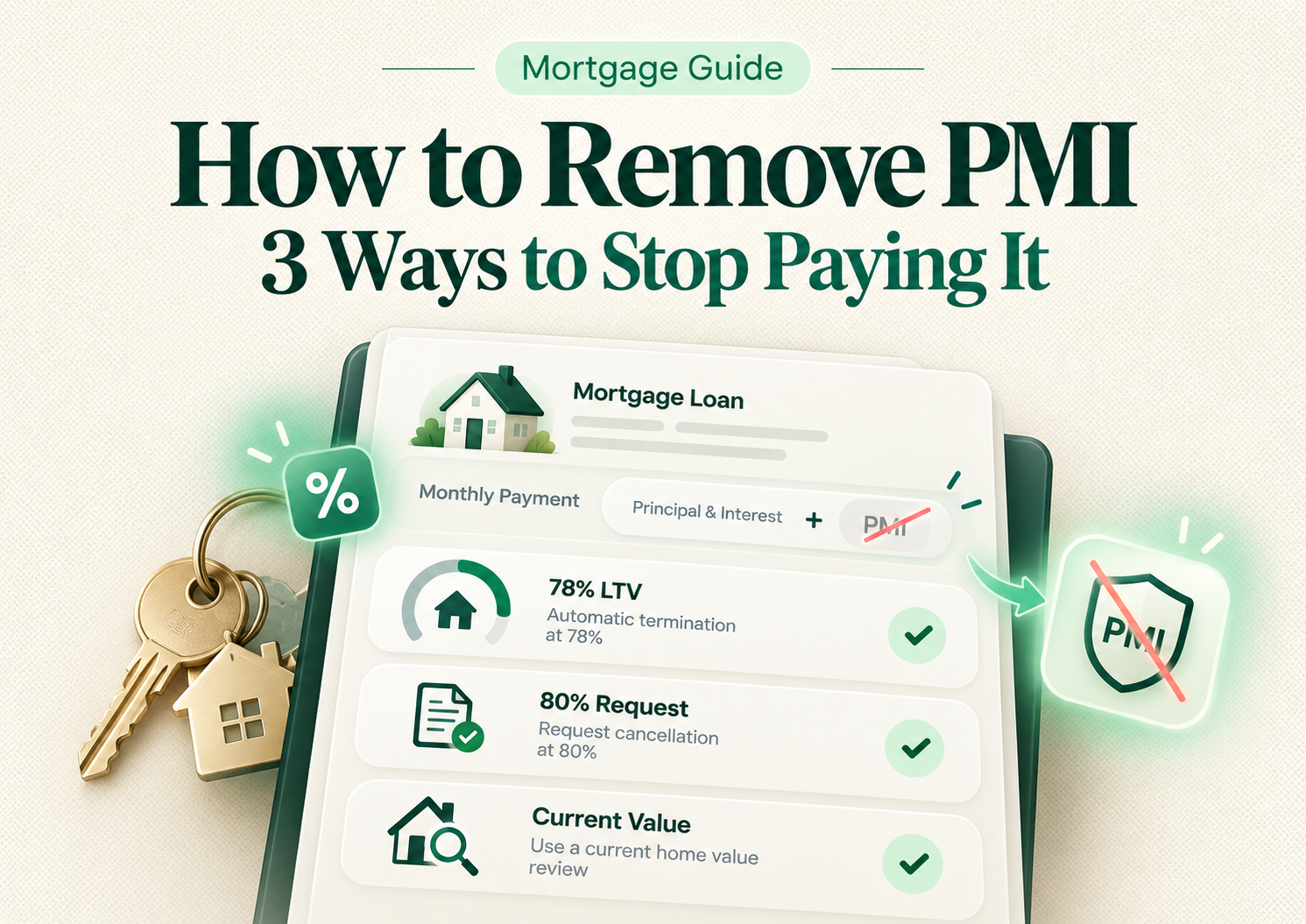
Private mortgage insurance may be removed automatically, through a borrower-requested cancellation, or through a current-value review, depending on the loan. The right route depends on the mortgage type, original value, current balance, payment history, property value, servicer and investor requirements.
The first step in learning how to remove PMI is identifying the type of mortgage insurance on your statement. The cancellation rules discussed below generally apply to borrower-paid private mortgage insurance on a conventional loan. FHA mortgage insurance and lender-paid mortgage insurance work differently.
Section 02
What PMI Is and Why You May Be Paying It
Private mortgage insurance, commonly called PMI, protects the lender if a borrower stops making payments. It does not protect the homeowner.
PMI is commonly associated with a conventional mortgage originated with less than 20% down. It may also apply to a conventional refinance when the borrower has less than 20% equity. The Consumer Financial Protection Bureau’s explanation of private mortgage insurance provides a useful overview.
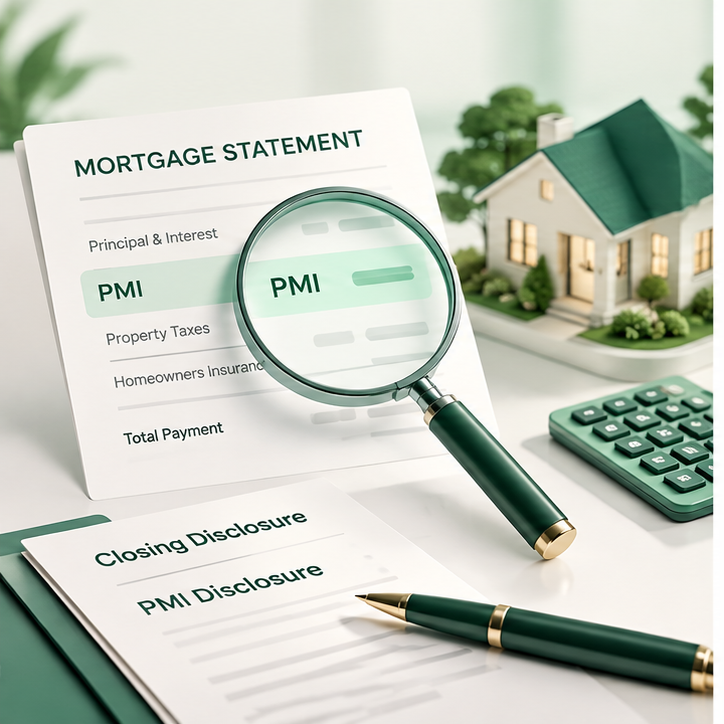
Check your Closing Disclosure, PMI disclosure and current mortgage statement before taking action. Those documents can help you determine:
- Whether the loan is conventional or government-backed
- Whether the mortgage insurance is borrower-paid or lender-paid
- The original property value used for the loan
- The current unpaid principal balance
- The scheduled PMI cancellation and termination dates, if applicable
- The name and contact information of the current servicer
Your servicer is the company that collects the mortgage payment. It may be different from the lender that originally made the loan. If that changed after closing, review what to keep track of after closing on a house before sending a PMI request.
Section 03
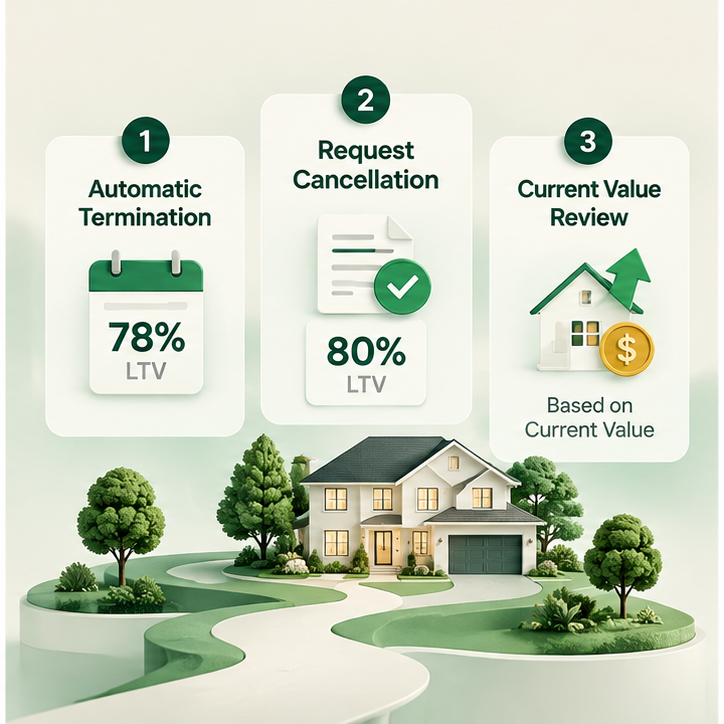
How to Remove PMI: Three Main Routes
The three routes below do not apply identically to every mortgage. Federal law establishes certain cancellation and termination rights for covered loans, while investors and servicers may provide additional options.
Route 1: Automatic PMI Termination at the Scheduled 78% Point
For a covered conventional mortgage, the servicer generally must terminate borrower-paid PMI when the principal balance is scheduled to reach 78% of the home’s original value, provided the loan is current.
This date comes from the original amortization schedule. It is not recalculated because the home has appreciated, and paying extra principal does not move the scheduled automatic termination date forward.
No borrower request or new appraisal is normally required for automatic termination. If the loan is not current when it reaches the scheduled termination date, PMI generally ends after the loan becomes current.
There is also a final termination provision based on the midpoint of the loan’s amortization period. Different rules and exceptions may apply to certain high-risk loans, modified loans or properties that are not a principal residence.
The annual PMI disclosure or the original disclosure package may show the scheduled date. If the date is unclear, ask the servicer to provide it in writing.
Route 2: Request PMI Cancellation at the Applicable 80% Point
A borrower may be able to request cancellation before automatic termination. For a covered loan, the request can generally be made when the balance is scheduled to reach 80% of the original value. A borrower who reduces the actual principal balance through extra payments may also be able to request cancellation once it reaches the applicable threshold.
The CFPB’s PMI cancellation guidance explains the federal requirements and the questions borrowers should ask their servicer.
A servicer may require the borrower to:
- Submit the request in writing
- Be current on the mortgage
- Meet the applicable payment-history requirements
- Certify that no junior lien, such as a second mortgage or HELOC, exists on the property
- Provide evidence that the property’s value has not declined below its original value
Do not send a large principal payment based only on an online estimate. First ask the servicer for the exact unpaid principal balance, applicable threshold and cancellation process. Also consider how the payment would affect emergency savings and other financial goals.
If you are considering a substantial principal payment, compare PMI cancellation with how a mortgage recast compares with refinancing. A recast, when offered and approved, may change the required principal and interest payment, but it does not automatically guarantee PMI cancellation.
Route 3: Request Removal Based on the Home’s Current Value
Home appreciation or qualified improvements may create another possible route. A borrower may ask the servicer whether PMI can be removed using the property’s current value instead of its original value.
This option is generally governed by the loan’s investor and servicer requirements, not the federal 80% borrower-requested cancellation rule alone. The servicer may need to identify whether Fannie Mae, Freddie Mac or another investor owns the loan.
For example, Fannie Mae’s current servicing guidance for certain one-unit principal residences and second homes uses:
- An LTV of 75% or less when the loan seasoning is between two and five years
- An LTV of 80% or less when the seasoning is greater than five years
- A possible waiver of the minimum two-year seasoning period when borrower improvements increased the property value, subject to additional conditions
Freddie Mac uses its own requirements, including how it treats the five-year boundary. Property type, occupancy, payment history and other factors can change the applicable standard. Do not assume that one online rule applies to every loan.
Review the Fannie Mae mortgage insurance termination guidance if Fannie Mae owns the loan. For any other investor, ask the servicer for the applicable written requirements.
The servicer will generally control the valuation process. It may use an appraisal, broker price opinion or another approved valuation method. The borrower may be responsible for the cost. Ask about the fee, required valuation type and refund policy before proceeding. An appraisal ordered independently may not be accepted.
Section 04
How to Calculate LTV Before Contacting the Servicer
Loan-to-value ratio, or LTV, compares the unpaid principal balance with the property value being used for the request. If this calculation is unfamiliar, review what LTV means for a mortgage before estimating whether a cancellation threshold may have been reached.
For an original-value request:
Current unpaid principal balance ÷ original value = LTV
For a current-value request:
Current unpaid principal balance ÷ approved current value = LTV
The original value is generally based on the value established when the mortgage originated, subject to the applicable legal and investor definition. It is not automatically the home’s estimated value today.
An online home-value estimate may help a borrower decide whether to call the servicer, but it does not establish eligibility. The servicer decides which valuation method and documentation are acceptable.

Section 05
What If You Have Lender-Paid Mortgage Insurance?
With lender-paid mortgage insurance, the borrower typically does not see a separate monthly PMI charge. The cost may be reflected in the mortgage’s pricing or interest rate.
Because there is no separate borrower-paid monthly premium, the standard PMI cancellation process may not apply. Changing that structure generally requires paying off or replacing the existing loan, which could happen through a sale, payoff or refinance.
Refinancing should not be evaluated solely as a way to remove mortgage insurance. Compare the new interest rate, term, closing costs, total monthly housing expense, break-even period and the length of time you expect to keep the loan. This guide to what mortgage refinancing means explains the broader comparison.
Section 06
FHA MIP Follows Different Rules
FHA mortgage insurance premium, or MIP, is not conventional PMI. Reaching an 80% or 78% LTV does not automatically create the same cancellation rights.
For many FHA mortgages with case numbers assigned on or after June 3, 2013, the duration of annual MIP is based on the original LTV and loan term. Depending on those factors, MIP may apply for 11 years or for the mortgage term. HUD provides the official FHA mortgage insurance premium guidance.
Do not determine the rule only from the closing month or today’s equity. Review the FHA case-number assignment date and original loan information, then confirm the result with the servicer.
Some FHA borrowers consider refinancing into a conventional mortgage, but approval and mortgage insurance requirements depend on the new application. The borrower should compare qualification, costs, rate, term, payment structure and break-even period before deciding.
Section 07
Documents to Prepare for a PMI Cancellation Request
The exact process varies, but these items can help:
- Most recent mortgage statement
- Original Closing Disclosure and PMI disclosure
- Original appraisal or other document showing the original value
- Written PMI cancellation instructions from the servicer
- Information about any second mortgage or HELOC
- Records and permits for substantial property improvements
- Copies of correspondence sent to and received from the servicer
Ask where the request must be submitted. A general customer-service email or payment mailing address may not be the correct destination.
Section 08
Common PMI Removal Mistakes
Assuming appreciation automatically cancels PMI
The servicer generally needs an approved valuation and must apply the investor’s eligibility requirements. Market appreciation alone does not remove the charge.
Ordering an appraisal before calling the servicer
The servicer may require a specific valuation provider or process. An appraisal ordered independently could be unusable.
Confusing original value with current value
Automatic termination and a current-value review are different routes. Each uses a different value and may follow different requirements.
Making a large principal payment without written instructions
An extra payment reduces the balance, but it does not by itself guarantee PMI cancellation. Confirm the threshold and the remaining conditions first.
Ignoring a HELOC or second mortgage
A junior lien may affect eligibility. Disclose it accurately and ask the servicer how it will be treated. Homeowners with an existing line of credit can also review the considerations involved when refinancing a mortgage with a HELOC.
Treating FHA MIP like conventional PMI
FHA MIP has a separate set of rules. Use the loan documents and FHA case information rather than the conventional 80% and 78% framework.
Section 09
Frequently Asked Questions
When does PMI go away automatically?
For a covered borrower-paid conventional mortgage, PMI generally terminates when the balance is scheduled to reach 78% of the original value, provided the loan is current. Certain loans and circumstances may follow different rules.
Can extra principal help remove PMI sooner?
It may help a borrower reach the balance required to request cancellation sooner. It does not move the scheduled automatic termination date. Other conditions still apply.
Do I need an appraisal to remove PMI?
Not always. Automatic termination generally does not require one. A borrower-requested cancellation or current-value review may require proof of value through a method approved by the servicer.
Can an online estimate be used to remove PMI?
Usually not by itself. It may be useful for an initial review, but the servicer determines the acceptable valuation.
Can PMI be removed because the home was renovated?
Possibly. Some investor guidelines provide a current-value route for substantial improvements. Routine maintenance may not receive the same treatment. Submit the improvement details to the servicer before ordering a valuation.
Can FHA mortgage insurance be canceled at 80% LTV?
Not under the conventional PMI rules. FHA MIP duration depends on factors such as the FHA case-number assignment date, original LTV and loan term.
Section 10
Start With the Servicer, Not an Online Estimate
If you want to know how to remove PMI from your loan, begin by requesting the servicer’s written cancellation requirements. Confirm whether the request will use original value or current value, which LTV standard applies, what payment history is required and who must order the valuation.
A Wonder Rates loan officer can help you review the available information and compare a possible refinance with keeping the current loan. Final PMI cancellation decisions are made by the servicer under applicable law, investor guidelines and the terms of the loan.
Duc Pham, Mortgage Broker | NMLS# 844897
Wonder Rates, Inc. | NMLS# 1518655
Equal Housing Lender.
AZ, CA, CO, FL, GA, LA, MI, OK, PA, SC, TX, VA, WA, OH, AL, OR, NC
This article is for educational purposes only and is not a commitment to lend. Loan approval is subject to creditworthiness, income verification, property eligibility, and current underwriting guidelines. PMI and MIP requirements vary by law, servicer, investor, loan type, property type and individual circumstances. Loan programs, interest rates and lender fees may change without notice. Review your mortgage documents and contact your servicer before making a financing decision.



