
Section 01
You have made the same mortgage payment for months. Then a notice arrives saying the payment is going up, even though nothing about your interest rate has changed. Did the lender make a mistake? Did your loan terms quietly shift underneath you?
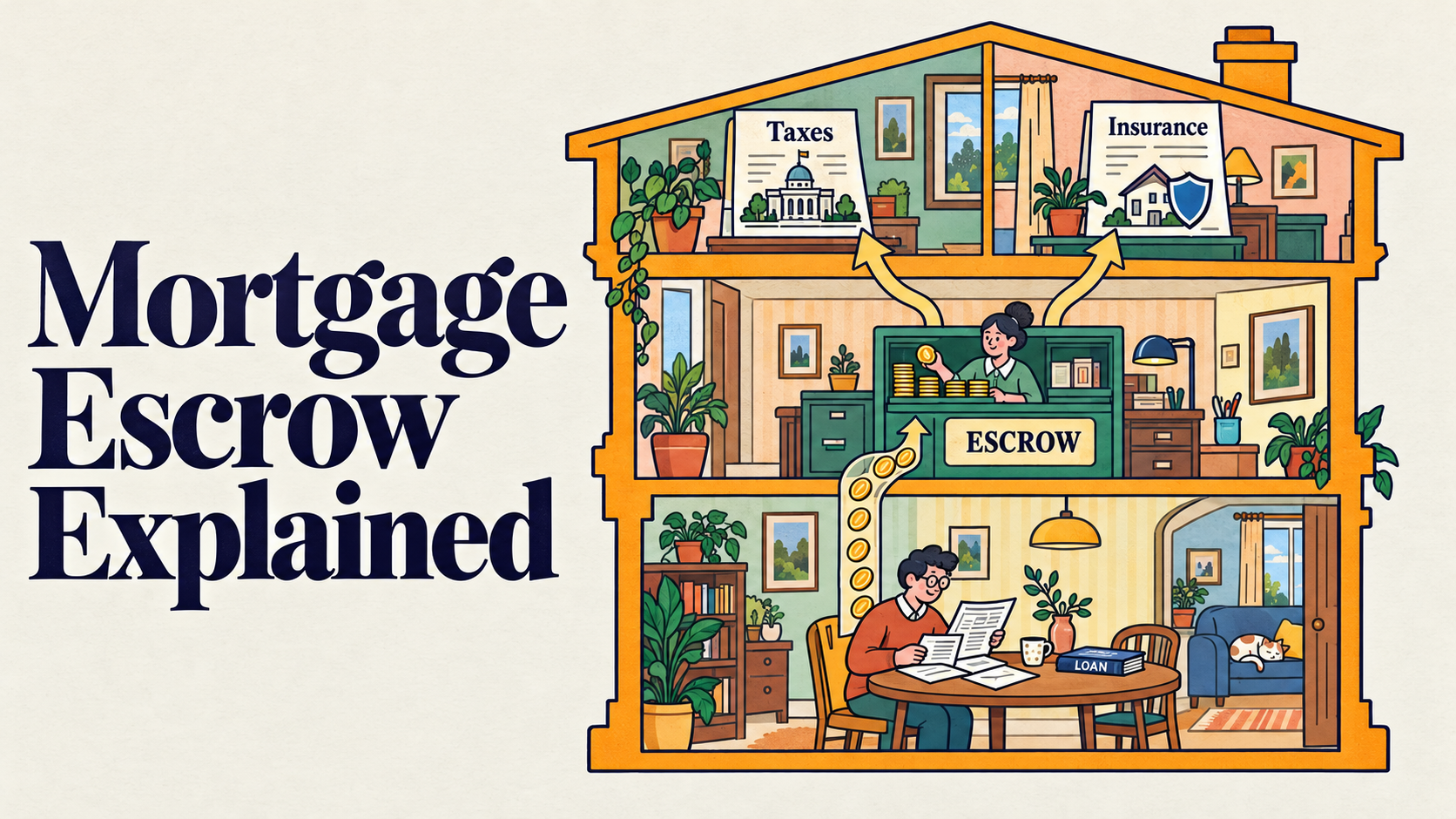
Probably not. For most homeowners, the monthly payment includes more than just principal and interest. It also includes money collected for property taxes and homeowners insurance. Your mortgage servicer holds that money in what is called an escrow account, then pays those bills on your behalf when they come due. When those underlying costs change, the escrow portion of your payment can change right along with them, even on a fixed-rate loan. This guide focuses on that ongoing mortgage escrow account used to pay recurring property expenses. It is not about the separate kind of escrow that briefly holds money during a real estate closing, which we touch on only briefly to avoid confusion. Here is everything you need to understand how escrow works, what it covers, how the monthly amount gets calculated, what happens at closing, and what a shortage or surplus actually means for your payment.
Disclaimer: This article is provided for general educational and informational purposes only and does not constitute financial, mortgage, tax, insurance, or legal advice. Mortgage escrow account requirements, payment calculations, account cushions, shortage repayment options, surplus refunds, and escrow waiver eligibility depend on the mortgage agreement, applicable federal and state laws, loan program, servicer procedures, and the borrower’s individual circumstances. Any calculations and hypothetical examples are for illustration only and may not reflect the amounts, timing, or treatment applicable to a specific mortgage account. This article does not guarantee a particular escrow payment, refund, or outcome. Requirements and guidelines may change. Homeowners should review their mortgage documents and escrow statements and contact their mortgage servicer for account-specific questions. Consult qualified tax, insurance, or legal professionals when appropriate.
Section 02
What Is a Mortgage Escrow Account?
A mortgage escrow account is an account your lender or servicer establishes and controls to collect and hold funds for certain property-related expenses. You contribute money toward it as part of your monthly mortgage payment, and your servicer uses that money to pay eligible bills on your behalf.
Here is the practical reason this exists. Instead of facing one massive property tax bill or annual insurance premium all at once, you set aside a portion of the expected cost every single month. Your servicer then pays the actual bill according to the account’s schedule, whenever it comes due.
What Does Escrow Mean on a Mortgage Statement?
The word “escrow” on your monthly statement generally refers to the amount being collected for your property expenses. It is not the same as the principal portion that reduces your loan balance, and it is not the interest you are charged for borrowing the money. Look for an itemized payment breakdown on your statement. It may separate principal, interest, escrow, and mortgage insurance or other applicable charges. Not every mortgage has the exact same components, and HOA dues are commonly paid separately rather than through escrow.
Who Manages the Mortgage Escrow Account?
Your mortgage lender and your mortgage servicer are not always the same thing. The lender originates or owns the loan, while the servicer is the one actually managing your monthly payments and likely administering the escrow account too. The servicer tracks expected bills, collects the funds, makes disbursements, and runs the periodic escrow account analyses. You still remain responsible for understanding your own property taxes and insurance coverage, even though the servicer handles the actual payments. Review your statements, and verify that your tax and insurance bills are actually being paid correctly.
Is a Mortgage Escrow Account Required?
It depends on your mortgage documents, applicable law, and your loan program. Many lenders require an escrow account. Some mortgages instead allow you to pay property taxes and insurance directly on your own. Certain loan categories carry additional escrow requirements built in. There is no single answer that applies to every mortgage, so check your own loan agreement rather than assuming either way.
Section 03
What Does a Mortgage Escrow Account Pay For?
An escrow account is built to cover specific recurring expenses identified in your mortgage arrangement. Exactly which items are included depends on your loan documents and the applicable requirements.
Property Taxes
Your servicer collects a monthly portion of your expected annual property tax bill, then pays the taxing authority when each installment comes due. That amount can change because of reassessments, local tax rate changes, special assessments, or a shift in the property’s taxable value. Your property tax bill and your assessed value are not always the same number. If the escrow estimate looks off, check your local tax assessment and the actual bill directly.
Homeowners Insurance
Your homeowners insurance premium may be collected through escrow so your policy stays active without interruption. If your insurer raises the premium at renewal, your servicer may need to collect more each month to cover that new annual cost. You can shop around for coverage, but coordinate any policy change with your mortgage servicer first, to make sure the replacement policy meets your lender’s requirements and the insurer actually sends over the necessary policy information.
Mortgage Insurance and Other Eligible Charges
Some mortgage statements include mortgage insurance, but do not assume every insurance-related charge runs through escrow automatically. Whether a specific premium is escrowed depends on your mortgage and the applicable arrangement. Other periodic property charges can be included too, if permitted and established under your loan documents. HOA dues and condo association fees are commonly paid separately, so check your actual payment instructions rather than assuming escrow has you covered there.
What Is Not Usually Covered by Mortgage Escrow?
Escrow is not a general household expense account. Utilities, routine maintenance, repairs, furniture, and most everyday homeownership expenses generally do not come out of a standard mortgage escrow account. This distinction matters for your own budgeting. Even when taxes and insurance are folded into your mortgage payment, you still need separate funds set aside for maintenance, utilities, HOA dues where applicable, and whatever unexpected repair comes up next.
Section 04
How Mortgage Escrow Fits into Your Total Monthly Payment
A common shorthand here is PITI: Principal, Interest, Taxes, and Insurance. It is a useful way to think about the main pieces of a housing payment, though your actual mortgage payment might also include mortgage insurance or other charges depending on your specific loan.
Principal and Interest vs. Escrow
Principal is the portion that repays what you actually borrowed. Interest is the cost of borrowing that money under your mortgage terms. Escrow is the funds collected for property expenses like taxes and insurance. Mortgage insurance, when it applies, is a separate cost layered on top of the loan terms. On a fixed-rate mortgage, the principal-and-interest piece generally stays stable as long as you keep making your scheduled payments. The escrow piece can still move whenever taxes or insurance premiums change, completely independent of your rate.
Why a Fixed-Rate Mortgage Payment Can Still Increase
Here is the misconception worth clearing up directly: a fixed interest rate does not freeze your property’s tax bill or your insurance premium. When those costs go up, your servicer recalculates the escrow contribution to cover the new expected expense. A shortage left over from the previous year can stack another, temporary increase right on top of that. Review your escrow analysis to figure out whether the change traces back to higher projected bills, a shortage repayment, or a combination of both.
How to Compare Mortgage Payments Accurately
Never compare two mortgage offers based on principal and interest alone. One lender’s estimate might fold taxes and insurance into escrow, while another shows those costs as separate line items. Compare the total expected housing cost instead: principal, interest, property taxes, homeowners insurance, mortgage insurance if it applies, and HOA dues where relevant. The CFPB specifically advises borrowers to examine the estimated total monthly payment rather than fixating on principal and interest in isolation. If you want to estimate how these costs can affect a potential monthly payment, the Wonder Rates Mortgage Payment Calculator can help you compare different loan and housing-cost scenarios.
Section 05
How Is a Mortgage Escrow Payment Calculated?
Your servicer generally estimates the expenses expected to be paid from escrow over the upcoming year, calculates the regular monthly contribution needed to cover them, and then adjusts for the account’s current projected balance.

Estimate the Annual Property Expenses
The starting point is the expected annual cost of eligible expenses, mainly property taxes and homeowners insurance. Your servicer uses the latest tax bill, insurance premium information, and other relevant records to estimate what will actually be due. If a homeowner’s annual property tax and insurance bills total $7,200, the simple monthly funding amount would be $600, before factoring in the existing account balance, any shortage or surplus, and the permitted escrow cushion.
Divide the Expected Annual Cost into Monthly Contributions
In a simplified calculation, annual escrow expenses get divided by 12 to find the monthly contribution needed to fund them. The real calculation gets more detailed in practice, since bills are paid at different times throughout the year and the account needs enough money sitting there whenever a payment actually comes due. For federally related mortgage loans covered by RESPA, Regulation X generally limits the regular monthly escrow deposit to one-twelfth of the total annual escrow disbursements the servicer reasonably anticipates, subject to the regulation’s other provisions.
Account for the Required Escrow Cushion
An escrow account can include a cushion to protect against unexpected disbursements or timing gaps. For covered loans, federal rules generally cap that cushion at one-sixth of estimated annual escrow disbursements, which works out to roughly two months of those expenses, unless your loan terms or applicable law set a lower limit. This cushion is not some extra fee your lender can collect without limit. It is a capped reserve held inside the account under federal rules.
Adjust for the Account’s Current Balance
Your servicer also has to factor in the account’s current and projected balance. A shortage means you might need to contribute extra funds. A surplus means your servicer has to handle that excess under the applicable rules, which we cover in detail below. This is exactly why your monthly escrow payment rarely equals the annual bills divided neatly by 12. The calculation also accounts for an existing shortage, a surplus, or the permitted cushion sitting on top.
Section 06
What Is an Initial Escrow Deposit at Closing?
The initial escrow deposit is money collected at closing to get your escrow account started, if your mortgage requires one. It is separate from your recurring monthly contribution. The amount depends on your anticipated tax and insurance bills, when they are due, your closing date, and the starting balance your account actually needs.
Why Do You Pay Escrow Before the First Monthly Payment?
Property taxes and insurance premiums can become due before you have accumulated enough monthly escrow contributions to cover them. The initial deposit helps fund those bills and establish the account balance needed for the scheduled disbursements ahead. You may also pay certain prepaid property expenses at closing. These are related to the initial escrow deposit, but they are a distinct line item, so check exactly how each amount is itemized on your Loan Estimate and Closing Disclosure.
Where Can You Find the Initial Escrow Deposit?
Check your Loan Estimate and Closing Disclosure directly. The initial escrow deposit is generally itemized in Section G, “Initial Escrow Payment at Closing,” on page 2 of the Loan Estimate. The final amount can shift before closing as the underlying estimates get updated. Compare that estimate against your Closing Disclosure, and ask your lender or settlement agent about any unexpected change. Do not assume a difference automatically means an error. Tax estimates, insurance premiums, and the timing of your closing can all genuinely shift the number.
Section 07
What Is an Escrow Analysis?
An escrow analysis is your servicer’s review of the account’s past activity and expected future activity. It compares the funds you have paid in against the expenses paid or expected to be paid, calculates the projected account balance, and determines whether the account has a shortage, a surplus, or a deficiency. For most covered mortgage escrow accounts, your servicer has to provide an annual escrow account statement showing the account’s history and projected activity for the year ahead.
What Does an Annual Escrow Statement Show?
Look for your current total monthly mortgage payment and the portion allocated to escrow. The prior year’s monthly payment and escrow contribution, for comparison. Total deposits made into escrow during the review period. Payments made for taxes, insurance, and other escrowed charges. The account’s ending balance. Any identified shortage, surplus, or deficiency, and how your servicer plans to handle it. And projected expenses along with the expected monthly escrow contribution for the coming year. The whole point of this statement is to explain exactly how the account was used and how your servicer arrived at your next payment.
How to Review an Escrow Analysis for Errors
Compare the statement against your latest property tax bill, your insurance renewal notice, and your previous escrow statement. Check whether the expected tax amount and insurance premium look reasonable, whether payments were recorded correctly, and whether the new monthly contribution accounts for both future expenses and any shortage repayment it includes. If something looks wrong, contact your mortgage servicer and ask for an explanation or correction. Keep copies of the statement, the relevant bills, and all of your communications.
Section 08
What Is a Mortgage Escrow Shortage?
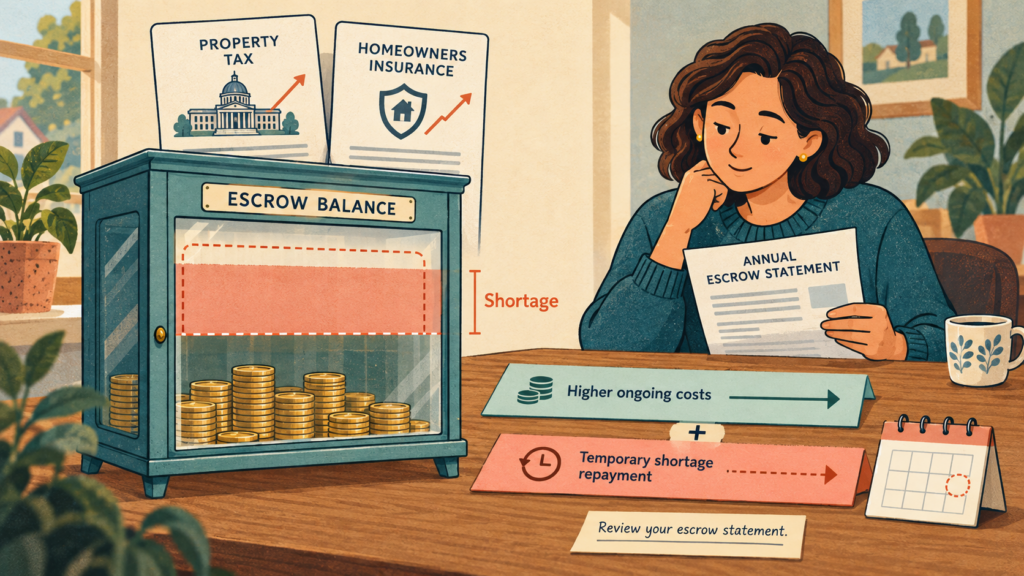
An escrow shortage means your account balance sits below the amount the escrow analysis projects you will actually need. A shortage can happen when real expenses come in higher than expected, or when the account simply has not collected enough to cover scheduled payments.
A shortage is not automatically a sign that your servicer made a mistake. It might just reflect a genuine jump in property taxes or insurance premiums, an earlier estimate that turned out too low, or other routine account activity. Still, review the calculation yourself rather than assuming the number is automatically correct.
Common Reasons for an Escrow Shortage
Property taxes rose after a reassessment or a local tax-rate change. Homeowners insurance premiums increased at renewal. A previous estimate came in lower than the actual bill. The account balance was affected by a payment timing issue or another adjustment. The account paid an eligible expense that turned out higher than expected. Sometimes a shortage lands alongside higher expected costs for the upcoming year too, which creates two separate effects on your next monthly payment at once: funding the new annual expenses, and addressing the previous shortfall.
How Do You Repay an Escrow Shortage?
The available treatment depends on the size of the shortage and the applicable rules. For covered loans under Regulation X, federal rules offer specified options for handling a shortage, including spreading the repayment over at least 12 months in certain circumstances, or allowing a smaller shortage to simply remain on the account. The exact option available to you depends on your specific circumstances and the rules that apply. Do not assume you can always choose a lump-sum payment, or that every servicer offers the exact same menu of choices. Review your annual escrow statement and ask your servicer which options actually apply to your account.
How an Escrow Shortage Affects Your Monthly Payment
Your monthly payment can rise because your servicer needs to collect more for upcoming taxes and insurance, and may also be collecting extra to repay the prior shortage at the same time. Separate the ongoing cost increase from the temporary shortage repayment in your head. The shortage repayment portion can end once that repayment period wraps up, while a higher contribution tied to rising taxes or insurance can continue if those annual expenses stay elevated going forward.
Section 09
What Is an Escrow Surplus, and Can You Get a Refund?
An escrow surplus is an account balance that exceeds the target balance calculated during the escrow analysis. This can happen when actual expenses come in lower than projected, when the servicer collected more than it actually needed, or from other account adjustments that push the balance higher than expected.
When Is an Escrow Surplus Refunded?
Here is the federal baseline rule for covered loans: if an escrow analysis finds a surplus of $50 or more and you are current on your loan, your servicer generally must refund it to you within 30 days of that analysis. If the surplus is under $50, your servicer can choose to refund it or simply apply it toward next year’s escrow payments instead. Specific rules and exceptions can still affect how a particular account gets treated, so this is a baseline, not a guarantee for every situation.
Why a Surplus Does Not Always Mean Your Payment Will Drop
A refund or surplus credit relates only to your existing account balance. Your servicer may still need to collect a different, possibly higher, monthly amount for the year ahead if your taxes or insurance costs have changed in the meantime. A homeowner might get a surplus because last year’s insurance premium came in lower than projected, while a brand-new insurance renewal simultaneously raises the amount needed for the next year. An account can genuinely have a surplus from the past and still require a higher contribution going forward, both at once.
What to Do If You Expected an Escrow Refund but Did Not Receive One
Start by reviewing your annual escrow statement to see whether the balance was actually classified as a surplus, and whether it was refunded or simply credited forward instead. If the explanation is not clear, contact your servicer and ask exactly how the surplus was calculated and handled. Keep a copy of the statement and whatever response you get.
Section 10
Why Did My Mortgage Payment Go Up Because of Escrow?
A payment increase can happen even when your mortgage’s principal-and-interest amount has not moved an inch. The most common escrow-related reasons are higher property taxes, higher homeowners insurance premiums, and repayment of an escrow shortage.
Property Taxes Increased
Property tax estimates can change after a reassessment, a local tax-rate change, or a shift in applicable assessments. Your servicer updates its projected annual expenses and recalculates how much the account needs. Compare your latest tax bill with the figure listed in the escrow analysis. If the bill itself looks wrong, contact the relevant tax authority. If the servicer’s calculation looks wrong, contact the servicer instead.
Homeowners Insurance Became More Expensive
Insurance premiums shift at renewal for all kinds of reasons: insurer pricing, coverage changes, property characteristics, or something else entirely. When your servicer expects to pay a higher premium, it may need to collect more from you each month. Review your renewal notice and confirm the premium and coverage. You can explore alternative coverage, but coordinate any change with your servicer first, and make sure the replacement policy actually satisfies your mortgage requirements.
Your Payment Includes a Shortage Repayment
Your new monthly payment might include both the updated escrow contribution and an amount working toward the prior year’s shortage. Your escrow statement should explain how that shortage will be handled and exactly how your new payment was calculated. Separate the projected annual expenses from the shortage repayment in your own head, so you understand which part of the increase might actually be temporary.
How to Identify the Exact Cause of the Increase
Compare the old and new monthly payment breakdowns side by side. Review the annual escrow statement. Check your latest property tax bill and insurance renewal notice. Identify any shortage repayment or other account adjustment tucked into the numbers. Contact your servicer if the calculation or disbursements still are not clear after all that. This sequence helps you actually investigate the cause, rather than jumping to the conclusion that your interest rate changed or your lender raised the payment arbitrarily.
Section 11
Can You Remove Escrow from Your Mortgage?
Some homeowners can request an escrow waiver, but whether that gets approved depends on your mortgage documents, your loan program, your loan-to-value ratio, your payment history, your lender or investor’s requirements, and applicable law. Some loans require escrow for a specific period or under particular conditions that cannot be waived at all.
When an Escrow Waiver May Be Possible
First, figure out whether your mortgage actually permits an escrow waiver in the first place. Your servicer evaluates eligibility and can impose its own conditions or fees where that is permitted. A waiver is never an automatic right for every homeowner, so confirm your specific eligibility rather than assuming it.
What Happens If You Pay Taxes and Insurance Yourself?
Removing escrow does not eliminate the underlying expenses themselves. You become fully responsible for setting aside enough money, tracking every due date, and paying the tax authority and insurance company on time, every single time. If property taxes or insurance get missed, penalties or a lapse in coverage can follow, and your lender may take action permitted under the mortgage agreement and applicable law.
Is Escrow Better Than Paying Directly?
There is a genuine trade-off here. Escrow simplifies budgeting and helps make sure bills get paid on time without you having to think about it. But your monthly payment can shift whenever expenses or the account balance change. Paying directly gives you more control over your money between due dates, but it demands disciplined budgeting and careful payment tracking on your own. The better option really depends on your loan terms, your eligibility, your cash-flow preferences, and your own comfort managing large annual bills without a safety net.
Section 12
What Happens to Escrow When You Sell or Pay Off Your Mortgage?
When a mortgage is paid off, your servicer generally has to return the remaining escrow balance under the applicable rules. For covered loans, federal Regulation X generally requires the remaining escrow funds under the servicer’s control to be returned within 20 business days, excluding legal public holidays, Saturdays, and Sundays, after the mortgage is paid in full, subject to certain exceptions.
Escrow Refund After Selling a Home
When a home sale pays off your mortgage, your existing escrow account generally gets reconciled as part of that payoff process. Any remaining balance is handled under the applicable rules, though the exact timing and process can depend on your servicer and the specific transaction. Confirm your payoff statement, keep your contact information current with the servicer, and watch for a separate escrow refund arriving after closing.
Escrow When Refinancing with a New Lender
A refinance pays off your existing mortgage and establishes a brand-new loan, typically with its own separate escrow arrangement. You may receive the remaining balance from the old account while also being required to make a new initial escrow deposit for the new loan at the same time. The old escrow balance does not automatically transfer directly into the new loan, and it does not automatically cancel out the new loan’s initial deposit requirement either. Plan for both amounts separately when thinking through your cash flow around closing.
Section 13
Practical Examples of Mortgage Escrow Calculations
Example 1: Calculating the Monthly Escrow Contribution
A homeowner’s estimated annual property tax bill is $4,800, and the annual homeowners insurance premium is $1,800. Together, these expenses total $6,600 per year. A simplified monthly funding estimate: $6,600 divided by 12 equals $550. This homeowner’s initial estimated escrow contribution would be $550 per month, before accounting for the existing account balance, any shortage or surplus, and the applicable cushion.
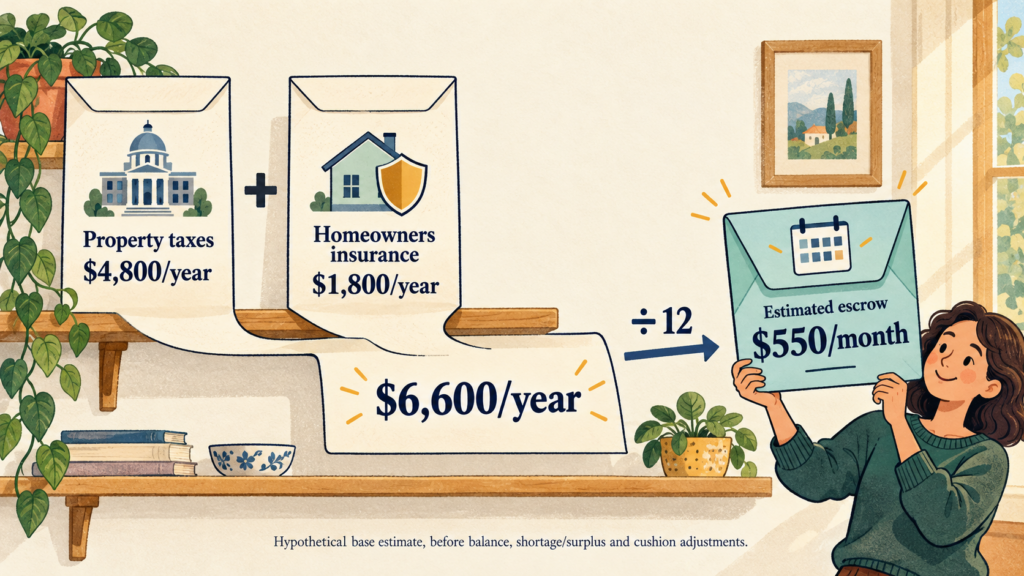
This is a hypothetical calculation for educational purposes only. Actual escrow contributions depend on the expenses the servicer reasonably anticipates, payment schedules, the account balance, any applicable cushion, and the requirements governing the mortgage. This example is not a quote or a prediction of a specific homeowner’s payment.
Example 2: A Higher Insurance Premium Increases the Monthly Payment
This same homeowner’s annual property taxes stay at $4,800, but the homeowners insurance premium rises from $1,800 to $2,400. The new annual total becomes $7,200. A simplified monthly estimate: $7,200 divided by 12 equals $600. The basic monthly escrow funding amount rises from $550 to $600, a $50 monthly increase, before any other escrow adjustments get factored in.
This is a hypothetical calculation for educational purposes only. Actual payment changes depend on the servicer’s escrow analysis, projected disbursements, account balance, and applicable rules. The example excludes any shortage repayment, cushion adjustment, or other charge and does not guarantee a particular payment increase.
Example 3: An Escrow Shortage Adds to the Monthly Payment
A homeowner has a $1,200 escrow shortage after the annual analysis. Suppose the applicable repayment arrangement spreads that shortage over 12 months. The shortage repayment component: $1,200 divided by 12 equals $100. If the newly calculated monthly contribution for future taxes and insurance is also $50 higher than before, the combined monthly increase could reach $150 during the shortage repayment period.
This is a hypothetical calculation for educational purposes only. The repayment treatment and timing of an escrow shortage depend on the shortage amount, the applicable law, the mortgage terms, and the servicer’s analysis. The example assumes a 12-month repayment schedule solely for illustration and does not establish a universal repayment requirement.
Section 14
Mortgage Escrow Checklist for Homeowners
Review your monthly mortgage statement and identify the escrow portion specifically. Keep copies of property tax bills and homeowners insurance renewal notices as they arrive. Read the annual escrow analysis, and compare the projected expenses with your actual bills. Check whether your payment changed because of higher taxes, higher insurance, a shortage, or more than one factor at once. Verify that your tax and insurance payments were actually made correctly. Ask your servicer to explain any balance, disbursement, or adjustment that is not clear. If a payment increase is genuinely hard to manage, ask your servicer which options are available under your loan terms and applicable rules. And if you are considering an escrow waiver, confirm your actual eligibility first, and remember that the underlying bills remain your responsibility either way.
Regular monitoring like this helps catch errors early, avoids missed property bills, and makes changes to your monthly payment far less of a surprise.
Section 15
Final Takeaways: Understanding Your Mortgage Escrow Account
A mortgage escrow account collects money for eligible property expenses, most commonly property taxes and homeowners insurance. The escrow portion sits separate from your principal and interest. Monthly escrow contributions are based on estimated annual expenses, the account’s current balance, and any applicable cushion or shortage adjustment layered on top. An escrow shortage can raise your monthly payment, while a surplus may lead to a refund or an account credit under the applicable rules.
A fixed-rate mortgage can still have a changing total payment, because property taxes and insurance premiums are never actually fixed, even when your rate is.
Review your annual escrow statements, and verify your tax and insurance disbursements, rather than letting an unexplained change sit there unquestioned. If your payment just went up, the answer is usually sitting right there in your own escrow analysis. If you are reviewing your overall mortgage costs or considering your next mortgage decision, you can talk with a licensed mortgage professional about your specific situation.
Section 16
Sources
- Consumer Financial Protection Bureau, What Is an Escrow or Impound Account?
- Consumer Financial Protection Bureau, Why Did My Monthly Mortgage Payment Go Up or Change?
- Consumer Financial Protection Bureau, Is There a Limit on Escrow Account Deposits?
- Consumer Financial Protection Bureau, What Is an Initial Escrow Deposit?
- Consumer Financial Protection Bureau, Problems with an Escrow or Impound Account
- Consumer Financial Protection Bureau, Regulation X, Section 1024.17
This article also touches on cash reserve requirements for a mortgage when discussing budgeting for taxes and insurance, and mortgage requirements after forbearance when explaining how escrow shortages can arise after a hardship arrangement.
Duc Pham, Mortgage Broker | NMLS# 844897, Wonder Rates, Inc. | NMLS# 1518655 | DRE# 02047445 | DFPI# 60DBO-59134 | Equal Housing Opportunity. Equal Housing Lender. | Licensed in: AL, AZ, CA, CO, FL, GA, LA, MI, NC, OH, OK, OR, PA, SC, TX, VA, WA.



