
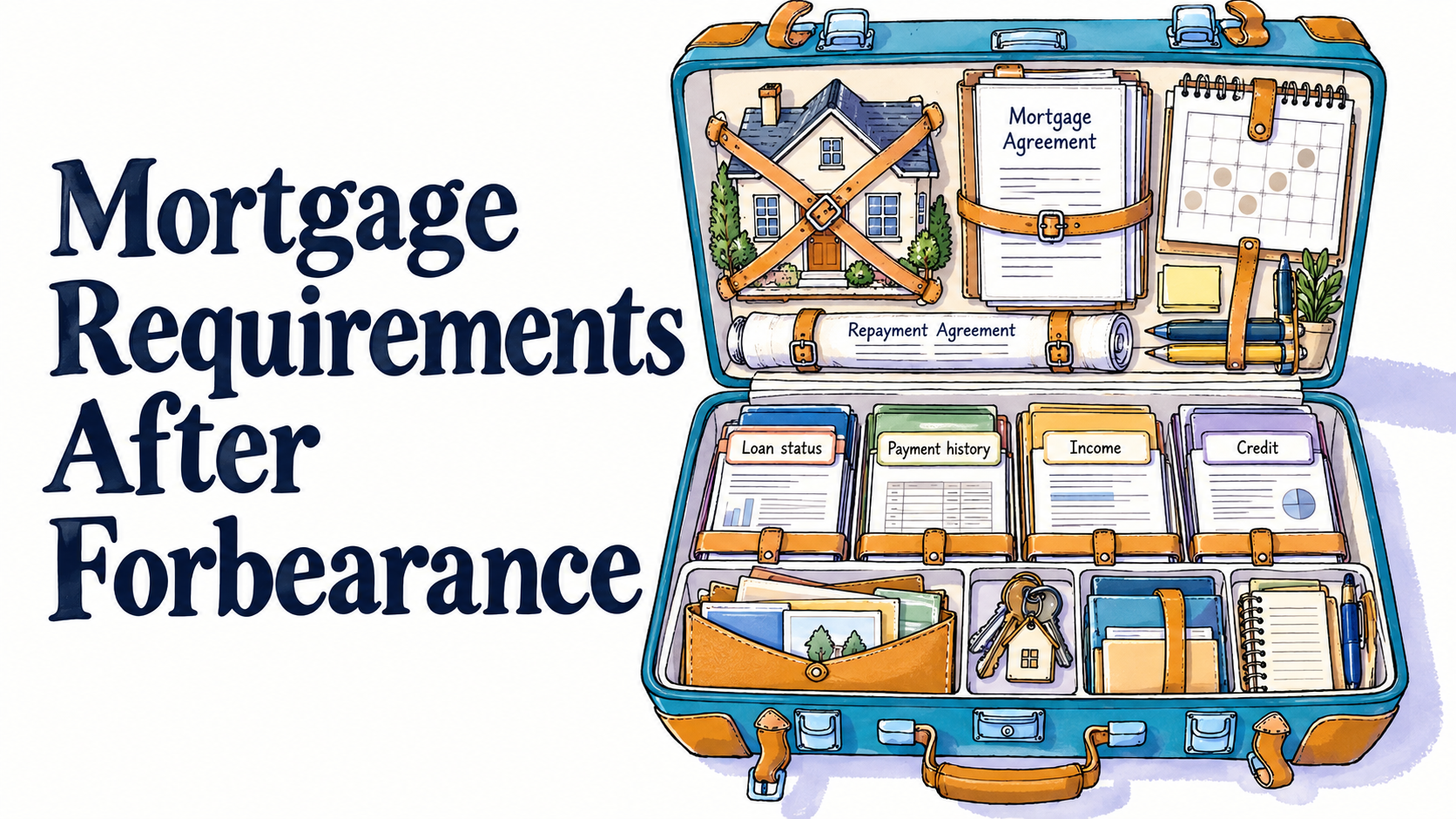
Section 01
A homeowner goes through a rough patch, income gets disrupted for a while, and they enter mortgage forbearance to get through it. Months later, life has stabilized. Now they want to buy a different home, or refinance the one they have, and they are not sure whether that past forbearance will follow them around and block the door.
Mortgage forbearance is an arrangement that temporarily pauses or reduces your mortgage payments. It is important to understand upfront that forbearance generally does not erase what you owed during that period. Those amounts still need to be addressed through whatever repayment arrangement you worked out with your servicer. Here is the central point worth holding onto through the rest of this guide: a prior forbearance does not automatically mean you can never qualify for another mortgage. Eligibility depends on the current status of your original mortgage, how the forbearance actually ended, your payment history since then, the loan program you are using, and whether you are buying a new home or refinancing the existing one. This guide walks through payment history, credit reporting, repayment plans and modifications, how loan programs differ, documentation, and the steps you can take before applying.
Disclaimer: This article is provided for general educational and informational purposes only and does not constitute financial, mortgage, credit, tax, or legal advice. Mortgage eligibility after forbearance, required payment history, waiting periods, credit reporting, refinance requirements, and underwriting decisions vary by loan program, current agency guidelines, lender requirements, the terms of the borrower’s forbearance or modification agreement, and the borrower’s individual circumstances. Any program-specific rules discussed in this article must be confirmed against the current applicable guidelines before a mortgage decision is made. Hypothetical examples are illustrative only and do not guarantee eligibility, loan approval, a particular interest rate, or a specific timeline. Requirements and guidelines may change. Readers should consult their loan officer for guidance on their specific mortgage application and contact their mortgage servicer or a qualified housing counselor for assistance with an existing mortgage hardship.
Section 02
What Happens to Your Mortgage After Forbearance Ends?
The end of your forbearance period does not automatically mean your mortgage is fully current, or that every deferred dollar has already been repaid. What happens next depends entirely on the terms your servicer offered you and your own financial situation at that point.
Resuming Regular Mortgage Payments
If you can afford to pick your scheduled payment back up, confirm the exact first payment due date, how much you actually owe, how any escrow shortage will be handled, and whether a repayment arrangement or deferred balance still remains on the loan. Getting back to regular payments is a genuinely important step, but it does not, on its own, guarantee you will be approved for a future mortgage. A new lender will likely still review your full housing payment history, your credit profile, your income, your assets, and your outstanding obligations, just like it would for any other borrower.
Repayment Plans, Deferrals, and Loan Modifications
These three outcomes get confused constantly, so here is the distinction. A repayment plan means you pay a bit extra alongside your regular payment each month to catch up on what you missed. A payment deferral (sometimes handled through a partial claim, depending on the loan type) moves your eligible missed amounts to a later point, such as when you sell, refinance, or pay off the loan, rather than requiring extra monthly payments now. A loan modification actually changes the terms of your loan to make the payment more manageable, which can shift your payment amount, your interest rate, or your loan term. The CFPB confirms these options work differently from each other and depend heavily on your situation and which agency or program backs your loan.
Here is why this distinction matters for a future mortgage: your new lender needs to know whether your existing loan is current, whether you are actually following the repayment arrangement you agreed to, and whether any modified or deferred obligation affects your overall financial profile.
Confirm the Status of Your Existing Mortgage
Ask your servicer for written confirmation of your forbearance end date, your current payment status, any repayment or modification agreement in place, and the remaining deferred amount, if any. Keep copies of your payment records and any correspondence you receive. This gives you a reliable starting point before you ever apply for another mortgage, and it can help you catch a discrepancy between what you believe your agreement says and how your account is actually being reported.
Section 03
Mortgage Eligibility After Forbearance: The Main Requirements
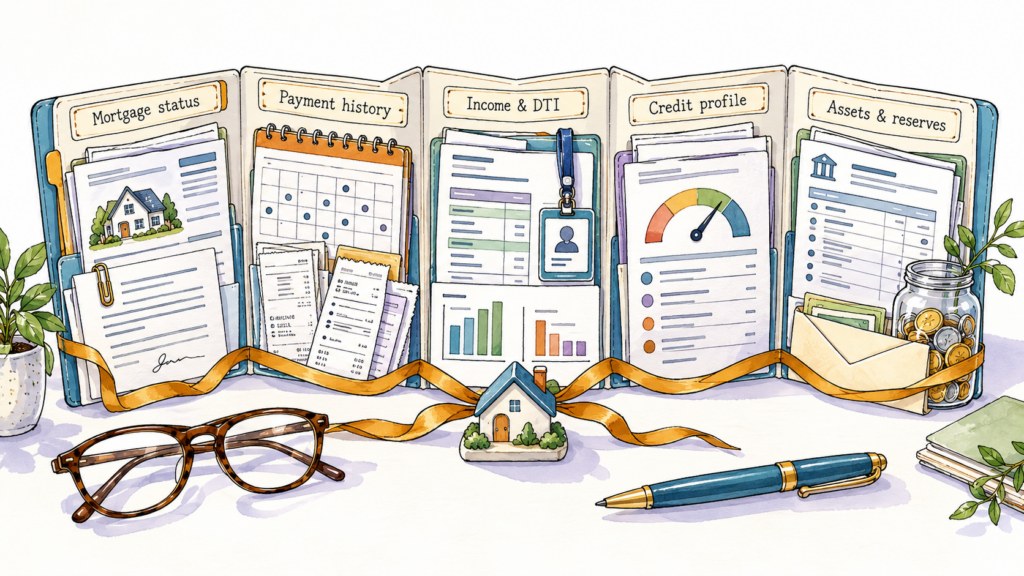
Lenders assess your present ability to repay and your acceptable recent housing payment history. Your prior forbearance is relevant, but it is never the only thing underwriting looks at.
Current Status of the Previous Mortgage
The status of your original loan is a key piece of this puzzle. A borrower whose forbearance has ended and whose mortgage is current under the agreed terms is in a genuinely different position than someone whose account remains delinquent, or who has not finished the required repayment arrangement. There is also a real difference between a borrower who followed an approved forbearance plan to the letter and one who missed payments outside that agreement entirely. Those two situations can be treated quite differently under the applicable underwriting rules.
Mortgage Payment History After Forbearance
Lenders typically review your payment history after your forbearance period ended, including whether you paid on time and whether you actually followed a repayment or modification agreement. There is no fixed number of consecutive payments that applies to every single borrower before any mortgage becomes possible. The required history depends on the loan program, the type of transaction, the specific circumstances of your forbearance, and current agency guidance, which is exactly why we dedicate a section below to pulling this apart in more detail.
Income, Employment, and Debt-to-Income Ratio
Your lender needs to confirm your income is sufficient and stable enough to support the mortgage you are proposing. You may have fully recovered from your original hardship, but the lender still has to assess your current income, your employment or self-employment documentation, your recurring debts, and your proposed housing payment, exactly as it would for anyone else. Debt-to-income ratio, or DTI, compares your qualifying monthly debt against your qualifying gross monthly income. A past forbearance does not replace this standard financial assessment in any way.
Credit Score and Overall Credit Profile
Your credit score and credit report can influence both your eligibility and your pricing, but the score alone never fully determines the outcome. Your lender also looks at the underlying payment history, any recent delinquencies, outstanding debts, and other credit factors relevant to your selected program. Forbearance does not automatically tank your credit score, and it does not automatically leave it untouched either. The actual reporting outcome depends on your payment status, the terms of your agreement, applicable reporting rules, and exactly how your servicer reported the account. Review your own credit reports, and ask your servicer or the credit reporting agencies about anything that looks inaccurate.
Assets, Down Payment, and Cash Reserves
If you are purchasing a new property, you will likely need to show sufficient funds for your down payment, closing costs, and any applicable reserve requirements, the same as any other buyer. You also need to account for the financial reality of your existing mortgage, including any deferred balance or active repayment arrangement still attached to it. Completing forbearance is just one part of the overall application. The new mortgage still has to clear every applicable underwriting requirement on its own merits.
Section 04
Is There a Waiting Period to Get a Mortgage After Forbearance?
There is no single waiting period that applies to every mortgage borrower after forbearance. Requirements depend on your loan program, whether you are buying or refinancing, how your previous mortgage is currently being handled, and the applicable underwriting guidance in effect at the time.
Why Waiting Periods Can Differ
Lenders generally distinguish between a new home purchase, a rate-and-term or no-cash-out refinance, a cash-out refinance, a streamline refinance of an existing government-backed mortgage under its own specific program, a loan that was modified after forbearance, and a borrower who kept making scheduled payments during forbearance versus one who missed payments under the approved arrangement. This is exactly why a blanket online claim like “you must wait 12 months after forbearance” can genuinely mislead borrowers once it gets applied outside its original, narrow context.
Here is a general pattern worth knowing, commonly reported for conventional loans following Fannie Mae and Freddie Mac guidance: if you resolved your missed payments through a full reinstatement, meaning you brought every missed payment current all at once, you can generally be immediately eligible for a new mortgage loan. If your missed payments were instead resolved through a repayment plan or a loan modification, you generally need to have made at least three timely payments as of the note date of your new loan, or to have completed the repayment plan outright, whichever comes first; for a modification specifically, this often means completing the three-month trial payment period. This is a common industry pattern, not a guaranteed rule for your specific lender or loan. Confirm the exact current standard with your loan officer before assuming it applies to you.
For FHA loans, HUD previously published guidance specifically addressing COVID-19 forbearance that drew a distinction between purchase and no-cash-out refinance transactions on one side, and cash-out refinances on the other, each with its own post-forbearance payment-history condition. That guidance was built for a specific historical period. Do not treat it as today’s universal FHA rule, and do not assume it automatically applies to conventional, VA, or USDA loans either. Verify the current version of FHA Handbook 4000.1 and any relevant Mortgagee Letters before relying on an exact payment count for your situation.
How to Find the Waiting Period That Applies to Your Loan
Ask your loan officer to identify your intended loan program, the exact transaction type, the relevant payment-history standard, and whether your existing loan needs to be fully current, or your forbearance plan formally terminated, before you can close on the new one. Get a clear, specific explanation of the requirement that actually applies to you, instead of relying on a generic waiting-period estimate pulled from somewhere else. If your previous loan was modified, or still carries an unresolved deferred balance, disclose that detail early rather than letting it surface partway through underwriting.
Section 05
Buying a House After Mortgage Forbearance
Can You Buy Another Home After Forbearance?
Often, yes. But the status and payment history of your previous mortgage will be part of the broader assessment. Your lender typically needs to confirm your original loan is being handled according to its agreement, and that you can genuinely afford the proposed new housing payment on top of whatever else you are carrying. This is not simply a question of whether enough time has passed. Your income, credit, assets, the proposed loan terms, and the obligations tied to your existing property all matter here too.
How the Existing Mortgage Affects the New Application
If you plan to keep your original property, your lender likely needs to factor its mortgage payment and related housing costs into your new application. If you plan to sell it instead, the timing of that sale and exactly how the existing loan will get paid off can affect the whole transaction. If you are considering buying another home while keeping your current mortgage, the Wonder Rates Mortgage Payment Calculator can help you estimate how a potential new housing payment may fit into the overall monthly picture. If a repayment plan, deferred amount, or modification is still in place, provide the actual agreement and your current payment information. Not every deferred amount automatically counts as a monthly debt the same way a regular payment would. Its exact treatment depends on the specific arrangement and the applicable underwriting rules.
What If the Forbearance Was Caused by a Temporary Hardship?
You might have stable employment and solid income today, even if the original hardship was genuinely serious. Your lender still needs to verify your current financial picture and evaluate your previous mortgage payment history under the relevant guidelines. If asked, prepare a concise, factual explanation of what happened and how you recovered. Supporting documentation can help your case, but a hardship letter by itself never overrides your program’s actual eligibility requirements.
Section 06
Refinancing a Mortgage After Forbearance
Rate-and-Term or No-Cash-Out Refinance
If you want to change your interest rate, your loan term, or other eligible terms without taking a significant amount of cash out, you may be subject to different requirements than someone doing a cash-out refinance. Your lender reviews your current mortgage, your payment history, the proposed refinance, and the applicable program rules together. If your existing loan was modified, the payment history under that modification can matter too. Do not assume a refinance is automatically available the moment forbearance ends. Confirm whether your loan needs to be current, whether a minimum payment history applies, and whether your current program actually permits the refinance you want.
Cash-Out Refinance After Forbearance
Cash-out refinances often carry their own distinct underwriting requirements, since you are pulling equity directly out of the property. Your lender may apply stricter, or simply different, payment-history standards than it would for a purchase or a no-cash-out refinance. Do not assume sufficient equity automatically overcomes a payment-history issue. Credit, income, equity, loan-to-value limits, and program-specific rules can all still affect your eligibility, regardless of how much equity you have built up.
FHA Streamline and Other Program-Specific Refinances
Streamline refinance options exist for eligible existing government-backed loans, and they carry their own specific requirements regarding your existing mortgage, your payment history, and any modification you have been through. Historical FHA guidance drew distinctions between streamline refinances, purchases, no-cash-out refinances, and cash-out transactions following certain forbearance arrangements. A streamline refinance is not a universal shortcut available to every borrower who has experienced forbearance. Eligibility depends on your existing loan and the specific program behind it, so verify the current handbook and applicable program guidance before assuming it fits your situation.
Section 07
Does Mortgage Forbearance Affect Your Credit Score?
Forbearance vs. Missed Payments
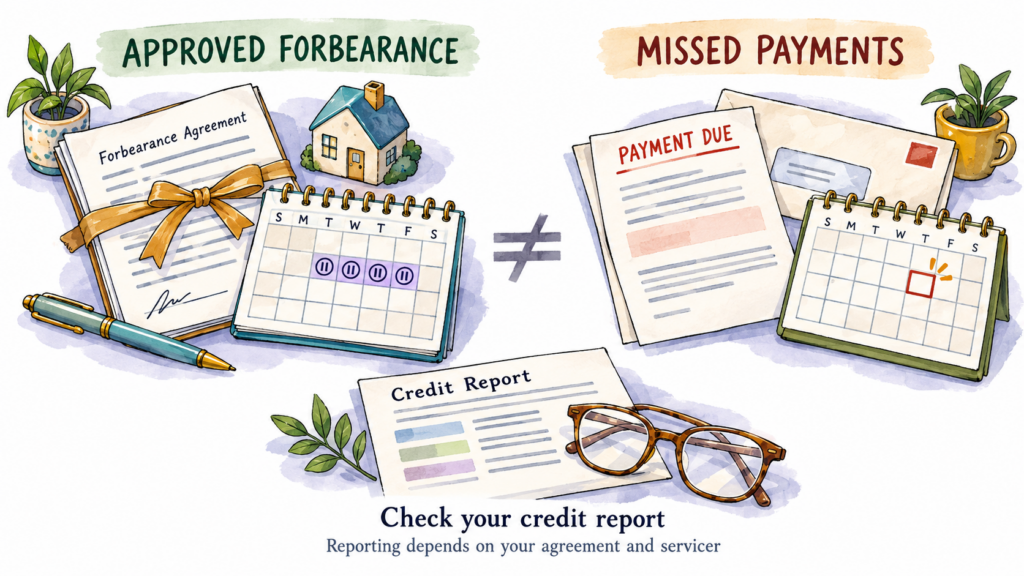
There is a meaningful difference between a payment that was paused or reduced under an approved forbearance agreement and a payment missed entirely outside that agreement. How your account’s status actually gets reported depends on your agreement, applicable reporting rules, and your servicer’s own reporting practices. Review your own credit reports rather than assuming your account was reported one way or the other just because you went through forbearance.
How to Review and Address Credit Report Errors
Pull your reports from the relevant credit reporting agencies, review your mortgage tradeline and payment history line by line, and compare anything that looks off against your actual forbearance agreement and payment records. If something genuinely looks inaccurate, contact your servicer and the credit reporting agency to dispute it. Correcting a real reporting error can help your file reflect the account accurately, but it never guarantees a specific credit score or a particular mortgage approval.
Will a Lower Credit Score Prevent Mortgage Approval?
A lower score can affect your eligibility, your pricing, or the range of programs available to you, but the actual outcome depends on your complete file, not the score in isolation. Do not assume a strong current score guarantees a smooth path, and do not assume a previous forbearance guarantees a difficult one either.
Section 08
Documents You May Need When Applying for a Mortgage After Forbearance
Forbearance and Repayment Records
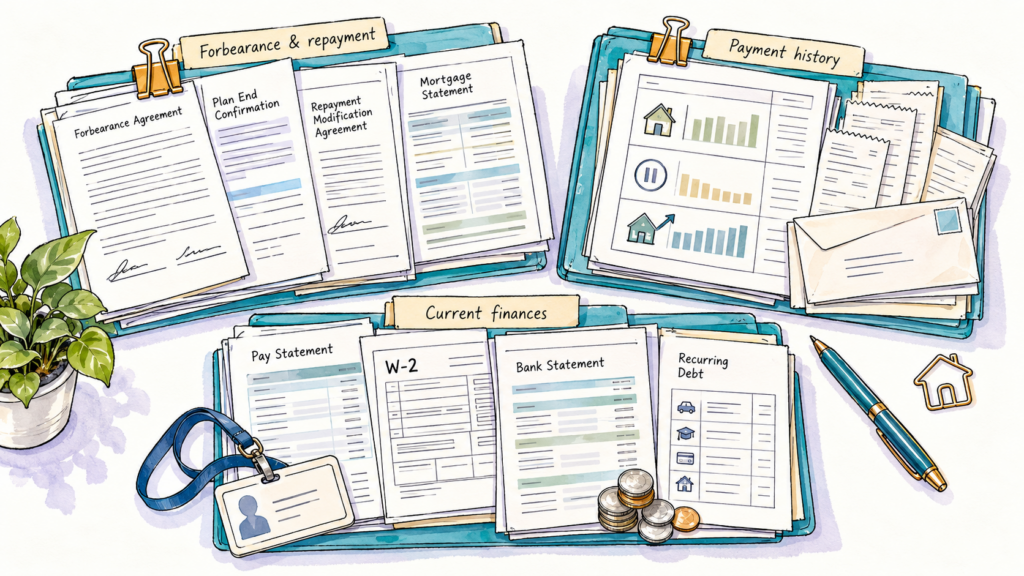
Your forbearance agreement itself. Confirmation that the plan has actually ended. Any repayment plan or modification agreement you entered into. And a current mortgage statement showing your account status and any remaining deferred amount. These records help your lender understand exactly how your existing mortgage is being handled right now.
Mortgage Payment History
Expect a request for a mortgage payment history, or some other form of verification of payments made before, during, and after your forbearance. The relevant time period and the exact documentation method depend on your program and underwriting requirements. Keep records of your payments and your communications with your servicer, especially if your account status or credit reporting ever looks unclear.
Income, Assets, and Current Debt
Standard mortgage documentation still applies on top of all of this. Expect to provide recent pay stubs, W-2s or tax returns as applicable, bank statements, information about your recurring debts, and whatever else your lender needs to assess your ability to repay the proposed loan. If your original hardship involved job loss, reduced hours, illness-related expenses, or a change in self-employment income, your lender likely needs to verify your current financial position directly. Not every borrower needs a special hardship documentation package. What gets requested depends on your actual circumstances.
Section 09
How to Improve Your Mortgage Readiness After Forbearance
Confirm the Existing Mortgage Is Properly Resolved
Contact your servicer to understand whether your loan is current under its agreed terms, whether a repayment plan or modification is still active, and whether any deferred balance remains outstanding. Request written confirmation, and keep it with your mortgage application documents. If anything looks inconsistent, ask your servicer to explain it before you apply for new financing.
Build a Consistent Payment History
Make every payment on time under your current mortgage agreement and any applicable repayment or modification arrangement. Consistent payment behavior genuinely helps demonstrate financial stability, though the exact history required for eligibility depends on your specific loan program. There is no single universal number of months that applies to everyone here.
Review Credit, Debt, and Cash Reserves
Review your credit reports for accuracy. Avoid taking on unnecessary new debt before applying. Assess honestly whether the proposed mortgage payment actually fits your current budget. If you are planning a purchase, also account for the down payment, closing costs, and any applicable reserve requirements. The goal is understanding your complete financial picture before you submit an application, not simply waiting out an assumed period and hoping for the best.
Speak with a Loan Officer Before Making Major Financial Decisions
Discuss your intended transaction early, especially if you want to refinance, buy another property while keeping your current home, or use a government-backed loan program. Your loan officer can identify the relevant underwriting requirements and flag any documentation gaps before they become last-minute problems. If you are still struggling with your existing mortgage, the priority may actually be discussing loss-mitigation options with your servicer, or seeking housing counseling, rather than applying for a brand-new loan right away.
Section 10
Common Mistakes to Avoid After Mortgage Forbearance
Assuming every borrower must wait 12 months. Waiting periods and payment-history requirements genuinely vary by program and transaction type. A rule published for one specific program or forbearance situation should never get applied automatically to every borrower.
Assuming forbearance erases the missed payments. Forbearance generally changes when or how the missed or reduced amounts get repaid. It does not automatically forgive them. Understand your repayment agreement and any remaining balance before assuming the slate is clean.
Applying before understanding the current mortgage status. Unresolved delinquency, an incomplete repayment plan, or unclear modification terms can all complicate a new application in ways you do not see coming. Confirm your current status and collect the relevant documents first.
Believing a strong credit score guarantees approval. Mortgage underwriting considers far more than a single credit score. Payment history, income, assets, DTI, property details, and loan-program requirements can all affect the final outcome.
Ignoring updated escrow or housing costs. Property taxes, homeowners insurance, HOA dues, and escrow adjustments can genuinely shift the real monthly cost of homeownership. CFPB guidance notes that escrow shortages can cause your payment to rise after forbearance, so confirm your actual current payment before evaluating what you can afford going forward.
Section 11
Practical Examples of Mortgage Requirements After Forbearance
Example 1: Buying a New Home After Returning to Regular Payments
A homeowner entered forbearance during a temporary income disruption. The forbearance has ended, the homeowner has resumed payments under the agreed terms, and income has since stabilized. This homeowner now wants to purchase a different primary residence. The lender reviews the status of the existing mortgage, the payment history, income, debts, assets, and the proposed new housing payment. The successful return to regular payments is genuinely relevant here, but the lender still needs to confirm the new transaction meets the applicable program requirements on its own terms.
This is a hypothetical scenario for educational purposes only. Eligibility to purchase a home after forbearance depends on the applicable loan program, current underwriting guidelines, mortgage payment history, financial circumstances, and lender requirements. This example does not guarantee mortgage approval or establish a universal waiting period.
Example 2: Refinancing After a Loan Modification
A borrower completed forbearance, then entered a loan modification because the original payment was no longer affordable. This borrower has been making payments under the modified terms and now wants to refinance. The new lender reviews the modification agreement, the payment history under the modified loan, the current mortgage status, and the requirements for the proposed refinance. This borrower may need to clear a program-specific payment-history standard before the refinance becomes eligible at all.
This is a hypothetical scenario for educational purposes only. Refinance eligibility after forbearance and loan modification depends on the existing mortgage, the proposed refinance type, current agency guidelines, payment history, and lender requirements. The example does not guarantee eligibility or a specific timeline.
Example 3: A Borrower Wants a Cash-Out Refinance Soon After Forbearance
A homeowner has substantial equity and wants a cash-out refinance to pay off other debts. This homeowner recently completed forbearance and assumes the available equity should make approval straightforward. The lender evaluates the cash-out refinance under its applicable rules, including this borrower’s mortgage payment history, current loan status, credit, income, equity, and the rest of its usual underwriting factors. The amount of equity alone never resolves every eligibility question by itself.
This is a hypothetical scenario for educational purposes only. Cash-out refinance requirements vary by loan program, current underwriting guidelines, property and equity factors, payment history, and lender policies. This example does not guarantee refinance approval or establish a universal post-forbearance waiting period.
Example 4: A Borrower’s Credit Report Shows a Payment as Late
A borrower completed an approved forbearance arrangement, but later notices the mortgage account appears to show a late payment during that exact period. Before applying for another mortgage, this borrower gathers the forbearance agreement and payment records, contacts the servicer, and reviews the credit report closely. The lender may need to evaluate the payment history using the applicable program’s rules alongside the documented account status. If a genuine reporting error turns up, the borrower can dispute the inaccurate information through the appropriate channels.
This is a hypothetical scenario for educational purposes only. Credit reporting, dispute outcomes, and mortgage underwriting treatment depend on the applicable reporting rules, account records, loan program, and lender requirements. A dispute does not guarantee that information will be changed or that a future mortgage will be approved.
Section 12
Final Takeaways: Mortgage Requirements After Forbearance
Mortgage forbearance does not automatically prevent you from qualifying for another mortgage. The status of your original mortgage, and your payment history after forbearance, are genuinely important considerations. There is no universal waiting period that applies to every program and every transaction type. Purchase loans, no-cash-out refinances, cash-out refinances, and specialized refinance programs can all carry different requirements from one another. Understand any repayment plan, deferral, or loan modification you are working under, and keep your supporting documentation organized. Income, credit, debt-to-income ratio, assets, and the proposed mortgage still need to meet the same applicable underwriting standards any other borrower would face.
If you have completed forbearance and are thinking about buying a home or refinancing, gather your mortgage records and ask a loan officer to review the exact requirements for your specific transaction, rather than making assumptions about eligibility based on something you read online that was written for a different borrower entirely.
Section 13
Sources
- Consumer Financial Protection Bureau, What Is Mortgage Forbearance?
- Consumer Financial Protection Bureau, Exit Your Forbearance Carefully
- Consumer Financial Protection Bureau, How to Work with Your Mortgage Servicer
- Fannie Mae Servicing Guide, D2-3.2-01, Forbearance Plan
- Fannie Mae Servicing Guide, D2-3.2-02, Repayment Plan
- HUD Single Family Housing Policy Handbook 4000.1
This article also touches on mortgage requirements after a credit score drop when discussing credit reporting, and cash reserve requirements for a mortgage when discussing buying another home.
Duc Pham, Mortgage Broker | NMLS# 844897, Wonder Rates, Inc. | NMLS# 1518655 | DRE# 02047445 | DFPI# 60DBO-59134 | Equal Housing Opportunity. Equal Housing Lender. | Licensed in: AL, AZ, CA, CO, FL, GA, LA, MI, NC, OH, OK, OR, PA, SC, TX, VA, WA.



