

Section 01
Someone has stable employment, enough saved for a down payment, and a reasonably solid credit profile. Then they discover that unpaid taxes turned into a lien somewhere along the way. Now they are stuck wondering: can I still buy a home, or does this tax debt have to get resolved first?
Here are three things worth knowing before anything else. A tax lien is not just another monthly debt sitting on a credit report. It can create an actual legal claim against property, which can complicate your lender’s ability to secure the required lien position on the home you want to finance. Owing a tax balance, being on an IRS installment agreement, and having a recorded tax lien are three genuinely different situations, and the distinction can change everything about how underwriting treats your file. And your actual mortgage approval depends on the specific loan program you are using, the lien’s current legal status, whether you can document a resolution, and your individual lender’s requirements. This guide walks through how tax liens affect mortgage eligibility, when a full payoff gets required, how repayment agreements actually get evaluated, and exactly what to prepare before you apply.
Disclaimer: This article is provided for general informational and educational purposes only and does not constitute financial, mortgage, tax, legal, or credit advice. Mortgage eligibility and underwriting requirements vary by loan program, investor guidelines, lender policies, state law, lien status, and individual borrower circumstances. Information about federal, state, and local tax liens, IRS installment agreements, payoff requirements, lien releases, withdrawals, discharges, and subordinations should be verified with the appropriate taxing authority, qualified tax or legal professional, mortgage lender, and title company. Program guidelines may change, and the examples in this article are hypothetical and do not guarantee mortgage approval or any particular underwriting outcome. Readers should verify current requirements before making financial decisions or entering into a real estate transaction.
Section 02
What Is an Outstanding Tax Lien?
How a Tax Lien Arises
A federal tax lien can show up after the IRS assesses a tax liability, sends you a notice and demand for payment, and you do not pay the full amount within the required period. At that point, the IRS can file a public Notice of Federal Tax Lien, which tells every other creditor out there that the government holds a legal claim against your property. Here is a distinction worth catching right away: owing taxes and having a public lien filed are related events, but they are not the same thing. Do not assume an unpaid balance automatically means a Notice of Federal Tax Lien has actually been recorded somewhere.
Federal, State, and Local Tax Liens
A federal tax lien stems from unpaid federal tax obligations, typically tied to the IRS. A state tax lien stems from unpaid state taxes, governed by that specific state’s own laws and procedures. A local tax lien is tied to qualifying unpaid local taxes, depending on the jurisdiction and the type of tax involved. The agency behind the lien, the applicable law, the recording status, and the lien’s priority can all change exactly how the issue needs to get resolved before closing. Not every state uses the same procedures, and not every tax lien attaches to property in the exact same way.
Outstanding Tax Debt Versus a Recorded Tax Lien
This is the single most important distinction in this entire guide. You might owe taxes without any recorded lien at all. You might have a recorded lien while actively making payments on it. Or you might have already paid the balance in full but still need documentation confirming the lien’s current status. For mortgage underwriting, these are not interchangeable situations. Your lender needs to pin down the actual amount owed, whether a lien has genuinely been filed, what the repayment terms actually look like, and whether that lien creates a real problem for the mortgage’s required lien position on the property.
Section 03
How an Outstanding Tax Lien Affects Mortgage Approval
It Can Affect the Lender’s Ability to Establish the Required Lien Position
Mortgage lenders generally need their new mortgage to hold the required priority against the property being financed. A tax lien can genuinely complicate that, depending on its legal status, its priority, and the specific loan program’s rules. Paying off a debt, obtaining a release, and obtaining a subordination are three different legal outcomes with three different effects. Your lender and the title company may need to figure out exactly which action your specific transaction actually requires.
It Can Affect Debt-to-Income Ratio and Affordability
A tax repayment agreement can create an ongoing monthly obligation. When the applicable guidelines require that payment to be counted in your debt-to-income ratio, or DTI, it reduces how much monthly debt capacity you actually have left for a mortgage payment. DTI is only one piece of this review though. Your lender also looks at income stability, assets, credit history, reserves, and your overall risk profile together.
It Can Lead to Additional Documentation and Closing Conditions
Expect requests for a current tax balance or payoff statement. A copy of your repayment agreement. Evidence of your payment history under that agreement. Proof of payoff, release, or another resolution, where applicable. And whatever else underwriting or the title company needs to see. Treat this as a general preparation list, not a universal checklist. The exact requirements depend on your specific facts and loan program.
It May Affect the Timeline to Close
An unresolved lien can genuinely delay underwriting or closing if everyone involved needs to obtain a payoff quote, confirm the lien’s status, secure a required agreement, or establish that title requirements have actually been satisfied. The real takeaway here: identify this issue early, long before your closing date starts bearing down on you.
Section 04
Mortgage Requirements With an Outstanding Tax Lien by Loan Type
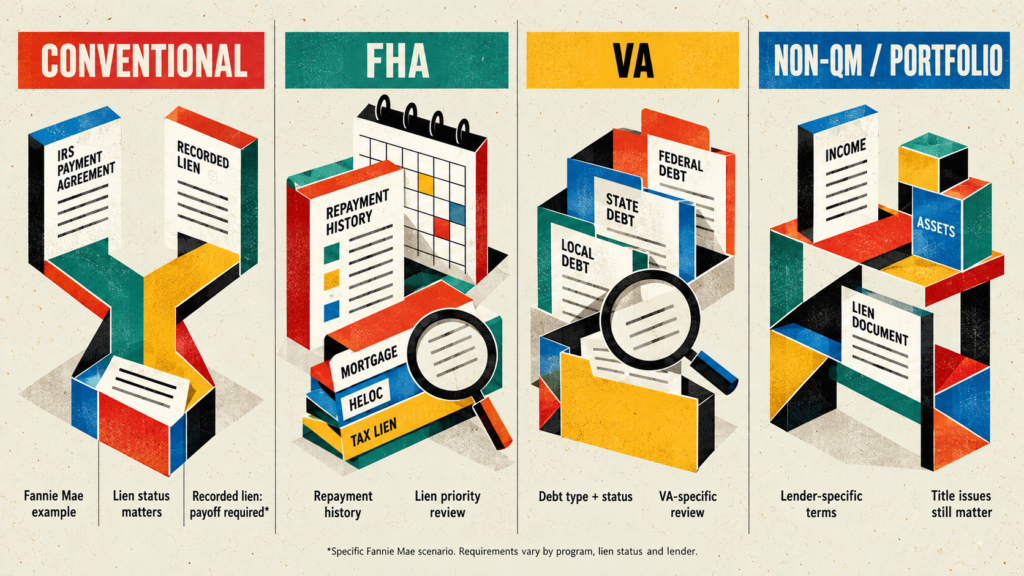
Conventional Mortgage Requirements
Under Fannie Mae’s Selling Guide, delinquent credit, including delinquent taxes and tax liens, generally must be paid off at or before closing. That said, Fannie Mae carves out a specific exception for delinquent federal income taxes being paid through an IRS installment agreement. If there is no indication that a Notice of Federal Tax Lien has been filed in the county where the subject property is located, Fannie Mae permits the documented monthly installment payment to be included in DTI rather than requiring full payoff, subject to its requirements. For an approved IRS agreement, obtain the agreement terms and evidence the borrower is current. For an agreement pending approval, obtain the application showing the proposed monthly payment and total amount due.
Here is the detail that changes everything: if there is any indication that a Notice of Federal Tax Lien has actually been recorded in that county, the federal income tax balance must be paid in full at or before closing, regardless of whether you have an active installment agreement. The presence of a recorded lien overrides the payment-plan exception entirely.
Whether your loan is sold to Fannie Mae specifically, or follows a different investor’s requirements, matters here too. Do not generalize this particular Fannie Mae rule to every conventional mortgage out there. Freddie Mac’s requirements, non-agency loans, individual lender overlays, and the specific facts of your transaction can all differ. Confirm the current official guidelines before assuming this rule applies exactly as written to your situation.
FHA Loan Requirements
FHA runs on its own policy framework under HUD’s Single Family Housing Policy Handbook 4000.1. That handbook’s published provisions address circumstances where certain tax liens can remain unpaid under a valid repayment agreement, as long as you have made timely payments for at least three months of scheduled payments, along with additional lien-subordination requirements on top of that. Federal tax liens specifically get treated under separate federal-debt provisions, so this deserves careful attention from your loan officer.
Key questions worth asking: is your tax debt covered by a genuinely valid repayment agreement? Have you made the required scheduled payments on time? Does the applicable FHA rule require the lien to be subordinated to the new mortgage? Can your lender actually obtain the necessary IRS or other taxing-authority documentation? Are there additional requirements layered on by your specific lender? Do not assume three months of payment history automatically makes every federal tax lien acceptable under FHA. Confirm the current handbook provisions and your lender’s own interpretation directly.
VA Loan Requirements
VA borrowers get evaluated under VA’s own credit underwriting and federal-debt requirements, not simply whatever conventional or FHA rules happen to say. VA guidance addresses delinquent federal debts and judgment liens, including the need to resolve the delinquency or establish a satisfactory arrangement under the relevant circumstances. A tax lien should be reviewed according to its exact nature and the current applicable VA guidance for your situation.
In practice, that means identifying whether the debt is federal, state, or local. Confirming whether it resulted in a recorded lien or a judgment. Determining what evidence of resolution or repayment your lender will actually accept. And having your lender review your eligibility along with any additional documentation requirements. It is commonly reported in the mortgage industry that VA and USDA loans generally require either a full payoff or an established repayment plan with at least three months of history, similar to FHA’s standard. This figure is widely reported but not something this article is quoting directly from VA’s own handbook text, so confirm the exact current requirement with a VA-approved lender rather than treating this as gospel. Never assume every VA loan treats a tax lien identically.
Non-QM and Portfolio Mortgage Options
Some lenders offer non-QM or portfolio products with underwriting frameworks that differ from standard agency loans. Alternative underwriting does not eliminate the legal implications of a tax lien, though, and it does not automatically resolve a title-priority issue either. Lenders here typically weigh your documented income, available assets, equity or down payment, debt obligations, the lien’s status, your repayment history, and the proposed resolution, much like any other loan. Compare total costs and conditions carefully. Never assume a non-QM option is automatically available to you, or automatically more affordable than a standard loan.
| Loan type | What matters most |
|---|---|
| Conventional | Investor-specific rules, payoff requirements, and treatment of recorded federal tax liens |
| FHA | Repayment-agreement conditions, payment history, and applicable subordination rules |
| VA | Federal-debt review and confirming the treatment of your specific lien |
| Non-QM / portfolio | Lender-specific underwriting, with lien and title issues still needing resolution |
Section 05
Can You Get a Mortgage While Paying Off an IRS Tax Debt?
When an IRS Installment Agreement May Be Considered
An IRS installment agreement is evidence of a formal repayment arrangement, but it is not a universal approval mechanism on its own. Under Fannie Mae’s guidance, when there is no indication a Notice of Federal Tax Lien has been filed in the subject property’s county, your lender must obtain the relevant installment agreement and evidence that you are current on payments. If the tax balance is not being paid off in full, the monthly installment amount generally has to be included in your monthly debt obligations. The absence of a recorded federal tax lien is the detail that makes this whole exception possible.
What if the IRS Payment Plan Is Pending Approval?
There is a real difference between a formally approved agreement and an application that is still sitting in the pending queue. Under Fannie Mae’s rules, a pending agreement still requires documentation of the proposed repayment terms, including the monthly payment amount and total amount owed. Every other condition in the applicable guidance still applies on top of that, and an outstanding recorded tax lien can still trigger entirely different requirements. Never treat a pending application as the equivalent of an approved agreement.
How the Monthly Payment May Affect Mortgage Qualification
When your tax payment has to be included in DTI, it can reduce how much mortgage debt you actually qualify for. Here is the basic formula: DTI equals monthly debt obligations divided by gross monthly income, multiplied by 100 percent. If you want to estimate how your own monthly debts compare with your qualifying income, the Wonder Rates DTI Calculator can help you get a starting point before speaking with a lender. This is a simplified explanation. Lenders calculate DTI under the applicable program’s own rules, and qualifying income or obligations are not always identical to what shows up in your own personal budget.
Why Payment History and Documentation Matter
Your lender needs real evidence that the repayment arrangement is genuine, current, and consistent with the applicable guidelines. Be ready to show the agreement’s actual terms, your current balance, and your recent payment history. A payment plan can genuinely help your mortgage qualification, but it never overrides a program rule that requires a lien or a debt to be paid off outright.
Section 06
Do You Have to Pay Off a Tax Lien Before Buying a House?
When Full Payoff May Be Required
Full payoff can be required under the applicable mortgage guidelines, particularly when the lien or delinquent tax debt conflicts with the loan’s eligibility or title requirements. Fannie Mae’s rule on delinquent taxes and recorded Notices of Federal Tax Lien, described above, is one concrete example of this, though not every lender follows identical rules. There is a real difference between paying the balance before you apply, paying it before closing, arranging an approved payoff as part of the closing itself where that is permitted, and resolving the lien through some other legally acceptable alternative. These paths are not interchangeable. Confirm the exact timing with your lender before you commit any funds to a payoff.
When a Lien May Be Handled Through Another Approved Resolution
Four terms get used here, and they mean genuinely different things. A release means the taxing authority confirms the lien has been released under its applicable process. The IRS notes that paying a tax debt in full is the clearest path to this, and it generally releases a federal lien within 30 days after the debt is paid in full. A withdrawal, in the federal context, removes the public Notice of Federal Tax Lien itself, but it does not, by itself, mean the underlying tax debt has disappeared. A discharge removes the lien from one specific property under the relevant legal process, while the lien can still apply elsewhere. A subordination lets another creditor, like your new mortgage lender, move ahead of the IRS in priority under an approved arrangement, without necessarily removing the tax lien at all. The IRS treats these as genuinely different tools with different effects and different eligibility requirements, so do not assume any one of them automatically accomplishes what another one does.
Why Borrowers Should Not Use Their Down Payment Funds Without a Plan
Paying off a large tax balance could eat into the money you actually need for your down payment, closing costs, and reserves. On the flip side, holding onto that cash is not enough if the mortgage guidelines actually require a payoff before you can close. Coordinate your tax resolution strategy with your mortgage lender, and bring in a qualified tax professional or attorney where it is genuinely needed, before you move any money around.
Section 07
Documents Needed to Apply for a Mortgage With an Outstanding Tax Lien
Tax Debt and Lien Documentation
Your most recent tax balance or payoff statement. A copy of the IRS or state taxing authority’s correspondence. A copy of the recorded lien, or available public-record information about it. Documents confirming the lien’s current status. Proof of payoff, release, withdrawal, discharge, or subordination, if any of those apply to your situation. Your lender or the title company may need to verify this information directly, or pull additional records of their own on top of what you provide.
Repayment Agreement and Payment History
If you are on a repayment plan, have the agreement itself ready, along with its monthly amount, the total outstanding balance, and evidence of your current payments. For an IRS installment agreement specifically, Fannie Mae’s guidance identifies the agreement’s terms and evidence of current payments as the key items your lender actually needs to see.
Standard Mortgage Qualification Documents
Identification, income and employment records, bank statements, documentation of your down payment funds, information on existing debt, and whatever tax returns or transcripts your lender requires. If you want a closer look at how lenders verify funds being used for a mortgage, see our guide to Proof of Down Payment. A tax lien does not replace the normal mortgage review process. You still have to clear the usual income, asset, credit, property, and underwriting requirements on top of resolving the tax issue.
Why Complete Documentation Can Reduce Delays
Inconsistent balances, missing payment records, an unclear lien status, or a recently paid debt with no updated confirmation attached can all trigger follow-up requests that slow everything down. Gather your documents early, and give your lender an accurate account of your actual situation from the start. A complete package does not guarantee approval or a faster closing on its own, but it genuinely removes some of the avoidable friction.
Section 08
Example Scenarios: How an Outstanding Tax Lien Can Affect Mortgage Eligibility
Example 1: A Borrower Owes Federal Taxes but Has No Recorded Notice of Federal Tax Lien

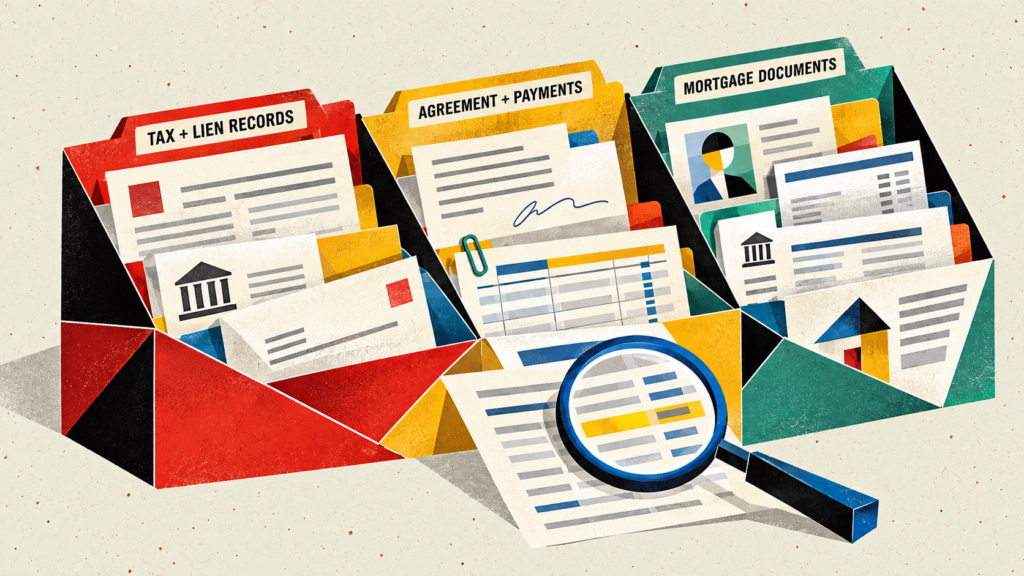

A borrower with stable income owes federal income taxes and has entered an IRS installment agreement. The lender requests the agreement and proof of current payments, then evaluates the monthly payment under the applicable loan guidelines. The absence of a recorded Notice of Federal Tax Lien can genuinely change how the lender treats this debt under certain conventional guidelines, but approval still hinges on every other applicable requirement being met too.
This is a hypothetical illustration for educational purposes only. It does not guarantee mortgage eligibility or approval. The treatment of an IRS installment agreement depends on the applicable loan program, the lien’s status, current underwriting guidelines, lender requirements, and the borrower’s complete financial profile.
Example 2: A Borrower Has a Recorded Federal Tax Lien
A borrower has sufficient income and a down payment ready, but discovers a recorded Notice of Federal Tax Lien during the process. Under the Fannie Mae guidance described above, delinquent federal income taxes under an IRS installment agreement must be paid in full at or before closing if there is any indication the notice has been recorded in the county where the subject property sits. The lender must confirm these facts and the applicable requirements before advising this borrower on next steps.
This example illustrates a specific Fannie Mae guideline and is not a universal rule for all mortgage products. Other investor, government-program, legal, and lender requirements may differ. Borrowers should obtain a review of their actual lien records and loan eligibility before making financial decisions.
Example 3: A Borrower Has a State Tax Lien and an Established Repayment Plan
A borrower owes state taxes and has made regular payments under a formal agreement for months. The lender evaluates the lien’s status, the applicable program’s rules, and whether payoff, subordination, or another resolution is actually required here. A repayment plan alone does not establish that the lien can simply remain in place during this mortgage transaction. State laws and program guidelines can both affect the ultimate outcome.
This is a hypothetical scenario, not legal, tax, or mortgage advice. State tax-lien procedures and mortgage underwriting requirements vary. The outcome depends on the relevant jurisdiction, lien documentation, loan program, and lender’s review.
Section 09
Steps to Take Before Applying for a Mortgage With a Tax Lien
Step 1, confirm the exact tax balance and lien status. Ask the relevant taxing authority for updated information. Determine whether the debt is unpaid, whether a lien has actually been recorded, and whether any prior resolution has been formally documented anywhere.
Step 2, identify the mortgage program before choosing a resolution strategy. The exact same tax situation can be treated completely differently under different mortgage programs. Never assume a solution that works under one set of guidelines will automatically work for another.
Step 3, discuss payoff and repayment options with the right professionals. Work with your lender to understand the mortgage requirements involved. Bring in a qualified tax professional or attorney when you need advice about an IRS or state tax resolution, legal lien priority, or the real consequences of paying off or restructuring the debt.
Step 4, recalculate your homebuying budget. Evaluate what funds remain after any proposed tax payoff, alongside your down payment, closing costs, reserves, and ongoing housing expenses. If a repayment agreement stays in place, determine whether its monthly payment has to be included in your DTI. If you want to understand how lenders may evaluate the money you have available after closing, see our guide to Mortgage Cash Reserves.
Step 5, collect written evidence of the resolution. Never rely solely on verbal confirmation that a debt has been paid or a lien has been addressed. Get the actual written confirmation, and give your lender and title company time to verify it properly.
Early disclosure and solid documentation give your lender a real shot at spotting obstacles before you are already under contract on a home.
Section 10
Common Mistakes to Avoid When Applying for a Mortgage With a Tax Lien
Assuming an IRS payment plan automatically satisfies mortgage requirements. A repayment arrangement and lien resolution are two separate questions entirely. A plan might help document the debt and its monthly obligation, but a recorded lien can still trigger a full payoff requirement under the applicable rules regardless of the payment plan.
Assuming paying the tax balance automatically removes every lien issue. Payment and the formal release or withdrawal of a recorded notice are two different steps. You may still need documentation showing the lien’s actual current status after you have paid. The IRS maintains entirely separate procedures for releases, withdrawals, discharges, and subordination, and they are not interchangeable actions.
Waiting until underwriting or closing to disclose the lien. Late discovery tends to create documentation requests, payoff timing issues, and title complications you could have avoided. Disclose early rather than hoping it slips by unnoticed.
Using all available cash to pay the tax debt without reviewing the full mortgage budget. A payoff might resolve one issue while leaving you short on funds for closing or reserves. The right approach depends on your specific mortgage program’s rules and your overall financial position.
Relying on generic online advice instead of the current loan guidelines. Mortgage requirements change and vary by program constantly. Verify the current agency guidance and your specific lender’s conditions, rather than trusting another borrower’s secondhand experience.
Section 11
Final Checklist: Getting Mortgage-Ready With an Outstanding Tax Lien
Confirm the type of tax debt and whether a lien has actually been recorded. Obtain the current balance and relevant lien documentation. Gather any IRS or state repayment agreement along with proof of payments. Ask your lender which loan programs might actually fit your circumstances. Confirm whether payoff, subordination, or another documented resolution is required for your situation. Review how any remaining monthly tax payment affects your DTI. Recalculate the funds available for your down payment, closing costs, and reserves. Get written evidence of any completed resolution before you count on it.
An outstanding tax lien is a situation to investigate and resolve carefully, never a reason to assume either automatic approval or automatic rejection. The most useful first step is simply establishing the exact lien status and reviewing it against the requirements of the mortgage program you actually intend to use.
Section 12
Sources
- Internal Revenue Service, Understanding a Federal Tax Lien
- Fannie Mae Selling Guide, B3-6-07, Debts Paid Off At or Prior to Closing
- Fannie Mae Selling Guide, B3-6-05, Monthly Debt Obligations
- HUD Single Family Housing Policy Handbook 4000.1
- U.S. Department of Veterans Affairs, VA Lenders Handbook
This article also touches on cash reserve requirements for a mortgage when discussing funds remaining after a tax payoff, and proof of down payment requirements when discussing documentation for funds used at closing.
Duc Pham, Mortgage Broker | NMLS# 844897, Wonder Rates, Inc. | NMLS# 1518655 | DRE# 02047445 | DFPI# 60DBO-59134 | Equal Housing Opportunity. Equal Housing Lender. | Licensed in: AL, AZ, CA, CO, FL, GA, LA, MI, NC, OH, OK, OR, PA, SC, TX, VA, WA.



