
Section 01
A mortgage loan is a loan used to buy or refinance real estate, where the property generally serves as security for the debt. You, the borrower, agree to repay the loan under set terms. Those terms include the loan amount, the interest rate, the length of the loan, and the payment schedule. If you do not keep up with the loan, the lender may have legal rights against the property, based on the laws that apply.
Still, a mortgage is not just “borrowing money to buy a house.” It has many parts, and each one affects what you can afford, what you pay each month, and what the loan costs over time. So before you compare loans, it helps to understand principal, interest, loan term, down payment, closing costs, taxes, insurance, and mortgage insurance. A mortgage is more than a loan for a house. It is a long-term promise.
In this guide, you will learn what a mortgage is and how it works. You will also see what lenders look at, the most common loan types, what goes into your monthly payment, and what to weigh before you choose a loan.
Section 02
What Is a Mortgage Loan?
Mortgage Loan Definition
Here is how a mortgage loan works in simple terms. A lender gives you money to buy or refinance a home. The home is used as security for the loan. You then pay the money back over time, under the terms you agreed to. Until the loan is paid off, the lender has a legal claim on the property, called a lien or security interest.
What Is a Mortgage?
In everyday talk, people use “mortgage” to mean the home loan itself. In legal terms, though, the mortgage can also mean the document that pledges the home as security for the loan. In some states, that document is called a deed of trust instead. The details vary by state, but the basic idea is the same.
What Is the Difference Between a Mortgage and a Home Loan?
Most people use these two terms to mean the same thing. “Home loan” is the broader, everyday phrase. “Mortgage loan” puts the focus on the fact that the loan is secured by real estate. For most buyers, the difference does not matter much in practice.
Section 03
How Does a Mortgage Loan Work?
The Borrower Gets a Loan to Buy or Refinance a Property
Most mortgages fall into two groups. A purchase mortgage helps you buy a home. A refinance replaces a loan you already have with a new one, often to change the rate, the term, or the amount you owe.
The Property Secures the Loan
The home is the collateral, which means it backs up the loan. If you stop making payments and do not work out a solution, the lender may be able to take the home through foreclosure, following the laws that apply. That is why a mortgage is a serious commitment.
The Borrower Repays the Loan Over Time
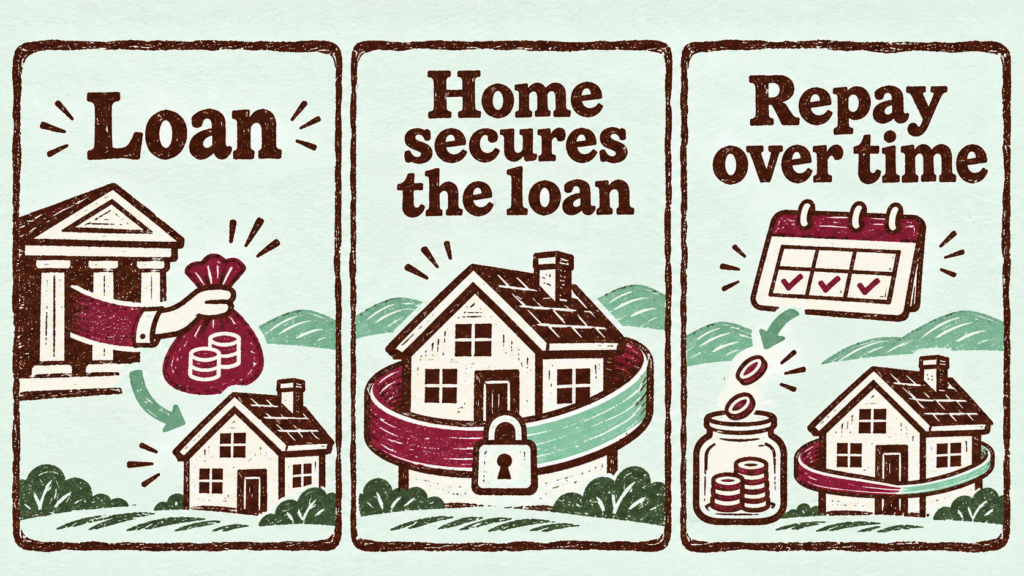
You pay back the loan with regular payments, usually once a month. Each payment covers interest and lowers your principal, which is what you still owe. Over time, your balance goes down until the loan is paid off. This process of paying down a loan on a set schedule is called mortgage amortization.
Section 04
What Are the Main Parts of a Mortgage Loan?
Principal
Principal is the amount you borrow. Your remaining principal is the part you have not paid back yet.
Interest
Interest is the cost of borrowing money. It helps to know the difference between two related terms. The interest rate is the percentage the lender charges. The interest amount is the actual dollars you pay, which depends on your rate and your balance.
Loan Term
The loan term is how long you have to repay the loan. Common mortgage terms are 15 and 30 years. A longer term usually means a lower monthly payment but more total interest.
Interest Rate
Your rate directly affects your interest cost and your monthly principal and interest payment. Even a small change in the rate can make a real difference over many years.
Down Payment
The down payment is the money you pay upfront toward the home’s price. It is not part of the mortgage loan. Instead, it is your own money that reduces how much you need to borrow.
Mortgage Insurance
Some loans require mortgage insurance. Whether you pay it depends on the loan type, your down payment, and other factors. It usually protects the lender, not you.
Taxes and Insurance
Property taxes and homeowners insurance are often part of your total monthly housing payment. But they are not part of the loan balance itself. They are separate costs that come with owning a home.
Section 05
What Is Included in a Mortgage Payment?
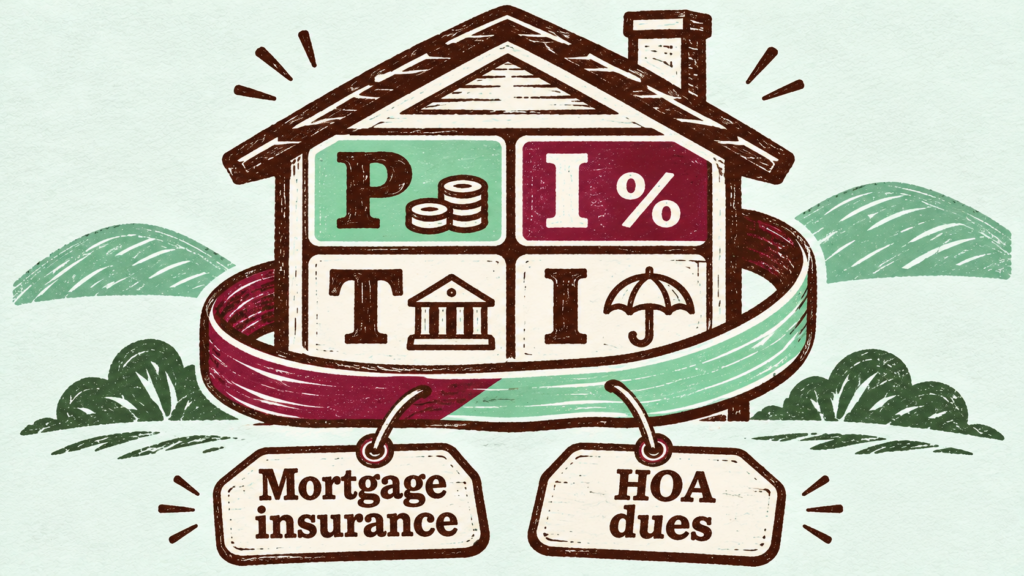
Your mortgage payment is not just principal and interest. Here is what it can include.
Principal and Interest
These are the two core parts of a standard mortgage payment. Principal lowers your balance, and interest pays the cost of borrowing.
Property Taxes
Many lenders collect property taxes as part of your monthly payment and hold the money in an escrow account. Then they pay your tax bill for you when it is due.
Homeowners Insurance
Homeowners insurance can also be collected through escrow and paid on your behalf.
Mortgage Insurance
If your loan requires mortgage insurance, the monthly premium is often part of your payment.
HOA Dues
HOA dues are usually not part of your mortgage payment. The Consumer Financial Protection Bureau (CFPB) explains that they are usually paid directly to the homeowners association, not to your mortgage servicer. Still, they are a real monthly cost, so include them in your budget.
What Is PITI?
PITI is a handy way to remember the main parts of a mortgage payment:
- P = Principal
- I = Interest
- T = Taxes
- I = Insurance
When mortgage insurance or HOA dues apply, they add to that total.
Section 06
How Is a Mortgage Loan Calculated?
Loan Amount
The loan amount is often the purchase price minus your down payment. In some cases, certain costs may be added to the loan, so the final amount can differ.
Interest Rate
All else equal, a higher rate means a higher interest cost and a higher monthly principal and interest payment.
Loan Term
The length of the loan changes the payment too. A 15-year loan has a higher monthly payment than a 30-year loan for the same amount, but much less total interest.
Amortization
Each payment is split between principal and interest based on an amortization schedule. Early on, more of each payment goes to interest, because interest is charged on a larger balance. Later, more goes to principal.
Other Housing Costs
Taxes, insurance, mortgage insurance, and HOA dues can make your real monthly housing cost much higher than the principal and interest alone.
Section 07
Mortgage Loan Example
Let’s walk through a simple example.
Hypothetical Home Purchase
- Purchase price: $400,000
- Down payment: 20%, or $80,000
- Loan amount: $320,000
- Interest rate: 6.50% fixed
- Term: 30 years
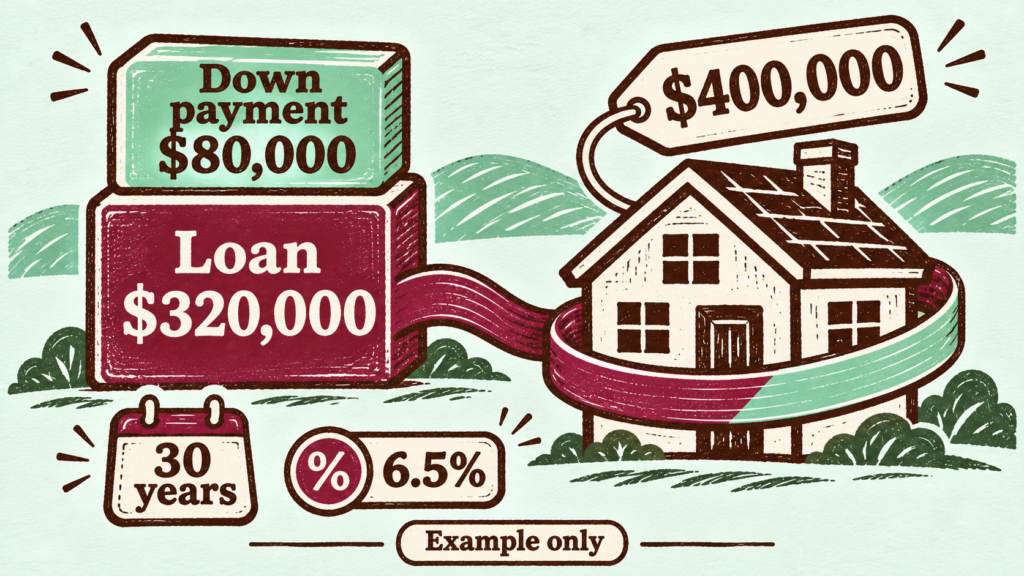
With these numbers, the monthly principal and interest payment would be about $2,022.62. In the first payment, about $1,733.33 would go to interest and about $289.28 to principal. If the loan were kept for the full 30 years with no extra payments, the total interest would come to about $408,142.
Here is how the pieces fit. The $80,000 down payment is your own money. The $320,000 is the mortgage principal. The monthly payment comes from the loan amount, the rate, and the term. Taxes, insurance, and HOA dues are separate from this basic calculation.
What This Example Does Not Include
This example leaves out several costs:
- Property taxes
- Homeowners insurance
- HOA dues
- Closing costs
- Mortgage insurance
- Lender fees
Disclaimer: This scenario is hypothetical and provided for educational purposes only. The purchase price, down payment, loan amount, interest rate, payment amount, and other figures are illustrative and do not represent a mortgage quote, offer, commitment to lend, or guarantee of actual loan terms. Actual mortgage payments and costs vary based on borrower qualifications, property characteristics, loan program, lender pricing, taxes, insurance, fees, and other factors.
Section 08
What Does a Mortgage Lender Look at Before Approving a Loan?
Credit
Lenders review your credit history to see how you have handled debt. They look at your credit score, your payment history, and other parts of your credit report.
Income
Lenders need to see that you have enough steady income to make your payments. They will ask for records that prove it, such as pay stubs, W-2s, or tax returns.
Employment
Your job history and how stable your income is can also matter. The exact rules depend on the loan type and your situation.
Debt-to-Income Ratio
Your debt-to-income ratio (DTI) compares your monthly debt payments to your gross monthly income. It helps lenders judge whether you can take on a new mortgage payment.
Down Payment and Loan-to-Value Ratio
Your loan-to-value ratio (LTV) compares your loan amount to the home’s value. The formula is simple: loan amount ÷ property value. In the example above, a $320,000 loan on a $400,000 home is an 80% LTV. A larger down payment means a lower LTV, which can affect your pricing and whether you need mortgage insurance.
Disclaimer: This LTV figure is a simplified, hypothetical calculation for illustration only. The value a lender uses and the LTV limits that apply depend on the loan program and lender guidelines.
Section 09
What Are the Different Types of Mortgage Loans?
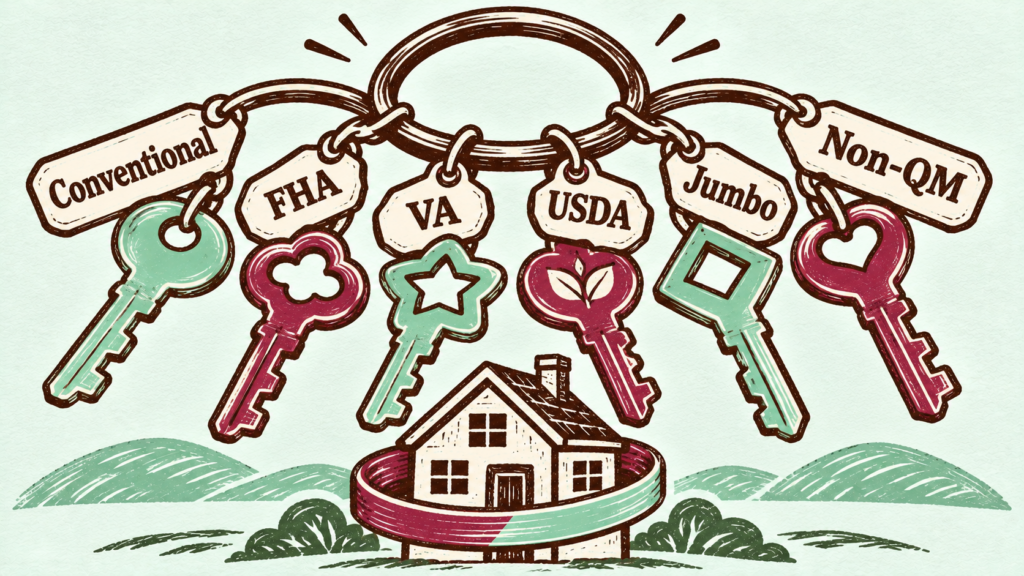
There are many kinds of mortgages. Here are the most common ones, with a quick look at what each is, who it may fit, and what to keep in mind.
Conventional Mortgages
A conventional loan is not insured or guaranteed by a federal agency the way FHA, VA, and USDA loans are. Many follow rules set by Fannie Mae or Freddie Mac. Some conventional programs, like Fannie Mae’s 97% loan-to-value options, allow as little as 3% down for eligible buyers. With less than 20% down, you will usually pay private mortgage insurance.
FHA Loans
FHA loans are insured by the Federal Housing Administration. According to HUD, FHA down payments can be as low as 3.5% for eligible buyers. FHA loans come with their own mortgage insurance, including an upfront premium and an annual premium that is usually paid monthly. Both the borrower and the property must meet FHA rules.
VA Loans
VA loans are for eligible veterans, service members, and certain surviving spouses. The VA home loan program notes that most VA-backed loans are made with no down payment, though a funding fee often applies.
USDA Loans
USDA loans help eligible buyers purchase homes in qualifying rural areas. Under the USDA guaranteed loan program, eligible buyers can get 100% financing. Household income limits and location rules apply.
Jumbo Loans
A jumbo loan is larger than the conforming loan limit for the home’s county. According to the Federal Housing Finance Agency (FHFA), the 2026 limit for a one-unit home is $832,750 in most areas and up to $1,249,125 in high-cost areas. Jumbo loans often have stricter rules for credit, down payment, and savings.
Non-QM Loans
Non-QM loans fall outside the legal definition of a Qualified Mortgage. They may use other ways to check income, such as bank statements, for borrowers whose finances do not fit standard rules. Lenders must still make a good-faith effort to confirm that you can repay.
Section 10
What Is a Fixed-Rate Mortgage?
How a Fixed-Rate Mortgage Works
With a fixed-rate mortgage, your interest rate stays the same for the life of the loan. So your principal and interest payment stays the same each month too.
Advantages and Considerations
The biggest plus is predictability. You always know what your principal and interest payment will be. On the other hand, a fixed rate may start a bit higher than the starting rate on some adjustable loans.
Who Might Consider a Fixed-Rate Mortgage?
Fixed-rate loans often suit borrowers who value a stable rate and payment, especially if they plan to stay in the home for a long time.
Section 11
What Is an Adjustable-Rate Mortgage?
How an ARM Works
An adjustable-rate mortgage, or ARM, usually starts with a fixed rate for a set period. After that, the rate can change on a schedule set in the loan terms.
Why ARM Payments Can Change
When an ARM adjusts, the new rate is usually based on a market index plus a set amount called a margin. Your loan terms also spell out how often the rate can change and caps that limit how much it can rise. Because of these changes, your payment can go up or down over time.
Fixed-Rate vs. ARM Mortgage
| Feature | Fixed-Rate | ARM |
|---|---|---|
| Initial rate | Fixed | Typically fixed for initial period |
| Later rate | Does not adjust under standard terms | May adjust |
| Payment predictability | Higher | Lower after initial period |
| Main consideration | Long-term stability | Future rate/payment uncertainty |
Section 12
How Much Does It Cost to Get a Mortgage?
Beyond the monthly payment, getting a mortgage comes with upfront costs. Our home buying costs checklist covers them in more detail.
Down Payment
This is the money you pay toward the price upfront. You may not need 20% down. Our guide on why a 20% down payment is not always required explains the options.
Closing Costs
Closing costs are the fees and charges you pay to finalize the loan and the purchase. The CFPB notes that they typically range from 2% to 5% of the purchase price.
Origination Fees
Mortgage origination fees are what the lender charges for making your loan. According to the CFPB, they can cover processing your application, underwriting, funding the loan, and other administrative work.
Discount Points
Discount points are an optional upfront payment you can make to get a lower interest rate. The CFPB’s guide to points and lender credits explains that paying points lowers your rate, while lender credits lower your upfront costs in exchange for a higher rate.
Prepaid Costs and Escrow
At closing, you may need to prepay some items, such as homeowners insurance, interest, and money to start your escrow account for future taxes and insurance.
Mortgage Insurance
Depending on your loan, you may pay mortgage insurance upfront, monthly, or both.
Section 13
What Is a Mortgage Loan Estimate?
What the Loan Estimate Shows
A Loan Estimate is a standard form lenders give you within three business days after you apply. It shows your loan terms, projected payments, estimated closing costs, estimated cash to close, and other key details.
Why the Loan Estimate Matters
Because every lender uses the same form, it is much easier to compare offers side by side. The CFPB recommends getting more than one Loan Estimate and comparing them carefully.
Loan Estimate vs. Closing Disclosure
The Loan Estimate comes early, after you apply. The Closing Disclosure is the final version of your loan terms and costs. You generally receive it at least three business days before closing, so you have time to review it and compare it with your Loan Estimate.
Section 14
How Do You Apply for a Mortgage Loan?
Get Your Finances Ready
Start by checking your credit, gathering proof of income and assets, listing your debts, and planning your down payment.
Compare Mortgage Options
Do not compare only interest rates. Look at the rate, the APR, lender charges, points, credits, cash to close, and the monthly payment together. The Wonder Rates Rate Comparison Calculator can help you compare two offers side by side.
Get Pre-Approved
A pre-approval gives you a sense of how much you may be able to borrow. It also shows sellers you are serious. But a pre-approval is a starting point, not a finish line. Final approval still depends on a full review.
Submit an Offer
Once a seller accepts your offer, your loan moves into a deeper stage of processing. If you want to protect your rate during this time, our guide on Rate Lock Explained covers how locking works.
Underwriting
During mortgage underwriting, the lender takes a close look at your income, assets, credit, debts, and the property. The underwriter may ask for more documents before giving final approval.
Closing
At closing, you sign the final loan documents, pay your closing costs and down payment, and the loan is funded. After that, the home is yours.
Section 15
What Happens After You Get a Mortgage?
Monthly Payments Begin
Your first payment is usually due about a month or two after closing. Your loan servicer will tell you when and where to pay.
Principal Balance Declines
With a standard loan, each scheduled payment slowly lowers your principal balance.
You Build Home Equity
Your equity can grow in two ways. First, it grows as you pay down principal. Second, it can grow if your home’s value rises.
You Can Potentially Refinance
If your situation or the market changes, you may be able to refinance into a new loan. Our guide on mortgage refinancing explains how it works.
Section 16
What Is Mortgage Equity?
Home Equity Formula
Home equity is the part of your home you own outright. The formula is simple:
Home Value − Mortgage Debt = Home Equity
For example, if your home is worth $400,000 and you owe $300,000, your equity is about $100,000.
Disclaimer: This is a simplified, hypothetical example for illustration only. Actual equity depends on your home’s real market value, all debts secured by the home, and other factors.
How Mortgage Payments Build Equity
As you pay down principal, your equity grows, as long as your home’s value stays about the same.
Why Equity Matters
Equity can matter when you sell, refinance, or apply for certain home equity products. Still, equity is not the same as cash in your pocket. To use it, you usually need to sell or borrow against it.
Section 17
How Long Does a Mortgage Loan Last?
Common Mortgage Terms
The most common terms are 15 and 30 years. Some lenders also offer 10, 20, or 25 years.
Loan Term vs. Amortization Period
On many loans, the loan term and the amortization period are the same. For example, a standard 30-year fixed loan is paid off over 30 years. But some loans, such as balloon loans, use a long schedule to set the payment while the remaining balance comes due sooner.
Why a Longer Term Usually Means More Total Interest
All else equal, a longer term means you pay interest for more years. So even though the monthly payment is lower, the total interest is usually higher.
Section 18
What Happens When You Pay Off a Mortgage?
The Loan Balance Reaches Zero
Once you make your final payment, your balance is paid in full.
The Mortgage Lien Is Released
The lender then releases its lien on your home. The exact process depends on your state and local recording rules. It is a good idea to keep a copy of the release for your records.
You Still Own the Property
Paying off a mortgage does not mean you finally own your home. You owned it all along. Paying off the loan simply means the debt is gone and the lender no longer has a claim on the property.
Section 19
Mortgage Loan vs. Other Ways to Buy a Home
Mortgage Loan vs. Paying Cash
Paying cash means no mortgage interest and no monthly loan payment. But it ties up a large amount of your money in one place. A mortgage lets you keep more cash on hand, in exchange for paying interest.
Mortgage Loan vs. Home Equity Loan
A home equity loan is usually a second loan taken against a home you already own. People often use it for repairs or other large costs. It works differently from a mortgage used to buy a home.
Mortgage Loan vs. HELOC
A home equity line of credit, or HELOC, is a revolving line of credit backed by your home’s equity. You can borrow, repay, and borrow again up to a limit. That is quite different from a standard purchase mortgage.
Section 20
How to Estimate Your Mortgage Payment
What Inputs Matter?
The main inputs are the home price, your down payment, the loan amount, the interest rate, and the loan term.
What a Basic Mortgage Calculator May Not Include
Some simple calculators show only principal and interest. They may leave out taxes, insurance, HOA dues, mortgage insurance, or closing costs.
Use the Wonder Rates Mortgage Payment Calculator
When you compare loan options, the Wonder Rates Mortgage Payment Calculator can help you estimate your principal and interest payment. It also lets you add taxes, insurance, PMI, and HOA dues for a fuller picture. Results are estimates, not loan quotes.
Section 21
Common Mortgage Loan Mistakes to Avoid
Choosing a Loan Based Only on Interest Rate
A lower rate does not always mean the lowest total cost. Fees, points, and other charges matter too.
Looking Only at the Monthly Payment
A payment can look low because the term is longer, the rate setup is different, or more costs were paid upfront. Look at the full picture.
Forgetting Taxes, Insurance and HOA
Your housing cost is more than principal and interest. Leaving out these costs can make a home look more affordable than it is.
Not Comparing Loan Estimates
Loan Estimates make side-by-side comparisons easier. Skipping that step can mean missing a better deal.
Borrowing More Than You Can Comfortably Afford
The amount you are pre-approved for is not always the amount that fits your budget. Leave room for savings, repairs, and life’s surprises.
Section 22
What to Know Before Taking Out a Mortgage Loan
A mortgage is a loan secured by real estate. Your monthly payment includes more than principal and interest. The type of loan you choose affects the rules, costs, and structure. Both you and the property need to meet the lender’s requirements. And comparing the total cost of a loan is more useful than focusing on any one number.
A mortgage is a long-term financial commitment. Understanding how the loan works before you choose one can help you compare your options with more confidence.
Section 23
Explore Your Mortgage Options
If you are ready to discuss your home financing situation, you can get started with Wonder Rates to review potential mortgage options based on your specific circumstances. If you are shopping for a home, you can also explore mortgage options for buying a home.
Section 24
Disclaimer
This article is provided for general educational and informational purposes only and should not be considered mortgage, financial, tax, legal, real estate, or investment advice. Mortgage qualification requirements, interest rates, fees, loan limits, underwriting standards, and program guidelines vary by lender, loan program, borrower circumstances, property characteristics, location, and market conditions.
Any rates, payments, loan amounts, down payments, fees, calculations, examples, or scenarios presented in this article are hypothetical and provided for educational purposes only. They do not constitute a mortgage quote, offer, commitment to lend, guarantee of approval, or guarantee of specific loan terms. Actual loan terms and costs may differ materially from the examples shown.
Mortgage payments may include principal, interest, property taxes, homeowners insurance, mortgage insurance, HOA dues, and other costs depending on the loan and property. Not every mortgage payment includes every item, and some expenses may be paid separately from the mortgage servicer.
Meeting general eligibility requirements for a mortgage program does not guarantee approval. Lenders may apply additional underwriting requirements, and final approval depends on the complete borrower, property, transaction, and documentation review.
Mortgage programs and applicable guidelines can change over time. Information about FHA, VA, USDA, Conventional, Jumbo, Non-QM, or other mortgage products should be verified against current official program guidance and the specific terms offered by the lender.
Readers should review their Loan Estimate, Closing Disclosure, loan documents, and other applicable disclosures carefully before proceeding with a mortgage. Consult qualified mortgage, tax, legal, or other professionals regarding questions specific to your individual circumstances.
References to government agencies, government-sponsored enterprises, or other organizations are provided for informational purposes and do not constitute an endorsement of Wonder Rates or any mortgage product.
Duc Pham, Mortgage Broker | NMLS# 844897, Wonder Rates, Inc. | NMLS# 1518655 | DRE# 02047445 | DFPI# 60DBO-59134 | Equal Housing Opportunity. Equal Housing Lender. | Licensed in: AL, AZ, CA, CO, FL, GA, LA, MI, NC, OH, OK, OR, PA, SC, TX, VA, WA.



