
Section 01
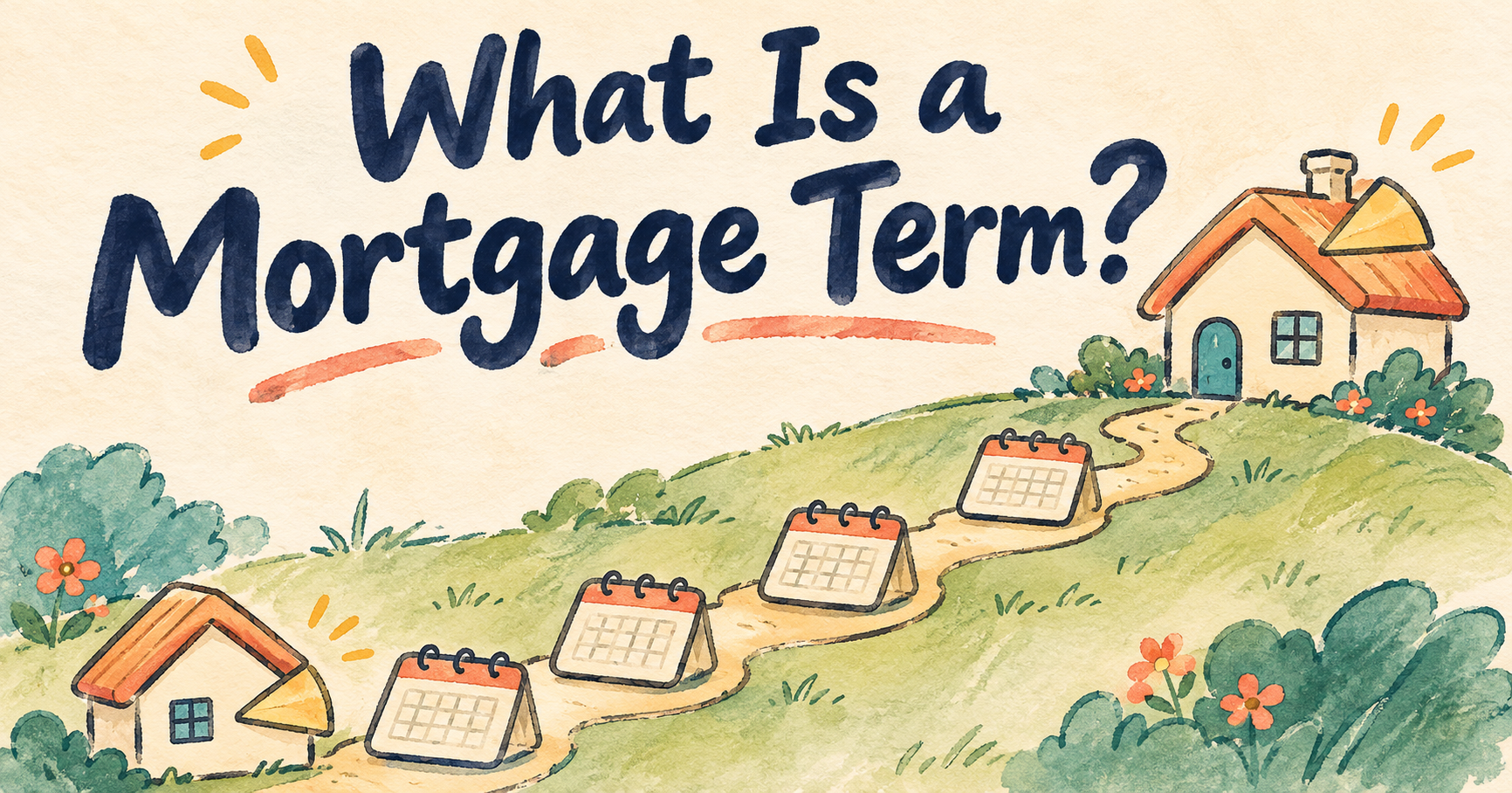
A mortgage term is the length of time you have to repay your home loan under the loan agreement. When people talk about a “30-year mortgage,” they mean a loan with a 30-year term. That does not mean you must keep the loan for 30 years. Many people sell, refinance, or pay off their loan early. Still, your mortgage term matters a lot. It shapes your monthly principal and interest payment, the total interest you pay, and how fast you build equity. It is not the only thing that decides whether a home fits your budget, but it is one of the biggest.
Section 02
What Is a Mortgage Term?
Mortgage Term Definition
The Consumer Financial Protection Bureau (CFPB) defines the term of a loan simply as how long you have to repay it. In other words, the mortgage term meaning is the repayment schedule built into your loan.
Most home loans are paid monthly. So a 30-year term works out to 360 scheduled monthly payments, and a 15-year term works out to 180.
It helps to keep two other ideas separate from the term. The first is your interest rate, which is the cost of borrowing. The second is how long you actually keep the loan. You might have a 30-year term but sell the home after seven years, and the loan gets paid off at that point.
What Does “30-Year Mortgage” Mean?
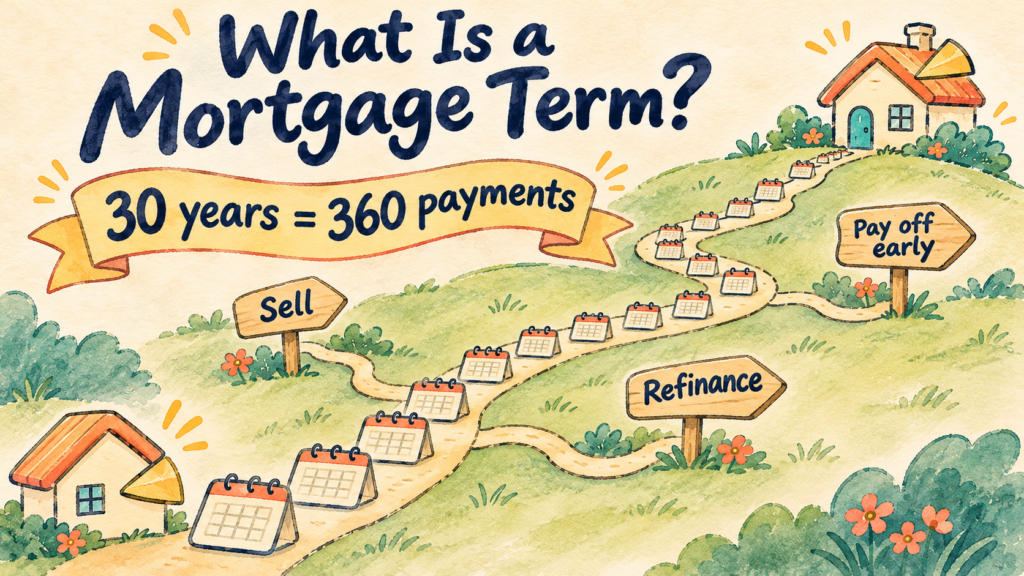
A 30-year mortgage is a loan scheduled to be paid back over 30 years. Here is a simple way to picture it.
Say you borrow $400,000 with a 30-year term. Your loan is set up to be repaid over 360 monthly payments. That assumes you make every payment on schedule and you do not pay early, refinance, or change the loan in some other way.
Disclaimer: This hypothetical example is for educational purposes only. It does not represent an actual loan, rate, or payment. Actual loan terms, payment schedules, and available options vary by borrower, lender, loan program, and market conditions.
A 30-year term is a schedule, not a sentence. Life changes, and your loan can change with it.
What Happens When a Mortgage Term Ends?
The last scheduled payment date on your loan is called the maturity date. On a standard loan that is paid down on schedule, your balance reaches zero by that date. At that point, the home loan is paid in full.
It helps to know a few related terms. A payoff happens any time the full balance is paid, whether at maturity or earlier. A refinance replaces your loan with a new one, which may have a new term. An early payoff happens when you clear the balance before the maturity date, for example by selling the home or making extra payments.
Not every loan pays down in the same way, though. Some loan types are built differently, so the rules for a standard 30-year loan do not apply to every mortgage.
Section 03
How Does a Mortgage Term Work?
Mortgage Term and Amortization
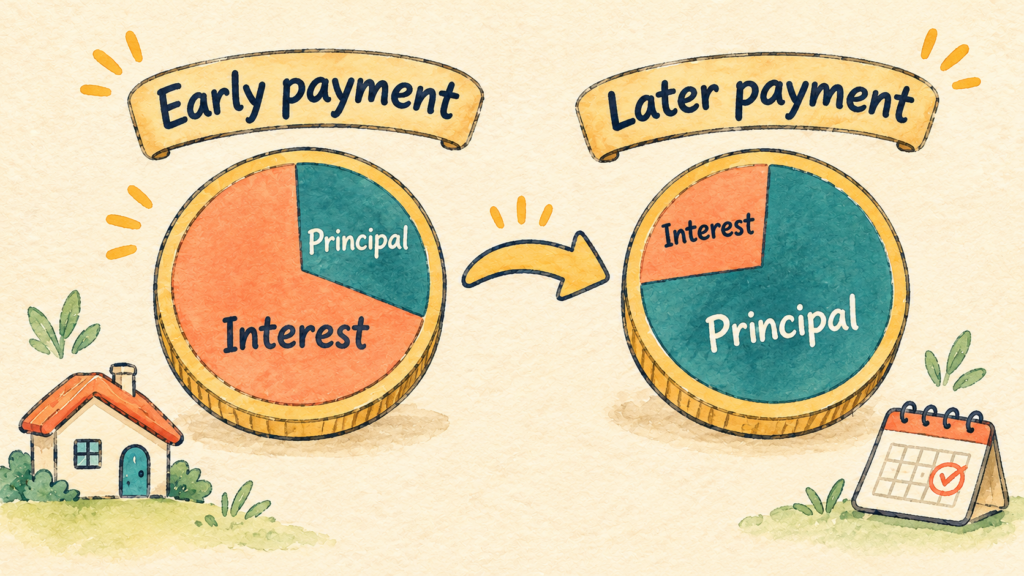
Amortization is the process of paying off a loan with regular payments over time. Each payment on a standard mortgage has two parts. Principal is the part that lowers what you owe. Interest is the cost of borrowing.
Early in the loan, more of each payment goes to interest. That is because interest is figured on your balance, and your balance is highest at the start. As the balance shrinks, more of each payment goes to principal.
Here is a quick look. On a $400,000 loan at 6.5% over 30 years, the first monthly payment of principal and interest would be about $2,528. Of that, about $2,167 goes to interest, and only about $362 goes to principal.
Disclaimer: These figures are rounded, hypothetical estimates of principal and interest only, based on an assumed 6.5% fixed rate. They are not rate quotes or loan offers. Actual rates and payment splits vary by borrower, lender, loan program, and market conditions.
A shorter term pays down principal faster, since the same balance is spread over fewer payments. A longer term spreads the payback over more years.
Mortgage Term and Your Monthly Payment
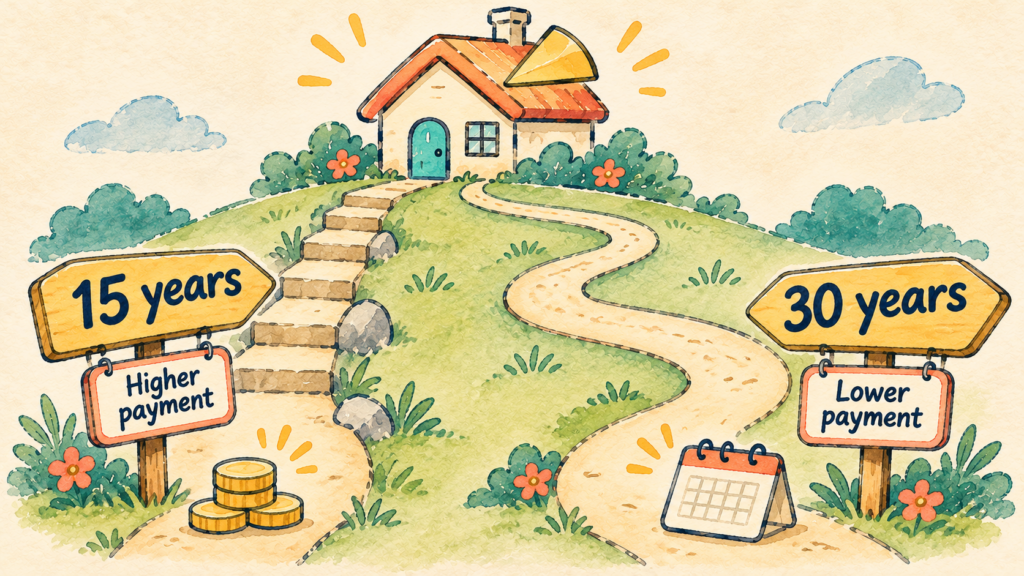
As a general rule, a shorter term means a higher monthly principal and interest payment. A longer term means a lower one. We say “generally” because your actual payment also depends on your rate, your loan amount, and other costs like taxes and insurance.
You can see this for yourself. The Wonder Rates Mortgage Payment Calculator lets you change the loan term and compare how it affects your estimated principal and interest payment.
Mortgage Term and Total Interest
This is why a 30-year loan is not simply the “cheaper” choice. A longer term lowers your required monthly payment. But it also gives interest more time to build up. So if you keep the loan for the full term, you will generally pay more interest in total.
A shorter term works the other way. Your monthly payment is higher, but you pay down principal faster. Over the life of the loan, you generally pay less total interest. The CFPB notes that shorter terms generally save you money overall but come with higher monthly payments.
Section 04
What Are the Most Common Mortgage Terms?
Here are the common mortgage terms you are most likely to see. Keep in mind that the options you can get depend on the lender and the loan program.
30-Year Mortgage
The 30-year mortgage term is the most familiar option. It has 360 scheduled monthly payments. Compared with a similar 15-year loan, it has a lower monthly principal and interest payment. If you keep it for the full term, though, you will pay more total interest.
Many buyers pick a 30-year term when a lower monthly payment matters most. It can leave more room in the budget for savings, repairs, and other goals. Even so, it is not the best choice for everyone. That depends on your budget and plans.
15-Year Mortgage
A 15-year mortgage term has 180 scheduled payments. The monthly payment is higher than on a similar 30-year loan. In return, you pay down the balance faster, build equity sooner, and pay less total interest when other factors are the same.
20-Year Mortgage
A 20-year term sits in the middle. Its payment is usually higher than a 30-year loan but lower than a 15-year loan. Some buyers like it as a balance between the two.
10-Year Mortgage
Some lenders offer terms as short as 10 years. The payment is high, but the loan is paid off quickly. Not every lender or program offers this term.
Other Mortgage Terms
You may also see 25-year terms or other custom schedules with some lenders. A few lenders offer 40-year loans. Note that loans longer than 30 years fall outside the CFPB’s Qualified Mortgage rules, so they may come with different features and protections.
It also helps to know that names like “5/1 ARM” or “7/6 ARM” do not describe the full loan term. They describe how an adjustable rate works. We cover this in more detail later in the guide.
Section 05
15-Year vs. 30-Year Mortgage: What's the Difference?
The 15 year vs 30 year mortgage choice is one of the biggest decisions buyers face. Here is a quick side-by-side look.
15-Year vs. 30-Year Mortgage at a Glance
| Feature | 15-Year Mortgage | 30-Year Mortgage |
|---|---|---|
| Scheduled repayment | 15 years | 30 years |
| Monthly P&I | Generally higher | Generally lower |
| Principal paid down | Faster | Slower |
| Total interest | Generally lower | Generally higher |
| Monthly cash-flow flexibility | Lower | Higher |
| Equity accumulation | Faster | Slower |
Why Is a 15-Year Mortgage Payment Higher?
With the same loan amount, a 15-year loan must pay back all of the principal in 180 payments instead of 360. So each payment has to cover a much larger share of the principal, on top of the interest. That is what pushes the monthly payment up.
Why Does a 30-Year Mortgage Usually Cost More Interest?
With a 30-year loan, your balance stays higher for longer. Since interest is charged on the balance, it gets charged over a longer stretch of time. That adds up to more total interest if you keep the loan for the full term.
Which Is Better: 15-Year or 30-Year?
Neither one is better for everyone. A 15-year term may fit borrowers who want to pay off the home faster and pay less interest over time, as long as they can handle the higher payment with ease. A 30-year term may fit borrowers who want a lower required payment and more room in their monthly budget.
The better term is not always the one with the lowest payment or the lowest total interest. It is the one that fits your budget, your goals, how much cash you want on hand, and how long you plan to stay.
The Wonder Rates Rate Comparison Calculator lets you compare a 15-year and a 30-year option side by side, including the payment, total interest, closing costs, and APR.
Section 06
How Does Mortgage Term Affect Your Monthly Payment?
Longer Terms Usually Lower the Required Monthly Payment
When you stretch the same loan over more payments, each payment has less principal to cover. That is why a longer mortgage term usually brings a lower required monthly payment. The tradeoff is that you stay in debt longer.
Shorter Terms Usually Increase the Required Monthly Payment
When you squeeze the same loan into fewer payments, each one has to cover more principal. So a shorter mortgage term usually raises the required monthly payment. In return, the loan is paid off sooner.
Your Mortgage Payment Is More Than Principal and Interest
When most people think of their mortgage payment, they picture the full amount that leaves their bank account each month. That total can include several pieces:
- Principal: the part that lowers your loan balance.
- Interest: the cost of borrowing.
- Property taxes: often collected monthly and held in an escrow account.
- Homeowners insurance: also often paid through escrow.
- Mortgage insurance: required on some loans, such as many loans with a small down payment.
- HOA dues: if the home is part of a homeowners association.
Your loan term mostly affects the principal and interest part. Taxes, insurance, and HOA dues generally stay about the same no matter which term you choose, though they can change over time.
Section 07
How Does Mortgage Term Affect Total Interest?
Why Loan Term Matters Over Time
Interest is charged on the balance you still owe. With a longer term, your balance shrinks more slowly. That means interest is charged on a larger balance for a longer time, and the total climbs.
Shorter Term vs. Longer Term
A shorter term cuts total interest in two ways. First, you are borrowing for fewer years. Second, your balance drops faster, so each month’s interest is figured on a smaller amount. A longer term gives you a lower payment, but you pay for that comfort with more interest over time.
Does a Lower Mortgage Rate Always Mean Less Interest?
Not on its own. Your total borrowing cost depends on several things working together. These include the rate, the loan amount, the term, any points or fees, and how long you actually keep the loan.
For example, a lower rate on a 30-year loan can still lead to more total interest than a slightly higher rate on a 15-year loan, simply because of the extra years. And if you sell or refinance early, the full-term totals may never apply to you at all.
A lower payment is not the same as a lower cost.
Section 08
Mortgage Term vs. Interest Rate: What's the Difference?
These two ideas get mixed up a lot, so let’s separate them.
What Is a Mortgage Term?
As covered above, the mortgage term is how long you have to repay the loan.
What Is a Mortgage Interest Rate?
The interest rate is the percentage used to figure the interest charged on the principal you still owe. It is the price of borrowing the money.
Can the Same Mortgage Term Have Different Interest Rates?
Yes. Two people can both get a 30-year fixed loan and end up with very different rates. Rates depend on things like credit, down payment, loan amount, loan program, lender, and the market on the day you lock.
Does a Longer Mortgage Term Mean a Higher Interest Rate?
Not automatically. Pricing depends on the loan program, the lender, the market, your profile, and other factors. The CFPB notes that longer terms typically come with higher interest rates. That is a general pattern, not a rule for every offer. So compare real quotes rather than assuming one term always has a certain rate.
Once you find a rate you like, it may help to understand how to protect it. Our guide on Rate Lock Explained covers how locking and floating work.
Section 09
Does Mortgage Term Affect How Quickly You Build Home Equity?
Principal Reduction and Equity
Home equity is the part of your home you own outright. In simple terms, it is the home’s value minus what you still owe on the mortgage. Equity grows when you pay down principal. It can also change when your home’s value rises or falls.
Why Shorter Terms Can Build Equity Faster
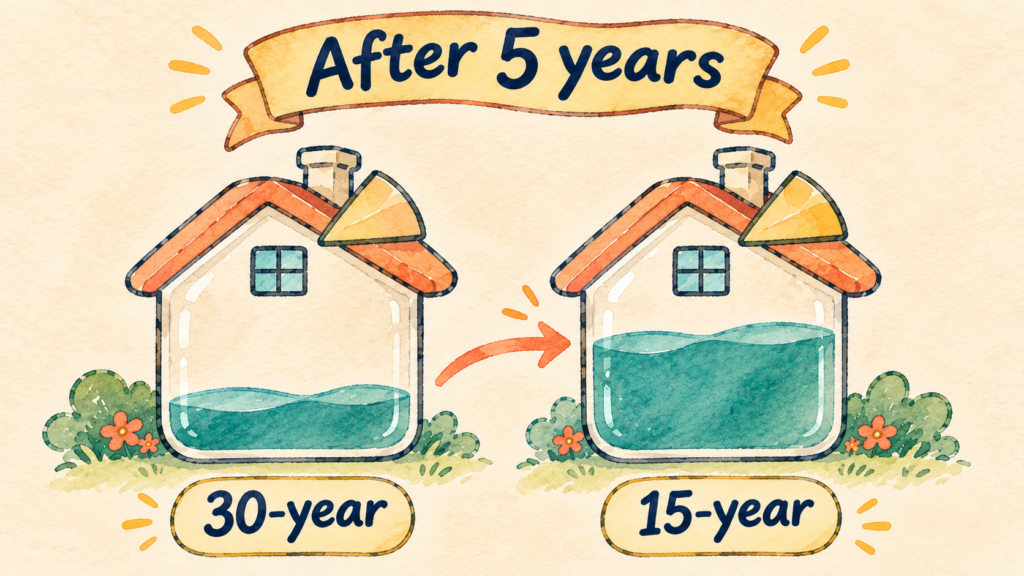
With a shorter term, more of each payment goes to principal from the start. So your balance falls faster, and your equity grows faster too.
Here is how that can look. Take the same $400,000 loan at 6.5%. After five years of on-time payments, the 30-year loan would still have a balance of about $374,444. The 15-year loan would be down to about $306,868. That is roughly $67,600 more principal paid off on the shorter term in the same five years.
Disclaimer: These balances are rounded, hypothetical estimates that assume a 6.5% fixed rate, on-time payments, and no extra payments. They exclude changes in home value. They are not rate quotes or predictions, and actual results vary by borrower, lender, loan program, and market conditions.
Why a 30-Year Mortgage Can Still Build Equity
A 30-year loan is not a bad choice just because equity grows more slowly at first. Your balance still goes down with every scheduled payment. Equity can also grow if your home’s value rises, if you make extra principal payments, or if you later refinance into a shorter term.
Section 10
How Mortgage Term Affects Different Types of Loans
Fixed-Rate Mortgages
With a fixed-rate loan, your rate and your principal and interest payment stay the same for the life of the loan. That makes the link between term and payment easy to see. A shorter term means a higher fixed payment, and a longer term means a lower one.
Adjustable-Rate Mortgages
With an adjustable-rate mortgage, or ARM, the loan term and the fixed-rate period are two different things. The full loan term is often 30 years.
The name of an ARM describes how the rate works. In a 5/1 ARM, the rate is fixed for the first five years and then can change once a year. In a 5/6 ARM, the rate is fixed for five years and then can change every six months. So a “5/1 ARM” is not a five-year mortgage. It is usually a 30-year loan with a five-year starting rate. The CFPB notes that ARM payments can rise a lot after the starting period, so it helps to plan for that. If you want to compare the two styles, the Wonder Rates ARM vs. Fixed Calculator can help you test scenarios.
FHA, VA, USDA, and Conventional Mortgages
Different term options may be available across many loan programs, including FHA, VA, USDA, and conventional loans. However, the exact choices and pricing depend on the program and the lender. For example, the USDA’s guaranteed home loan program offers only 30-year fixed-rate loans, while other programs may offer more choices.
Section 11
How Do You Choose the Right Mortgage Term?
Consider Your Monthly Budget
Look beyond whether you can make the payment today. Think about whether you could still make it if your income dipped, your insurance went up, or a big repair came along. A payment that feels tight now may feel tighter later.
Consider How Long You Expect to Keep the Loan
Your loan term is not the same as how long you will keep the loan. Many borrowers sell, refinance, or pay off early. If you expect to move in a few years, the full-term interest totals may matter less than your monthly payment and upfront costs.
Consider Your Long-Term Financial Goals
Different goals point in different directions. Some people want the lowest payment to keep cash flowing. Others want to pay off the home fast or cut lifetime interest. Some want to keep cash on hand for emergencies, and others want room to save toward other goals. There is no single right answer, so think about which goals matter most to you.
Compare the Full Cost, Not Just the Monthly Payment
A lower monthly payment does not always mean a lower total cost. Look at the payment, the total interest, the closing costs, and the APR side by side. The Rate Comparison Calculator makes this kind of comparison easier.
The right term is the one you can live with, month after month.
Section 12
Mortgage Term Example: 15 Years vs. 30 Years
Let’s put real math behind the comparison. Say a borrower takes out a $400,000 mortgage. To isolate the effect of the term, we use the same loan amount and the same 6.5% fixed rate for both options.
| 15-Year | 30-Year | |
|---|---|---|
| Loan amount | $400,000 | $400,000 |
| Term | 15 years | 30 years |
| Number of payments | 180 | 360 |
| Assumed fixed rate | 6.5% | 6.5% |
| Monthly principal and interest | About $3,484 | About $2,528 |
| Total scheduled interest | About $227,197 | About $510,178 |
The 15-year option costs about $956 more each month. But over the full schedule, it saves about $282,981 in interest. Same loan and same rate, yet the interest gap is about $283,000.
In real life, 15-year and 30-year loans often come with different rates. That could make the gap larger or smaller. Also, these totals only apply if the loan is kept for the full term with no extra payments.
Disclaimer: This hypothetical example is for educational and illustrative purposes only. Figures are rounded and show principal and interest only, using an assumed 6.5% fixed rate for both terms. Actual mortgage rates, payments, loan costs, eligibility, and available terms vary by borrower, lender, loan program, property, credit profile, and market conditions. The example does not represent an offer, commitment to lend, or prediction of actual loan terms.
Section 13
Can You Pay Off a Mortgage Before the End of the Term?
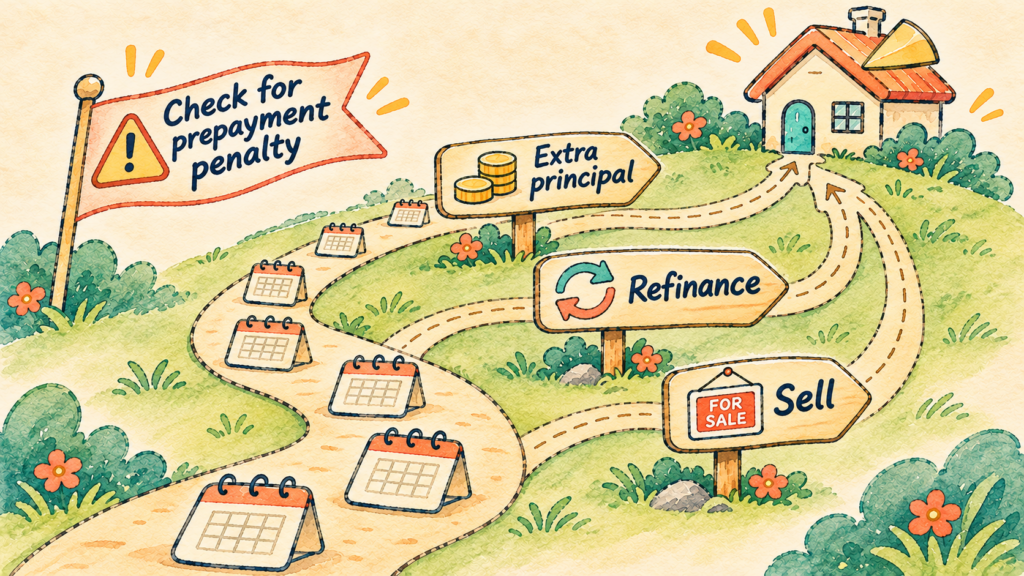
Yes, in most cases. Here are the common ways it happens.
Paying Extra Principal
You may be able to send extra money toward principal on top of your regular payment. This lowers your balance faster and can shorten the time it takes to pay off the loan. Check your loan papers first, since terms vary. The Wonder Rates Extra Payment Calculator can help you estimate the effect of paying more.
Refinancing
A refinance replaces your current loan with a new one. The new loan may have a different rate, a different term, or both. For example, some people refinance from a 30-year loan into a 15-year loan. Our guide on mortgage refinancing explains how this works.
Selling the Home
When you sell your home, the mortgage is generally paid off from the sale proceeds at closing. This is one of the most common ways a loan ends before its full term.
Does Paying Off Early Always Make Financial Sense?
Not always. Before you pay extra or refinance, think about a few things. Check whether your loan has a prepayment penalty, which is a fee for paying off early. Make sure you will still have enough cash for emergencies. Consider your other goals, such as paying down higher-cost debt or saving for the future. If you plan to refinance, weigh the closing costs too. The right move depends on your full money picture.
Section 14
What to Know Before Choosing a Mortgage Term
Your mortgage term affects both your monthly payment and the total interest you pay. A longer term usually lowers your payment but raises your lifetime interest. A shorter term usually does the reverse.
Choosing between 15 and 30 years comes down to your priorities. Some buyers value a lower payment and more flexibility. Others value a faster payoff and lower total cost.
The terms you can actually get depend on you, the property, the loan program, the lender, and the market. That is why general examples like the ones in this guide are only a starting point.
The best next step is to compare real scenarios based on your own numbers.
Section 15
Compare Mortgage Options Based on Your Numbers
If you are comparing mortgage terms, the most useful comparison is usually based on your actual loan amount, estimated rate, down payment, and budget. You can start by running different scenarios through the Wonder Rates Mortgage Payment Calculator. Then speak with a licensed mortgage professional if you want to compare available loan options.
When you are ready, get started with Wonder Rates to review your options. If you are shopping for a home, you can also start your home buying journey.
Section 16
Disclaimer
This article is for general educational and informational purposes only and does not constitute financial, tax, legal, or investment advice. It is not an offer, a guarantee of credit, or a commitment to lend. Rates, payments, fees, and program terms shown in this article, including calculator references and sample scenarios, are estimates for illustration only. Rates and loan programs change over time, and your actual rate and APR may be higher or lower than any example shown. All loans are subject to underwriting, credit approval, income and asset verification, property appraisal, title review, and program eligibility. Actual loan terms depend on your credit, income, assets, property, loan program, and lender guidelines. Your full monthly payment may also include property taxes, homeowners insurance, mortgage insurance, and HOA dues, which are not reflected in principal-and-interest examples. Calculators produce estimates from the inputs you provide and do not include every cost of homeownership. Not all applicants qualify, and not every loan term is available for every borrower or program. Wonder Rates, Inc. is licensed to originate residential mortgage loans only in the states listed below. Consult a qualified mortgage professional before making a borrowing decision.
Duc Pham, Mortgage Broker | NMLS# 844897, Wonder Rates, Inc. | NMLS# 1518655 | DRE# 02047445 | DFPI# 60DBO-59134 | Equal Housing Opportunity. Equal Housing Lender. | Licensed in: AL, AZ, CA, CO, FL, GA, LA, MI, NC, OH, OK, OR, PA, SC, TX, VA, WA.



