
Section 01
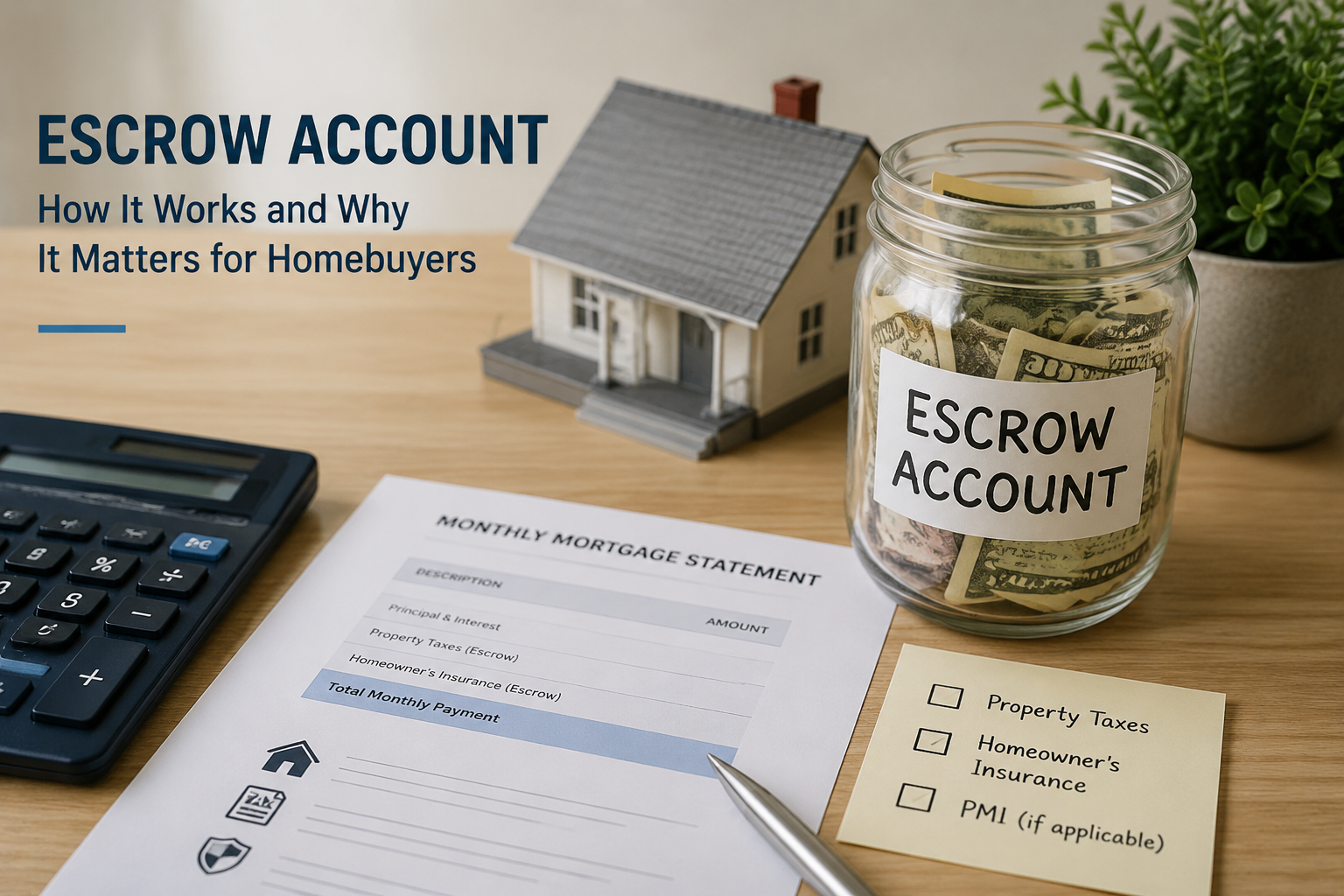
Most first-time buyers focus on the principal and interest portion of their mortgage payment. However, an escrow account can also affect your total monthly payment by covering expenses like property taxes and homeowner’s insurance.
That makes sense because it is the number the lender quotes most often, and it is the part that actually pays down the loan. Most homeowners pay more than just principal and interest each month. For many borrowers, part of the monthly payment is deposited into an escrow account to cover future property tax and homeowner’s insurance bills.
If you have ever looked at your mortgage statement and wondered why the total payment is so much higher than the loan payment you expected, escrow is almost certainly the answer. Here is exactly how it works.
Section 02
What Is an Escrow Account
An escrow account is a separate account managed by your mortgage servicer that holds funds for specific property-related expenses, primarily property taxes and homeowner’s insurance.
Instead of paying large property tax and insurance bills all at once, you pay a portion of those costs each month. Your mortgage servicer holds the money in your escrow account and pays the bills when they come due.
Escrow protects both you and your lender. It helps make sure property taxes and homeowner’s insurance are paid on time. Unpaid taxes can lead to a tax lien, while expired insurance leaves the home unprotected. For you, escrow spreads these costs into smaller monthly payments, making them easier to budget for.
Section 03
What Goes Into an Escrow Account
The two primary items in most escrow accounts are property taxes and homeowner’s insurance. PMI, or private mortgage insurance, is sometimes collected through escrow as well depending on the lender.
Property taxes are assessed by your local government, typically your county or municipality, as a percentage of your home’s assessed value. They are usually due once or twice a year depending on your location, with some counties collecting quarterly. Your servicer collects one-twelfth of your estimated annual tax bill each month and holds it until the bill comes due.
Homeowner’s insurance is your annual premium divided by 12, collected monthly and paid to your insurance carrier when the renewal date arrives each year.
PMI, if applicable, may be collected through the escrow account or billed separately depending on the lender and loan program.
Section 04
How the Monthly Escrow Amount Is Calculated
Your servicer estimates your annual property taxes and homeowner’s insurance costs, then calculates a monthly escrow payment. This payment is designed to help keep enough money in the account to pay those bills when they come due. The calculation may also include a required minimum balance, often called an escrow cushion or reserve, as allowed under federal rules.
For example, if your estimated annual property taxes are $4,800 and your homeowner’s insurance premium is $1,200, your servicer would use those estimates to calculate your monthly escrow payment. The final amount may also reflect the escrow account’s required minimum balance, as allowed under federal rules.
An escrow cushion is a minimum balance that servicers may maintain to help cover timing differences or unexpected increases in property tax and insurance payments. Under the Real Estate Settlement Procedures Act (RESPA), this cushion is generally limited to no more than one-sixth of the estimated annual escrow disbursements. Learn more about escrow requirements from the Consumer Financial Protection Bureau.
Here is a simplified breakdown of how your monthly escrow payment is calculated:
| Escrow Item | How It Is Used |
|---|---|
| Property taxes | Estimated annual taxes collected through monthly escrow payments |
| Homeowner’s insurance | Annual premium collected through monthly escrow payments |
| Escrow cushion (reserve) | Minimum balance the servicer may maintain under federal rules |
| Monthly escrow payment | Calculated to help ensure sufficient funds are available when bills come due |
Your monthly escrow payment is based on estimated property taxes and homeowner’s insurance costs. Actual amounts vary by location, property value, insurance coverage, and lender requirements.
Adding escrow means your total monthly mortgage payment will usually be higher than your principal and interest payment alone. The final payment depends on factors such as your loan amount, property taxes, homeowner’s insurance, and loan terms.

Section 05
What Happens at Closing: The Initial Escrow Deposit
When you close on a home, you are not starting the escrow account from zero. Your lender collects an upfront escrow deposit at closing to pre-fund the account so it has enough money to cover the first bills that come due.
The amount depends on your closing date, when your property tax and insurance bills are due, and how much will be collected through your monthly escrow payments before those bills come due.
For example, if a property tax bill is due soon after closing, the lender may collect a larger upfront deposit because there will be fewer monthly escrow payments before the bill comes due. If the bill is due several months later, more of the required funds can be collected through your regular monthly payments. The goal is to have enough money in the account by the time each bill is due.
This initial escrow deposit is part of your closing costs and is separate from your down payment and loan-related fees. This initial escrow deposit is included in your overall closing costs, but it is often shown separately because it covers future property tax and insurance payments collected at closing.
Here is an illustrative example for a $400,000 home purchase:
| Cash Requirement Before Closing | Approximate Amount |
|---|---|
| Down payment (10%) | $40,000 |
| Other lender and third-party closing costs (excluding initial escrow/prepaids) | $8,000 to $16,000 |
| Initial escrow deposit and prepaid items | $3,000 to $5,000 |
| Estimated total cash requirement before credits and earnest money already paid | $51,000 to $61,000 |
Figures are illustrative estimates for a $400,000 purchase. The estimate includes the down payment, other closing costs excluding initial escrow/prepaid items, and the initial escrow deposit required at closing. Actual amounts vary by location, lender, loan program, and timing of tax and insurance bills. These figures do not constitute an offer of credit.
Section 06
The Annual Escrow Analysis
Once a year, your servicer reviews your escrow account to make sure the monthly collection amount matches the actual bills. This is called an escrow analysis.
If your property taxes or insurance premiums go up, your monthly escrow payment usually goes up too. If those costs decrease or the servicer collected more than needed, you may receive a refund check for the surplus, or the excess will be applied to reduce your future monthly escrow amount.
Many homeowners are surprised when their escrow payment increases after the first year. In many areas, property taxes are reassessed after a home purchase, which can lead to a higher tax bill than the previous owner paid.
If your escrow analysis shows a shortage, it means there is not enough money in your escrow account to cover upcoming property tax or insurance bills. How the shortage is handled depends on the amount, your servicer’s policies, and applicable federal rules. Your escrow analysis notice will explain your repayment options, if any.
Section 07
Can You Opt Out of Escrow?
In some cases, yes. Some borrowers with conventional loans and sufficient equity may be eligible to waive escrow, depending on lender requirements and loan guidelines. Lenders may charge a fee or apply different pricing when you request an escrow waiver because they are taking on additional risk.
FHA loans generally require borrowers to use an escrow account for property taxes and homeowner’s insurance. VA loans may require escrow depending on lender requirements and borrower circumstances.
For borrowers who choose to opt out of escrow when eligible, the responsibility shifts entirely to them to budget for and pay property tax bills and insurance premiums on time. Failing to pay property taxes creates a lien that supersedes the mortgage, which lenders treat as a serious risk. Borrowers who opt out of escrow need to be disciplined about setting aside the equivalent amount each month so the funds are available when the bills arrive.
| Loan Type | Typical Escrow Requirement |
|---|---|
| Conventional | Depends on lender requirements and down payment |
| FHA | Generally required |
| VA | May depend on lender requirements |
| USDA | Generally required |
Requirements vary by lender. Verify escrow waiver availability and any associated fees with your specific lender.
Section 08
Frequently Asked Questions
Why did my mortgage payment go up when my loan balance went down?
The most common reason is an escrow adjustment. If your property taxes or homeowner’s insurance premiums increase, your servicer raises your monthly escrow payment to cover those higher costs. On a fixed-rate loan, your principal and interest payment stays the same, but the escrow portion can change. Your annual escrow analysis will explain any adjustment.
What happens to the money in my escrow account if I sell my home?
After your loan is paid off at closing, your mortgage servicer refunds any remaining balance in your escrow account. The refund amount depends on your account balance after any outstanding property tax or insurance payments have been processed.
My escrow analysis shows a shortage. What are my options?
If your escrow analysis shows a shortage, depending on the shortage amount and your servicer’s policies, you may be offered one or more repayment options. Your escrow analysis notice explains how the shortage will be handled and whether you have repayment options.
Section 09
Conclusion
Before you buy a home, make sure you understand your full monthly payment not just principal and interest. Reviewing your estimated escrow costs ahead of time can help you avoid surprises after closing.

Reach out to Duc Pham or the Wonder Rates team to review your estimated monthly payment, including the escrow portion, so you know what to expect before you buy.
All figures, escrow estimates, and examples in this article are for illustrative and educational purposes only and do not constitute an offer of credit or financial advice. Property tax rates, insurance premiums, escrow requirements, and lender policies vary significantly by location, property, loan program, and lender and are subject to change. RESPA escrow rules referenced are based on current federal regulations and may be updated. Consult your loan officer and mortgage servicer for guidance specific to your loan and property.
Duc Pham, Mortgage Broker | NMLS# 844897 | Wonder Rates, Inc. | NMLS# 1518655 | DRE# 02047445 | DFPI# 60DBO-59134 | Equal Housing Opportunity. Equal Housing Lender. | Licensed in: AL, AZ, CA, CO, FL, GA, LA, MI, NC, OH, OK, OR, PA, SC, TX, VA, WA.