

Section 01
A home insurance delay at closing can postpone or prevent mortgage funding because the property securing the loan generally must have acceptable coverage in place. A quote alone may not be enough if the insurer has not completed underwriting, the policy does not meet lender requirements, or coverage is withdrawn before closing.
The buyer should involve the insurance agent and loan team early. Wildfire exposure, roof condition, prior claims, vacancy, property type, deductible structure, and incomplete repairs can all affect whether a policy is available and acceptable.
Section 02
Why Can Home Insurance Delay Mortgage Closing?
The lender has a secured interest in the property. Insurance helps protect the collateral from covered losses. Before funding, the lender may need evidence showing the insurer, named insured, property, coverage, deductible, effective date, premium, and mortgagee information.
Fannie Mae’s general property-insurance requirements describe standards for policies securing eligible mortgages. The actual requirements vary by loan program, property, insurer, hazard exposure, and lender.
Insurance is not the same as mortgage insurance. Homeowners insurance primarily protects against covered property losses and liability. Mortgage insurance generally protects the lender against part of the borrower-default risk.

Section 03
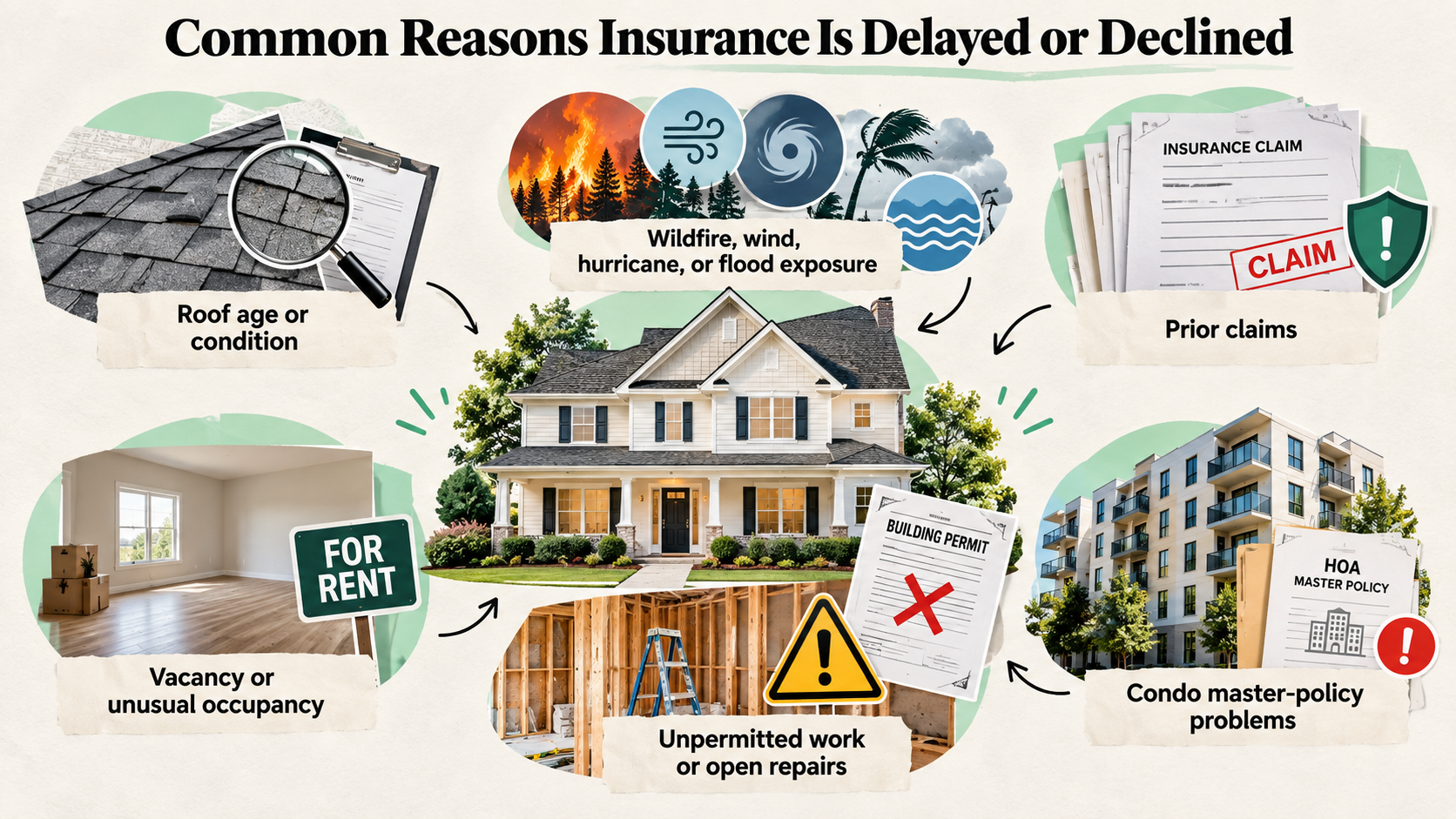
Common Reasons Insurance Is Delayed or Declined
Roof age or condition
An insurer may request documentation, inspection, repair, or replacement before binding coverage. The lender may separately review property condition through the appraisal.
Wildfire, wind, hurricane, or flood exposure
Location can limit carrier availability or require additional policies. Standard homeowners insurance does not automatically cover every hazard.
Prior claims
Claims associated with the property or applicant can affect underwriting. Buyers should correct inaccurate information but cannot require a carrier to accept the risk.
Vacancy or unusual occupancy
A vacant property, short-term rental plan, business use, or renovation may require different coverage from a standard owner-occupied policy.
Unpermitted work or open repairs
Additions, electrical issues, incomplete construction, or open permits may create insurance and mortgage concerns.
Condo master-policy problems
For a condominium, the HOA’s master policy and the buyer’s individual unit policy may both matter. Missing documentation or insufficient master coverage can delay the entire loan review.
Section 04
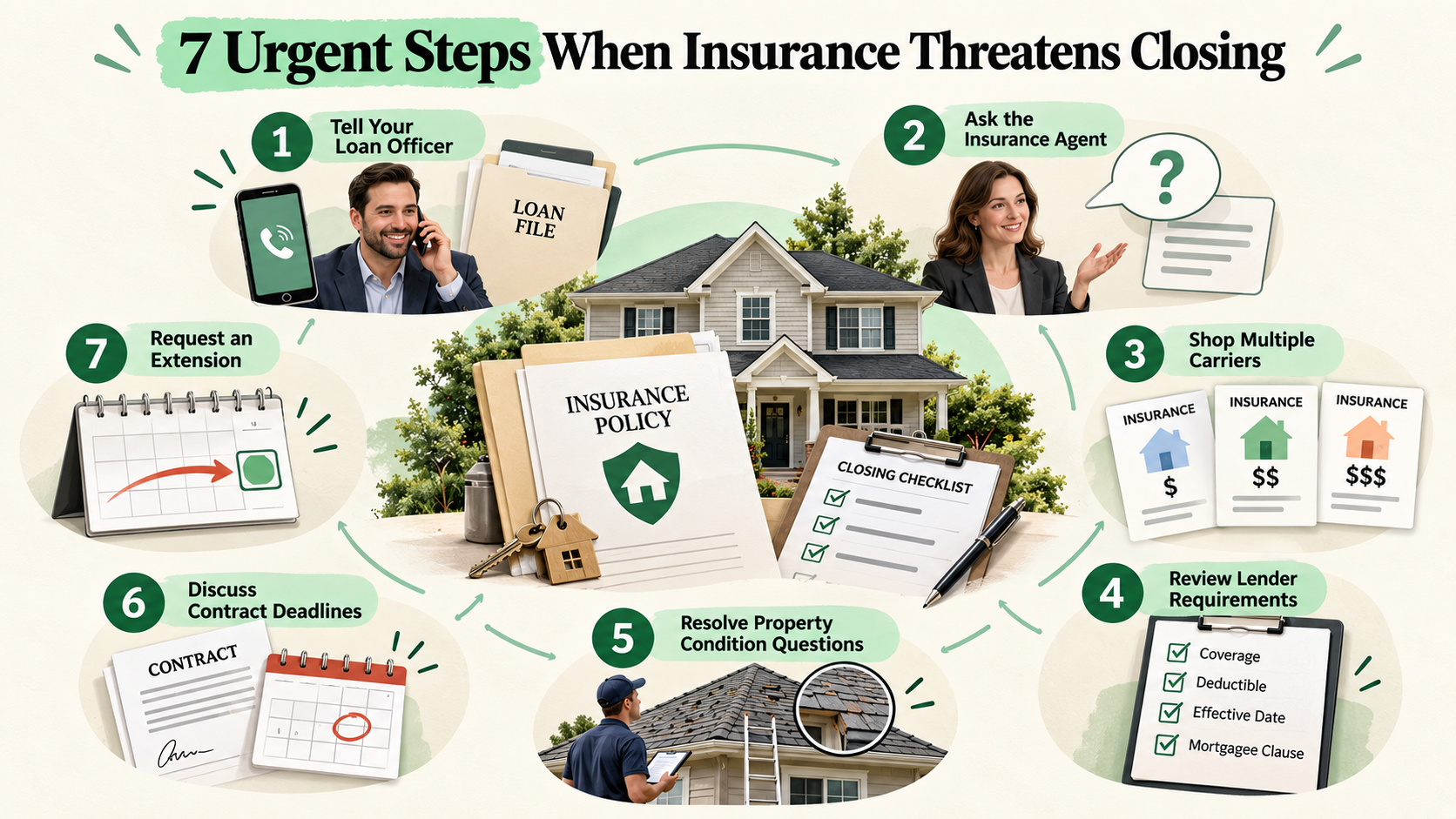
7 Urgent Steps When Insurance Threatens Closing
1. Tell the loan officer immediately
Do not wait for the final week. The loan team needs to know whether the problem concerns availability, coverage, deductible, premium, effective date, or documentation.
2. Ask the insurance agent for the exact reason
Request a clear explanation of what remains outstanding. “Still underwriting” is not specific enough when a closing deadline is approaching.
3. Shop more than one qualified carrier
Different insurers can evaluate risk differently. Provide accurate and consistent information to each carrier. Do not omit a roof issue, prior claim, property use, or hazard exposure.
4. Review lender requirements before binding
A policy may be available but still fail a mortgage requirement because of coverage, deductible, named insured, mortgagee clause, or effective date. Send the proposed evidence of insurance to the loan team early.
5. Resolve property-condition questions
If the insurer requires repairs, ask whether they must be completed before coverage. Cathryn’s article explaining appraisal versus home inspection helps buyers understand which professional identified the condition and what each report is designed to do.
6. Discuss contract deadlines
Insurance difficulty can affect loan approval without automatically creating a right to cancel. Review financing, insurance, inspection, and closing provisions with the real estate professional or attorney.
7. Request an extension when necessary
If a solution is likely but documentation will arrive late, the parties may consider a written extension. The seller is not required to agree unless the contract provides otherwise.
Section 05
What Does the Lender Review?
The lender may review:
- Policy effective date.
- Covered property address.
- Borrower or owner names.
- Coverage amount and settlement terms.
- Deductibles for required perils.
- Annual premium.
- Mortgagee clause.
- Carrier eligibility.
- Flood, wind, or other required coverage.
- Condo master and individual policies when applicable.
The premium can also affect qualification when it changes the projected housing payment. A policy costing substantially more than expected can increase DTI or cash needed at closing.
Fannie Mae publishes specific insurance requirements for one-to-four-unit properties, including deductible limitations for required perils. Other programs may apply different standards.
Section 06
Insurance Binder, Quote, and Policy Are Not the Same
A quote estimates proposed coverage and price. It does not necessarily mean the insurer has agreed to issue coverage.
An insurance binder or evidence of insurance may show temporary or confirmed coverage, depending on the carrier and document. A final policy contains the contractual terms, exclusions, endorsements, and conditions.
Ask both the insurer and lender what document is required. A screenshot of an online quote may not satisfy closing conditions.
Section 07
Condo and HOA Insurance Problems
Condo transactions can be delayed even when the buyer obtains an individual HO-6 policy. The lender may need to evaluate the HOA master policy, deductibles, covered property, fidelity coverage when applicable, and other project documents.
If the master policy is inadequate, one buyer may not be able to correct it alone. The HOA, management company, insurance broker, and lender may need to coordinate. Starting this review early is important in areas where associations face rising premiums or limited carrier options.
Section 08
How Insurance Relates to Other Buying Decisions
Insurance problems can change the true cost of the home. A buyer should consider premium, deductible, exclusions, potential nonrenewal, and required mitigation work rather than focusing only on the mortgage payment.
Cathryn’s guide on what homeowners should do after an insurance nonrenewal provides the next layer of planning. Buyers considering an older loan structure can also review her explanation of assumable mortgages, but assuming a loan does not eliminate property-insurance requirements.
Section 09
Frequently Asked Questions
Can I close without homeowners insurance?
For a financed purchase, acceptable property insurance is generally a lender requirement before funding. Cash transactions involve different considerations, but buyers still face property risk.
Is the cheapest policy always acceptable?
No. Price alone does not determine compliance. Coverage, deductible, carrier, property type, effective date, endorsements, and lender requirements matter.
Can the seller keep the current policy for me?
Insurance policies generally do not simply transfer with the sale. The buyer needs appropriate coverage in the correct name and effective for the transaction.
What if no standard carrier will insure the home?
Ask a qualified insurance professional about available state, surplus-lines, specialty, or layered options. Availability and lender acceptance vary. Review cost and limitations carefully.
Can an insurance problem cancel the contract?
That depends on the contract, contingencies, deadlines, and state law. Obtain advice from the appropriate real estate professional or attorney.
Section 10
The Bottom Line
A home insurance delay at closing is both an insurance problem and a mortgage problem. The fastest path is to identify the exact coverage issue, compare qualified options, send documents to the lender early, and protect contract deadlines.
Do not treat insurance as a last-minute checkbox. It can affect property eligibility, monthly affordability, cash to close, and whether the transaction can fund on time. Starting the insurance review soon after the offer is accepted gives every party more time to solve documentation, condition, carrier, or coverage problems early.
Duc Pham, Mortgage Broker | NMLS# 844897
****Wonder Rates, Inc. | NMLS# 1518655
Equal Housing Lender.
AZ, CA, CO, FL, GA, LA, MI, OK, PA, SC, TX, VA, WA, OH, AL, OR, NC
This article is for educational purposes only and is not a commitment to lend or insurance or legal advice. Loan approval is subject to creditworthiness, income verification, property eligibility, insurance, and current underwriting guidelines. Coverage and loan requirements may change.