
Section 01
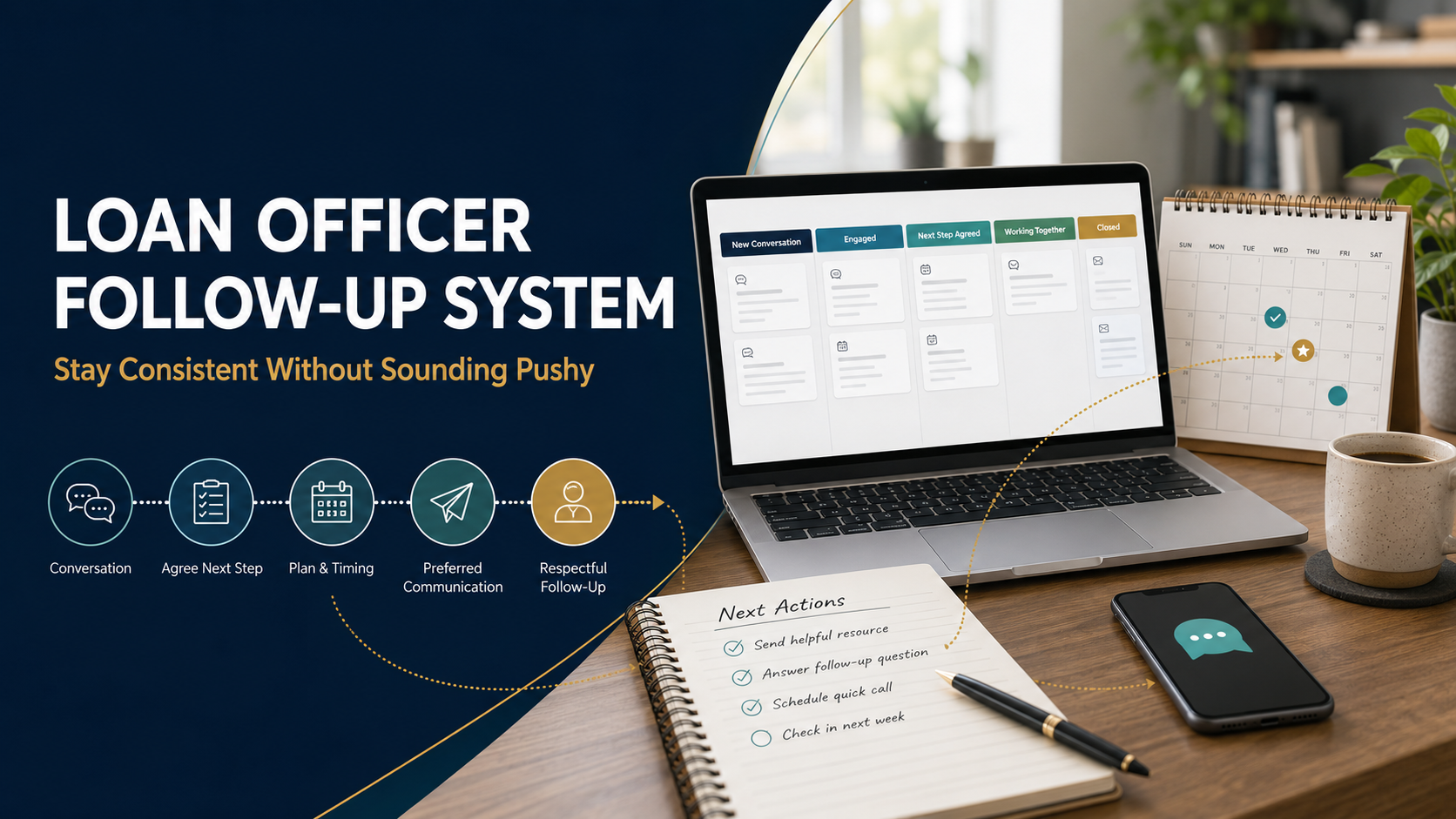
A loan officer follow-up system should help each prospective borrower take the next relevant step without turning every conversation into a sales pitch. The system works best when it records the person’s situation, communication preferences, open questions, and agreed next action not simply how many times the loan officer has called.
Follow-up can become uncomfortable when the message serves only the sender: “Are you ready yet?” “Just checking in.” “Any update?” A more useful approach gives the recipient a reason for the contact and makes it easy to respond, pause, or opt out.
There is no universal cadence that fits every mortgage lead. A buyer writing an offer, a homeowner considering a refinance, and a borrower working on a longer-term qualification issue need different communication. The purpose of a system is to preserve that context at scale.
Section 02
Why Good Leads Get Lost Without a System
Loan officers meet prospective borrowers through calls, website forms, open houses, referrals, social media, and past-client introductions. Details can fade quickly as files and inquiries accumulate.
Without a consistent record, common problems may include:
- Forgetting the next step promised to the borrower
- Contacting someone too frequently or after they asked to pause
- Sending a generic message that ignores an earlier concern
- Failing to follow up when a document or decision is actually due
- Losing track of the referral source
The article on the first year as a loan officer explains why tracking every lead, referral source, next step, and follow-up date can be especially useful early in a mortgage career. The follow-up system described here turns that basic habit into a repeatable workflow.
Section 03
Define the Minimum Information to Record
A CRM can be useful, but software alone does not create a process. Even a simple approved system can work when required fields are clear and consistently maintained.
For each lead, consider recording:
- Name and reliable contact information
- Lead source and referral partner, if applicable
- General purpose of the inquiry
- Approximate timeline stated by the person
- Current stage in the process
- Main question, concern, or obstacle
- Last meaningful interaction
- Next agreed action and responsible person
- Follow-up date and reason
- Communication preferences and consent or opt-out status
Keep notes factual, professional, and limited to the business purpose. Follow company rules for data storage, access, retention, and approved systems.
Section 04
Organize Leads by Their Next Action
Labels such as “hot,” “warm,” and “cold” do not explain what should happen next. A stage-based system connects each record to a responsibility.
An illustrative structure might include:
| Stage | Current situation | Possible next action |
|---|---|---|
| New inquiry | No meaningful conversation yet | Confirm the request and offer a time to talk |
| Initial review | Goals discussed; information incomplete | Send the agreed checklist or answer the open question |
| Application in progress | Application or documents outstanding | Clarify what remains and why it is needed |
| Pre-approval planning | Review underway or completed | Explain limitations and the next property-related step |
| Active transaction | Buyer is under contract | Communicate agreed milestones and material changes |
| Longer-term preparation | Buyer is addressing a documented issue | Follow the timeline discussed with the borrower |
| Paused | Person is not ready or asked to stop | Record the instruction and do not continue routine outreach |
| Past client | Transaction completed | Provide appropriate post-closing support |
This table is a planning example, not an industry standard. Teams should adapt it to their workflow, policies, and applicable law.
Section 05
Replace “Checking In” With a Reason to Respond
A useful follow-up message contains three elements:
- Context from the last interaction
- A relevant piece of information or a clear question
- One easy next step
For example:
When we spoke, you were comparing the cash needed for different down payment options. I prepared two general scenarios using the information you provided. Would you prefer to review them by phone or email?
For a borrower still preparing:
You mentioned that you planned to review your credit reports this month. If you have completed that step, I can help identify which mortgage questions may be worth discussing next. If your timeline has changed, just let me know and I can update my notes.
For a buyer who has gone quiet:
I have not heard back, so I do not want to crowd your inbox. Would you like me to follow up next month, pause for now, or close out this request?
These are examples, not required scripts. A message should not imply approval, eligibility, savings, urgency, or terms that have not been established.
Section 06
Match Follow-Up to the Borrower’s Stage
New inquiries
Confirm what the person wants help with and invite a specific next step. Explain the purpose and approved submission method before requesting documents.
Buyers exploring options
Educational follow-up may be more useful than repeated application prompts. Topics might include pre-qualification and pre-approval, total housing cost, or potentially relevant documentation.
Borrowers working on a qualification issue
Do not promise that completing one task will result in approval. Record what may need to change or be verified and when another review may be appropriate. Explain the limit of the loan officer’s role when legal, tax, or credit guidance is needed.
Active transactions
Follow-up becomes transaction communication: milestone updates, material issues, document requests, and realistic timing. Understanding what happens during mortgage underwriting can help explain additional review without presenting conditions as final approval.
Past clients
Post-closing contact may include servicing direction or mortgage education. Marketing must still follow consent, opt-out, licensing, privacy, and company requirements.
Section 07
Use Cadence as a Planning Tool, Not a Pressure Tactic
A follow-up date should have a reason: an expected document, an offer, a borrower-selected timeline, a review, or a requested call.
When no date has been agreed upon, ask permission:
Would it be helpful if I followed up in two weeks, or would you prefer to contact me when you are ready?
Record the answer as the next follow-up rule. No response is not permission to contact someone indefinitely or through every channel. Team cadences should remain adjustable based on the consumer’s instructions, communication method, and company policy.
Section 08
Coordinate Borrower and Referral-Partner Updates
When another professional introduces a borrower, acknowledge the introduction and clarify appropriate communication. It does not automatically authorize disclosure of income, credit, assets, debts, or other nonpublic personal information.
The parties may agree on high-level updates, subject to authorization and policy. The Realtor referral partnerships guide offers an illustrative communication framework.
Keep two records separate:
- The next action required for the borrower’s mortgage process
- The update, if any, that may appropriately be provided to the referral partner
These records should remain separate so a relationship update is not mistaken for permission to disclose borrower information.
Section 09
Build Compliance Into the Workflow
Consent rules depend on the channel, technology, message purpose, relationship, jurisdiction, and facts. Follow approved systems, disclosures, suppression lists, and compliance procedures.
The Federal Communications Commission provides official guidance concerning unwanted calls and texts, including consent requirements for certain calls and messages. The Federal Trade Commission’s CAN-SPAM compliance guide explains requirements for commercial email, including accurate header information, nondeceptive subject lines, a valid postal address, and an opt-out method.
State law and company policy may be more restrictive. Obtain company approval before launching automated texts, prerecorded calls, drip campaigns, purchased-lead outreach, or bulk email.
Follow-up must also comply with mortgage advertising, licensing, fair-lending, and privacy requirements. Review loan officer marketing compliance before using messages that mention rates, payments, costs, approval, eligibility, or results.
Section 10
Create a Weekly Review Routine
A recurring review can identify missing next actions, overdue commitments, outdated stages, and opt-out instructions.
An illustrative weekly review might ask:
- Which borrowers are waiting on something from me?
- Which records have no next action or follow-up reason?
- Which active files have a material update that has not been communicated?
- Which longer-term leads reached an agreed review date?
- Which contacts asked to pause or stop communication?
- Which referral sources need an appropriate transaction update?
The goal is not to produce the highest possible activity count. It is to make each open record accurate and actionable.
Section 11
Measure Process Quality Carefully
Possible internal measures include inquiry acknowledgment, records with a documented next step, overdue follow-ups, application completion, borrower response, opt-outs, and feedback.
These are not universal benchmarks. A low response rate may reflect timing, borrower readiness, contact accuracy, market conditions, or the inquiry itself.
Review quality alongside activity. If a sequence creates confusion, complaints, or opt-outs, greater frequency may worsen the problem.
Section 12
A Simple 30-Day Implementation Framework
The following framework is an illustrative starting point, not a guaranteed method for generating applications or closed loans.
Week 1: Define stages and required fields
Choose the minimum stages, fields, consent records, and next-action rules. Confirm the system is company approved.
Week 2: Clean the current pipeline
Correct contact information, add prior context, record the last meaningful interaction, and confirm whether outreach remains appropriate.
Week 3: Build message templates by purpose
Draft messages for acknowledging inquiries, requesting agreed items, explaining milestones, re-engaging after a pause, and closing dormant records. Obtain required review.
Week 4: Review and adjust
Check whether the system helps the team keep promises and provide clear next steps. Adjust fields, stages, and templates based on actual workflow problems.
Section 13
Frequently Asked Questions
How often should a loan officer follow up with a lead?
There is no universal schedule. Frequency should reflect the person’s request, stage, preferences, consent, channel, company policy, and applicable law. Agree on the next contact date when possible.
What should a loan officer say in a follow-up message?
Reference the prior conversation, provide relevant information or ask one clear question, and offer an easy next step. Avoid unsupported claims and artificial urgency.
Should every mortgage lead go into a CRM?
Follow company requirements. The approved system should preserve the request, next action, communication preferences, and compliance status.
When should a loan officer stop following up?
Stop or pause when the person requests it, withdraws consent where applicable, opts out, provides a future date, or when company policy requires suppression. Do not move the outreach to another channel to avoid the instruction.
Can a loan officer automate follow-up messages?
Automation may be useful, but the workflow should be approved before launch. Consent, opt-outs, channel rules, content, licensing, security, and state requirements may apply.
Section 14
Consistency Should Feel Personal, Not Mechanical
The strongest loan officer follow-up system is not the one that sends the most messages. It is the one that helps the loan officer remember what matters, keep commitments, communicate at the right stage, and respect the recipient’s choices.
A clear record of the last conversation and next agreed step allows follow-up to sound natural because it is based on real context. That combination consistency supported by good judgment can improve the experience even when a borrower is not ready to move forward immediately.
Duc Pham, Mortgage Broker | NMLS# 844897
Wonder Rates, Inc. | NMLS# 1518655
Equal Housing Lender.
AZ, CA, CO, FL, GA, LA, MI, OK, PA, SC, TX, VA, WA, OH, AL, OR, NC
This article is for educational purposes only and does not constitute legal or compliance advice, a commitment to lend, or a guarantee of employment, production, leads, applications, or income. Mortgage professionals should follow applicable federal and state laws, licensing requirements, company policies, and approved compliance procedures. Loan approval is subject to creditworthiness, income verification, property eligibility, and current underwriting guidelines.