
Section 01
What Does "Marry the House Date the Rate" Mean?
“Marry the house, date the rate” is a real estate phrase that encourages buyers not to let a high mortgage rate stop them from purchasing a home they genuinely want, with the idea that the rate can potentially be lowered later through a refinance if conditions improve. The phrase treats the house as the long term commitment and the interest rate as something that may be renegotiated down the road.

The important nuance is that this is not a plan to “buy now and refinance later” as if the current payment were temporary. A future refinance is never guaranteed. Rates may not fall, home value could change, and a buyer’s income or credit could look different in a year or three. The strategy only makes sense if the buyer can comfortably afford the mortgage payment at today’s rate, on its own, without assuming a rate drop will bail out the budget later. A future refinance, if it happens, is a bonus on top of an already affordable purchase, not the reason the purchase works.
Section 02
How the Strategy Works in Practice
A buyer purchases a home and takes a mortgage at whatever rate they qualify for and can sustain long term, based on their actual income, debt, and budget today. They are not purchasing on the assumption that a lower rate is coming. If, months or years later, the Federal Reserve cuts rates or the bond market shifts and mortgage rates decline meaningfully, the homeowner has the option to refinance and lower the payment. If rates never fall, or fall by less than expected, the homeowner still owns a home they could afford from day one.
This distinction matters because several things about the future are genuinely unknown at the time of purchase:
- Rates may stay flat, rise, or fall by less than hoped, and there is no reliable way to predict the timing.
- Home equity depends on local market conditions and is not guaranteed to grow; values can also decline.
- Income and employment can change, affecting whether a refinance is approved later.
- Credit profile can shift due to new debt, missed payments, or other life events, which affects future qualification.
- Refinance costs and fees are set by market conditions at the time of the refinance and are not locked in today.
Because all of these are uncertain, the buyer’s ability to afford the home has to stand on its own at the original rate, not on a projected future refinance.
Section 03
The Math Behind the Strategy
Numbers make this strategy easier to evaluate than slogans do, but the numbers only mean something when they’re tied to a specific timeline. Here is one full worked example, with every assumption stated.
The purchase: A $400,000 loan at 7.5 percent, 30-year fixed. The principal and interest payment is about $2,797 a month.
The refinance point: Rates drop to 6 percent three years (36 payments) after closing. By that point, the loan has amortized down from $400,000 to a remaining balance of approximately $388,050 (the loan balance only drops slowly in the early years, since most of each early payment goes toward interest).
The new loan: The homeowner refinances the $388,050 remaining balance into a new 30-year fixed loan at 6 percent. The new principal and interest payment is about $2,326 a month. Note that resetting to a new 30-year term extends the payoff timeline compared to simply continuing the original loan, which would have had 27 years left; a homeowner who wants to avoid extending the loan could instead refinance into a shorter term, which would produce a smaller monthly savings than shown here.
Monthly savings: $2,797 minus $2,326 is about $471 a month, or roughly $5,650 a year.
Closing costs: Refinancing typically runs 2 to 5 percent of the new loan balance. On $388,050, that is roughly $7,760 to $19,400.
Break-even: Dividing closing costs by monthly savings gives the break-even period after the refinance:
- At 2 percent ($7,760) in costs: about 16 months to break even.
- At 5 percent ($19,400) in costs: about 41 months to break even.
So on this specific timeline, break-even lands somewhere between roughly a year and a half and three and a half years after the refinance itself, which means the buyer would need to stay in the home until somewhere between about 4.5 and 6.5 years from the original purchase date before the refinance has fully paid for itself. If the buyer expects to sell or move before that point, refinancing does not pay off financially on this scenario. If they plan to stay well beyond it, the numbers tend to work in their favor.
Changing any one input, when the refinance happens, how far rates actually drop, what the new term is, or how much closing costs run, changes this math meaningfully. The break-even calculation should always be rebuilt with the buyer’s actual numbers rather than borrowed from an example.
Section 04
Rate Sensitivity and Timing Risk
The strategy’s outcome depends on how much rates actually fall and when they fall, and both are unpredictable. Rather than leaning on a general rule of thumb for how big a rate drop “needs” to be, the better approach is to run the break-even math above using the buyer’s actual remaining balance, the actual new rate being offered, and the actual closing costs quoted, the same way it was worked through in the example.
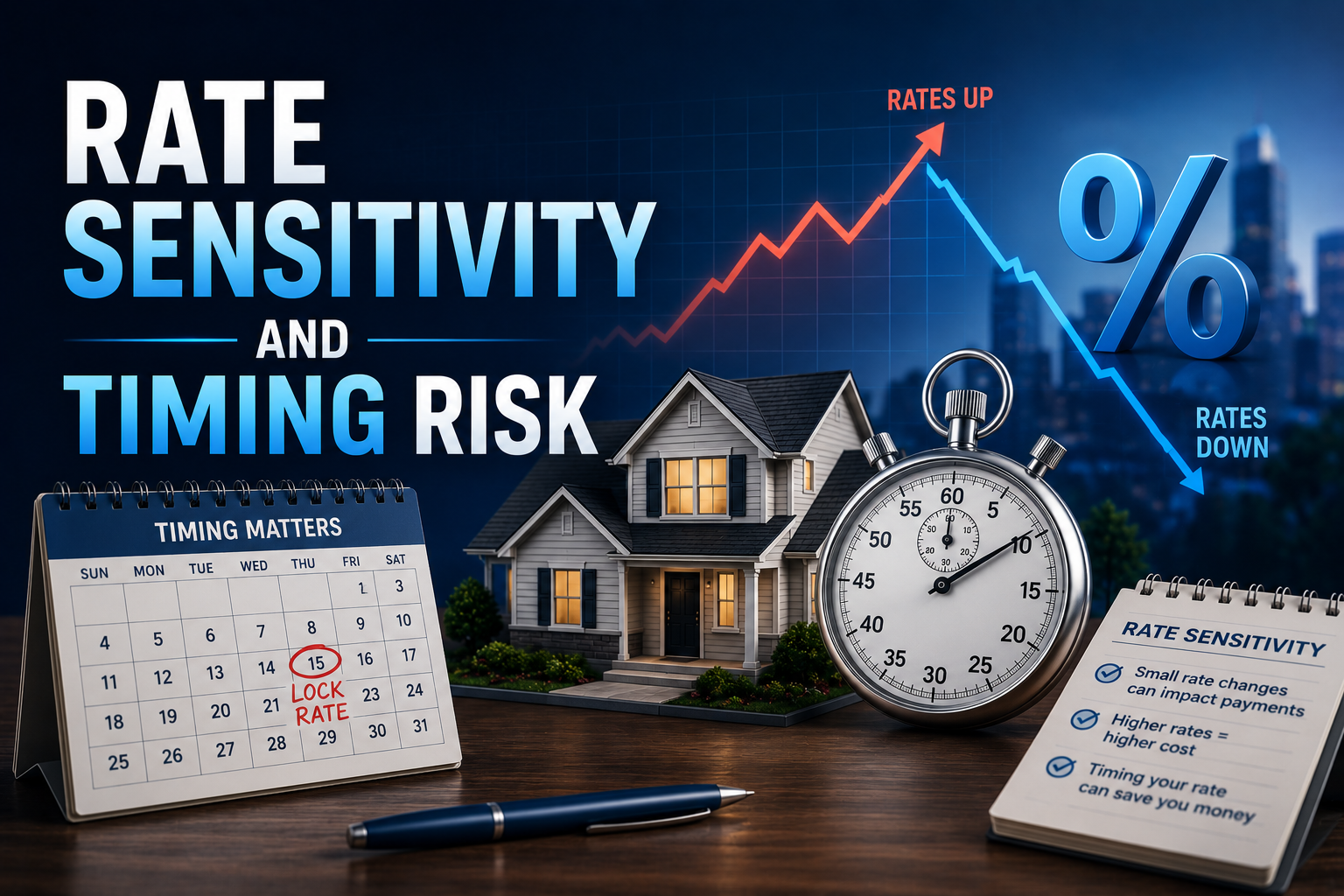
There is also a timing risk that’s easy to underestimate. Rates do not move in a straight line. A buyer might wait three, five, or even seven years for a meaningful drop, paying the original rate the entire time. The longer that window stretches, the longer the buyer needs to stay in the home afterward to clear the break-even point, and the less certain the eventual payoff becomes.
Section 05
Pros and Cons at a Glance
| Factor | Advantage (Pro) | Disadvantage (Con) |
|---|---|---|
| Home price | Locks in today’s purchase price and terms instead of waiting on an uncertain market | Home values can also fall after purchase, and closing/transaction costs are incurred either way, regardless of which direction prices move |
| Competition | Avoids future bidding wars once lower rates draw more buyers back into the market | May still face competition today depending on local inventory |
| Monthly payment | Payment can drop if a refinance later succeeds | The original payment must be affordable on its own; there’s no guarantee a lower payment ever arrives |
| Rate outlook | Refinancing can capture savings if rates fall as hoped | No guarantee rates fall; some cycles keep rates elevated for years |
| Refinance process | Simpler than buying a new home, no bidding, no new search | Closing costs of roughly 2 to 5 percent apply each time, and “no-cost” refinance offers often just build the cost into the rate instead |
| Qualification | Existing homeowners often refinance through their current lender | Future approval isn’t guaranteed if income, credit, or home value change in the meantime |
| Equity and wealth building | Builds equity through principal payments and potential appreciation starting immediately | Money spent on the original payment is unavailable for other investments in the meantime, an opportunity cost |
Section 06
Deeper Look at Each Factor
Home Price and Competition
Buying now locks in a specific price and a specific home, removing the uncertainty of what a given property might cost or whether it will still be available later. But this cuts both ways: home prices do not move in only one direction, and a buyer who purchases today is exposed to the possibility that local values soften, not just the possibility that they rise. Either way, the buyer has paid closing costs and transaction fees at purchase, and those costs don’t come back if prices move against them. When rates eventually fall broadly, demand from buyers who were previously priced out also tends to pick up, which can bring renewed competition for whoever is buying at that later point.
Payment and Rate Outlook
Because the strategy depends on being able to afford the loan at today’s rate without a future refinance, it’s worth stress-testing the payment against the household budget as it exists now, not as it might look if a rate drop materializes. Lenders also qualify buyers based on the rate at the time of the loan, which affects the approved loan amount today regardless of what happens to rates later. Rates themselves are shaped by inflation, economic growth, and central bank policy, none of which are predictable with certainty, so there’s no guarantee an anticipated drop arrives on any particular schedule, or at all.
Refinance Costs and Qualification
Refinancing is generally simpler than buying a new home, since there’s no bidding, negotiating, or new property search involved. That said, closing costs, appraisal fees, and lender fees typically run 2 to 5 percent of the loan amount, as shown in the worked example above. A borrower approved for a purchase loan today is not automatically approved for a refinance later either; income, credit score, debt-to-income ratio, or a drop in home value can all affect eligibility at that future point.
Equity and Opportunity Cost
Every month spent as a homeowner is a month building equity through principal payments and potential appreciation, rather than paying rent with no long-term return. At the same time, money spent on the mortgage payment is money unavailable for other investments or savings, and that gap can add up over several years, refinance or not.
Section 07
Alternatives Worth Comparing
Buyers considering this approach often benefit from comparing it against a few alternatives before committing.
A temporary rate buydown, such as a 2-1 buydown, lowers the effective payment for the first one or two years by subsidizing the rate upfront, which can ease the initial adjustment period. It’s important to note that the borrower still has to qualify based on the permanent note rate, not the temporarily bought-down rate, so a buydown doesn’t lower the bar for approval the way a genuine rate reduction would. It also shouldn’t be treated as a bridge to a future refinance; once the buydown period ends, the payment steps up to the full permanent-rate payment regardless of whether rates have moved, so the buyer needs to be able to afford that full payment from the start.
An adjustable-rate mortgage may offer a lower initial rate than a fixed loan, though it carries the risk of rate increases once the fixed period ends. Continuing to rent while investing the difference in payment is another path, though it forgoes the equity building and price certainty that ownership provides.
Each alternative shifts risk differently, and the right choice depends on how long the buyer plans to stay, how much payment flexibility their budget allows, and their tolerance for rate uncertainty.
Section 08
Is This Strategy Right for Every Buyer?
This approach tends to work best for buyers who have found a home they genuinely want to stay in for many years, can afford the payment at today’s rate on its own without counting on a future refinance, and maintain enough of a financial cushion to handle unexpected costs. It’s less suitable for buyers stretching their budget to the maximum on the assumption that rates will fall, or for those who are uncertain about how long they plan to stay in the home.
Before committing, it helps to run the numbers the way they were run in the example above: pick a realistic point in the future where a refinance might happen, estimate the remaining balance at that point, apply a realistic new rate and term, factor in closing costs, and calculate the break-even period from there. A mortgage professional or financial advisor can help model these scenarios against individual circumstances.
Section 09
Final Thoughts
“Marry the house, date the rate” can be a reasonable way to think about buying in a higher-rate market, for buyers who find the right property and can afford the payment as it stands today. It shifts the focus away from trying to time the market perfectly and toward securing a home that fits long-term needs. The strategy only holds up, though, if the current payment is affordable on its own merits; treating a future refinance as a given, rather than a possibility, is where the real financial risk lives. As with most major financial decisions, the right choice depends on individual budget, risk tolerance, expected time in the home, and how the break-even math actually works out on paper before signing anything.
This content is for general informational purposes only and does not constitute financial or mortgage advice. Buyers should consult a licensed mortgage professional or financial advisor before making decisions.
Duc Pham, Mortgage Broker | NMLS# 844897,
Wonder Rates, Inc. | NMLS# 1518655 | DRE# 02047445 | DFPI# 60DBO-59134 |
Equal Housing Opportunity. Equal Housing Lender. |
Licensed in: AL, AZ, CA, CO, FL, GA, LA, MI, NC, OH, OK, OR, PA, SC, TX, VA, WA.