
Section 01
A 1099 income mortgage does not usually qualify an independent contractor using the total printed on their 1099 forms. For an agency loan, the lender commonly analyzes tax returns, business expenses, cash-flow adjustments, income history, and whether the earnings appear stable enough to continue.
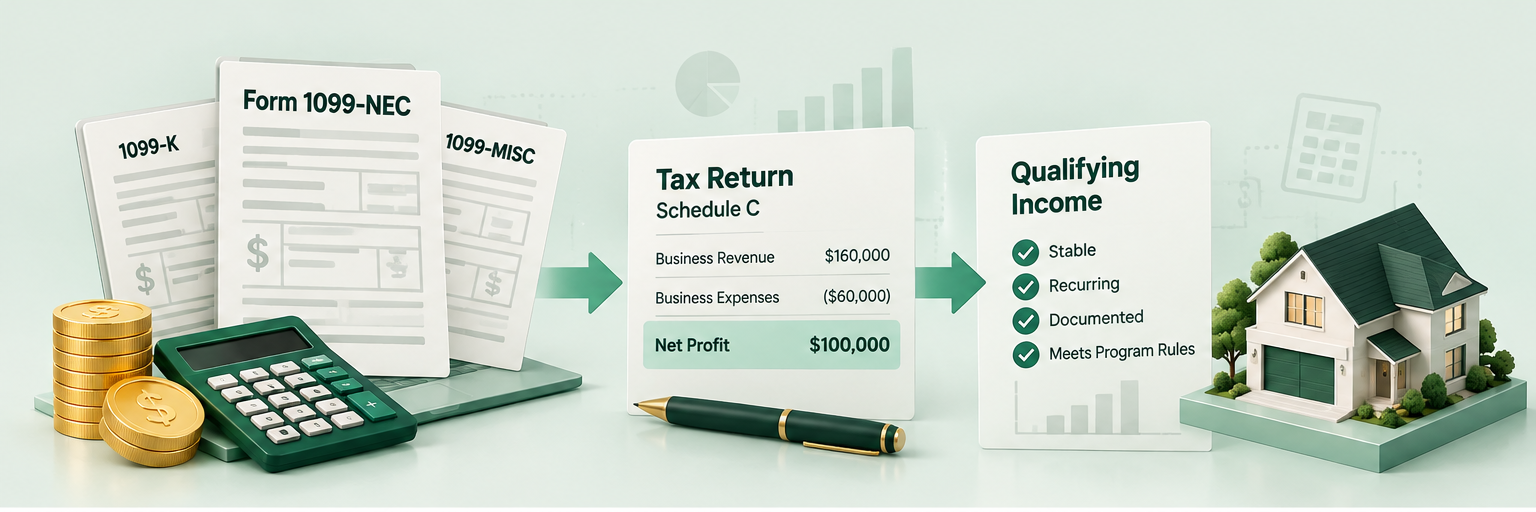
That is why a contractor who receives $160,000 in annual client payments may not have $160,000 of qualifying income. The difference is not necessarily an underwriting error. The 1099 reports payments received, while the mortgage analysis focuses on sustainable income available after the costs of operating the business.
Section 02
Myth: The Total on My 1099 Is My Qualifying Income
A Form 1099 may show what a client or platform paid during the year. It does not show the full cost of earning that money, whether the income is recurring, or the complete tax treatment of the business.
For a sole proprietor, the lender often starts with the income or loss reported on Schedule C rather than simply adding the 1099 totals. The IRS explains that Schedule C reports income or loss from a sole proprietorship. Other business structures, such as partnerships, S corporations, and corporations, require different forms and cash-flow analysis.
Section 03
Reality: Revenue, Net Profit, and Qualifying Income Are Different
These terms describe different parts of the calculation:
| Term | What it generally means |
|---|---|
| Revenue | Money paid to the business before business expenses |
| Gross profit or gross income | Revenue after applicable returns and direct costs |
| Net profit or loss | Business income after deductible expenses, often shown on Schedule C for a sole proprietor |
| Qualifying income | Income the lender determines is stable, recurring, documented, and available for mortgage qualification |
Qualifying income can differ from net profit because underwriting cash-flow analysis may add back certain deductions, subtract nonrecurring income, account for business obligations, and evaluate trends. It is therefore not accurate to calculate mortgage income by dividing the latest 1099 total by 12.
Section 04
How Lenders Calculate 1099 Income for a Mortgage
The method depends on the loan program, business structure, documentation, and underwriting findings.
Step 1: Identify the applicable tax-return income
The lender reviews filed federal tax returns or acceptable tax transcripts and the relevant schedules. For a sole proprietor, Schedule C net profit or loss is a common starting point. A partnership, S corporation, or corporation requires a different analysis, and income reported on a K-1 may need additional review before it can be treated as available to the borrower.
Step 2: Review recurring business expenses
Ordinary business expenses reduce net profit. Vehicle expenses, insurance, supplies, contract labor, advertising, software, and other costs can all affect the income shown on the return.
The lender applies the program’s cash-flow rules rather than simply reversing every tax-return entry.
Step 3: Make permitted cash-flow adjustments
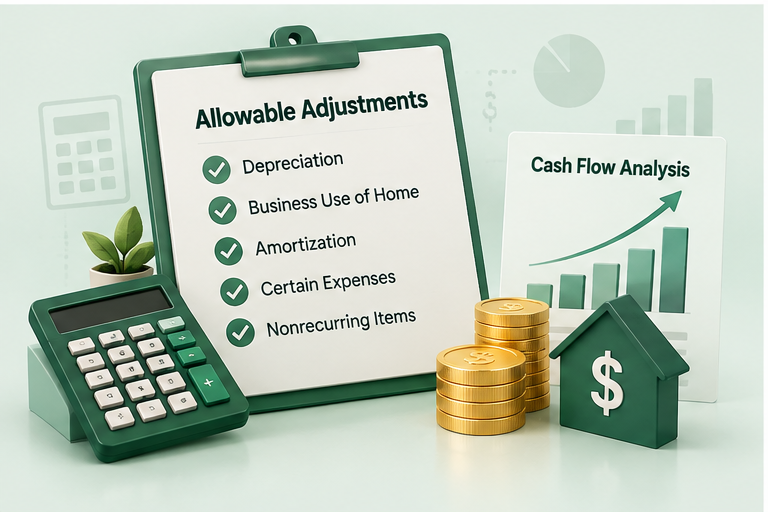
For Fannie Mae Schedule C analysis, recurring deductions for depreciation, depletion, business use of a home, amortization, and casualty losses are added back to cash flow. Nonrecurring income may need to be deducted. The official Schedule C income guidance from Fannie Mae explains these adjustments.
An add-back does not mean every business expense can be ignored. Expenses that represent an ongoing cash cost generally remain relevant.
Step 4: Evaluate income history and trends
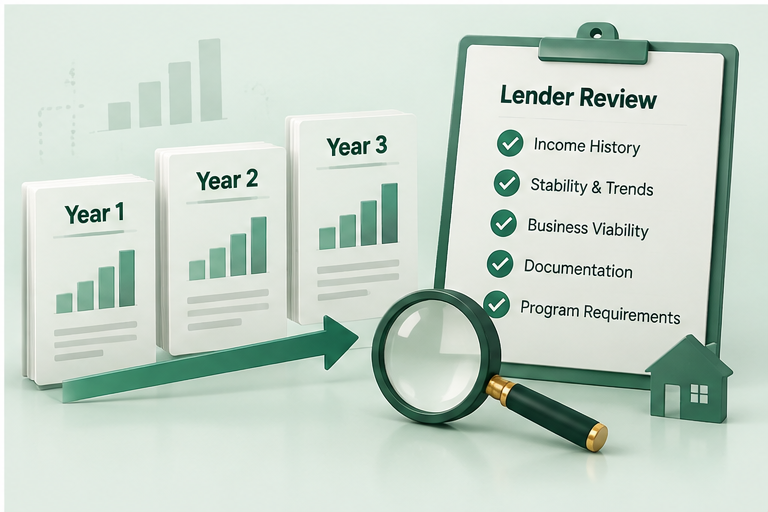
Fannie Mae generally requires a two-year history of prior earnings to help establish that self-employment income is likely to continue. A borrower with less than two years may still be considered when the most recent returns show a full 12 months in the current business and the file documents comparable prior income in the same field or a similar occupation.
This does not mean every lender always averages two years. Requirements vary by program and circumstances.
Step 5: Test stability and business viability
The lender looks at year-to-year changes in revenue, expenses, and taxable income. An upward trend does not automatically mean the latest and highest number will be used. A downward trend does not automatically mean only the latest year will be used. The underwriter must decide whether the income is stable and likely to continue, and a material decline may require explanation or additional documentation.
Fannie Mae describes this as an evaluation of the business’s financial strength and its ability to keep generating sufficient income. Its current self-employed borrower documentation guidance also explains when one or two years of returns may be required.
Section 05
A Simplified 1099 Income Calculation
Consider an independent contractor with two years of Schedule C activity. This example is for education only and does not represent a loan decision.
| Calculation | Year 1 | Year 2 |
|---|---|---|
| Business revenue | $150,000 | $160,000 |
| Business expenses | $40,000 | $42,000 |
| Schedule C net profit | $110,000 | $118,000 |
| Illustrative permitted depreciation add-back | $2,000 | $2,000 |
| Adjusted cash flow for this simplified example | $112,000 | $120,000 |
If the applicable analysis allowed these figures to be averaged, the calculation would be:
($112,000 + $120,000) ÷ 24 months = $9,666.67 per month
The contractor might have expected the most recent $160,000 of revenue to produce $13,333.33 per month. The simplified qualifying figure is lower because business revenue and sustainable personal cash flow are not the same measurement.
Business debts, nonrecurring income, entity structure, ownership, liquidity, and current performance may affect an actual file.
Use the Wonder Rates DTI calculator after a loan officer estimates qualifying income. Entering gross 1099 revenue as monthly income can produce a misleading affordability result.
Section 06
What Documents May Be Requested?
Depending on the program and file, a lender may request:
- personal federal tax returns with all applicable schedules;
- business federal tax returns when required;
- IRS tax transcripts or authorization to obtain them;
- recent business bank statements;
- a year-to-date profit and loss statement;
- a current balance sheet;
- evidence that the business remains active;
- documentation of business debts; and
- an explanation and supporting records for significant income changes.
Not every borrower needs every item. Our overview of the mortgage underwriting process explains why document requests can continue after the initial application.
Section 07
What If You Recently Switched From W-2 to 1099 Work?
Moving from employee status to contracting changes how earnings are documented. A higher contract rate does not necessarily produce higher qualifying income after business expenses.
Prior experience in the same field may support a shorter self-employment history under some guidelines, but it does not remove the need for a full documented period in the current business when the program requires it. The comparison of 1099 and W-2 mortgage qualification explains how the documentation methods differ.
Do not assume that applying before filing the next return will prevent the lender from seeing a slowdown. Depending on the file, the lender may review current profit and loss information, bank statements, business activity, and other evidence of continuing income.
Section 08
Should You Reduce Tax Write-Offs Before Applying?
Do not change accurate tax reporting simply to qualify. A loan officer can explain how returns may be analyzed but should not tell a borrower which deductions to claim. Filing an amended return does not guarantee that a lender will accept a higher income figure and can create additional questions. Coordinate early with both a loan officer and a qualified tax professional.
Section 09
When Tax Returns Do Not Support the Needed Income
Some borrowers explore non-QM programs when agency documentation does not reflect their current cash flow. Depending on availability and eligibility, these may include bank-statement or 1099-based programs.
A bank-statement program may analyze eligible deposits and apply an expense factor. A 1099-based program may use eligible 1099 income under that lender’s guidelines. These are not universal calculations, and the documentation, expense factor, down payment, reserves, pricing, and property requirements vary.
Review how bank-statement loans work for self-employed borrowers before comparing alternatives. A non-QM option may have different costs or terms than an agency loan, so compare the complete Loan Estimates and not only the income calculation.
Section 10
How to Prepare Before Applying
- Gather complete personal and business tax returns with every schedule.
- Identify each business, ownership percentage, and entity type.
- Keep business and personal transactions organized and explainable.
- Review current revenue and expenses rather than relying only on last year’s totals.
- Avoid opening new debt or moving business funds without discussing the impact.
- Ask for an income review before setting a home-price target.
- Consult a tax professional before changing tax filings or deductions.
Section 11
Frequently Asked Questions
Can I qualify for a mortgage with 1099 income?
Potentially. Independent contractors qualify for mortgages under agency, government, and non-QM programs, but the lender must document and calculate eligible income under the selected program. Approval also depends on credit, assets, debts, property, occupancy, and other underwriting factors.
Do lenders use gross 1099 income or Schedule C net profit?
For a sole proprietor using an agency program, Schedule C income or loss is commonly part of the starting analysis. Permitted adjustments may then be made. Certain non-QM programs may use eligible 1099 totals or bank deposits with an expense factor, but their rules vary.
Do I always need two years of self-employment?
No single answer applies to every program. Fannie Mae generally looks for a two-year earnings history, but may consider a shorter self-employment history when at least 12 months in the current business is documented and prior comparable experience and income requirements are satisfied.
What happens when income declined?
The lender evaluates the size and reason for the decline, recent business performance, and whether the income remains stable. The result may be a lower usable figure, additional conditions, or a determination that the income is not currently eligible. It is not accurate to assume that every lender simply uses the latest year.
Can depreciation be added back?
Certain depreciation may be added back under the applicable cash-flow analysis. The lender must review where it appears and whether the program permits the adjustment. An add-back does not make all business expenses disappear.
Section 12
See Your Income the Way an Underwriter Will
A Wonder Rates loan officer can review your income documents, identify the calculation that may apply, and compare available loan structures before you establish a purchase budget. Final income and approval remain subject to complete underwriting.
Start a 1099 income mortgage review with Wonder Rates.
Duc Pham, Mortgage Broker | NMLS# 844897
Wonder Rates, Inc. | NMLS# 1518655
Equal Housing Lender.
AZ, CA, CO, FL, GA, LA, MI, OK, PA, SC, TX, VA, WA, OH, AL, OR, NC
This article is for educational purposes only and is not a commitment to lend or tax advice. Income calculations and documentation requirements vary by loan program, lender, business structure, and underwriting method. Consult a qualified tax professional regarding tax reporting. Loan approval is subject to creditworthiness, income verification, property eligibility, and current underwriting guidelines. Loan programs, interest rates, and lender fees may change without notice. Always review your official Loan Estimate before making a financing decision.