Section 01
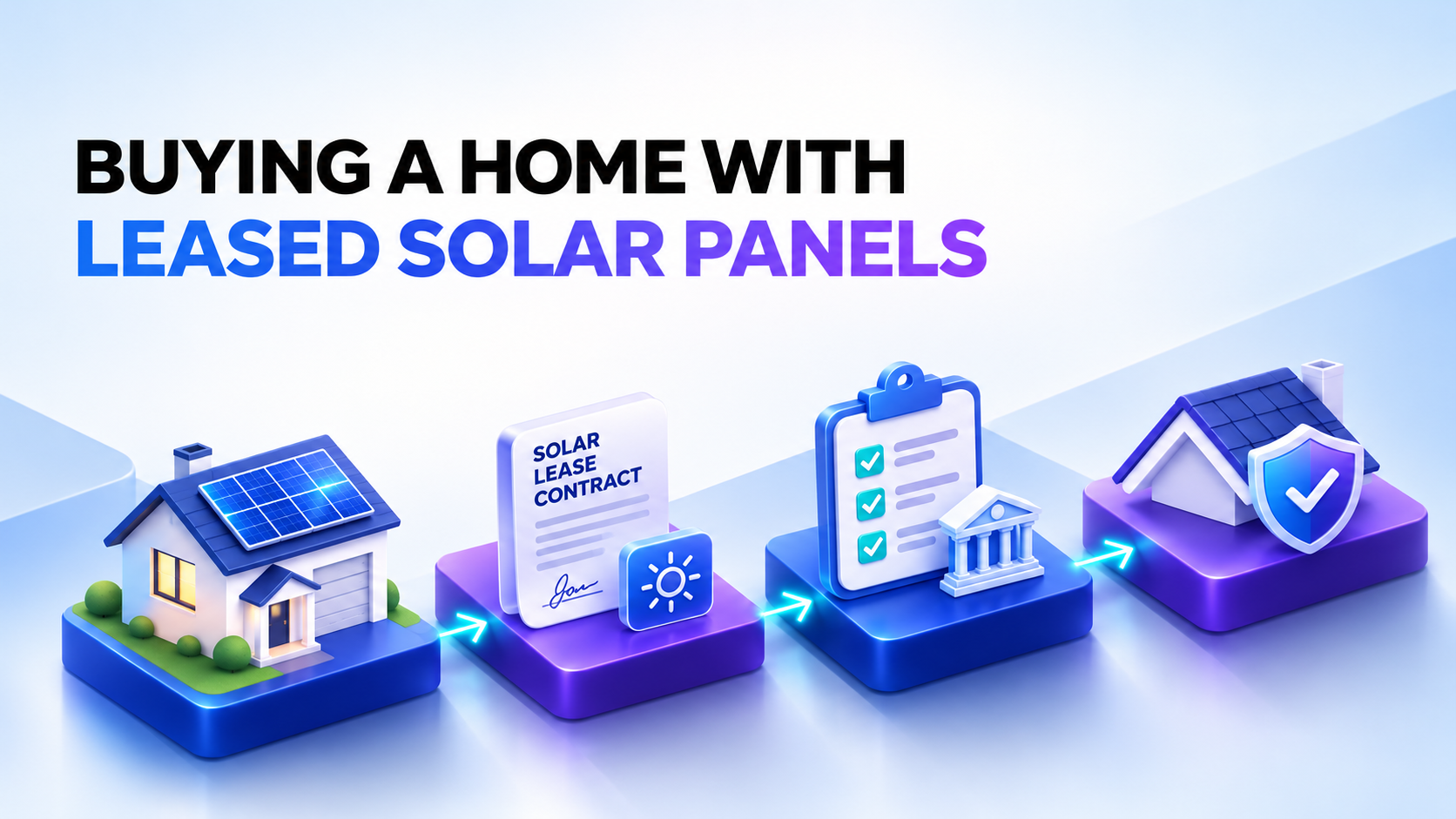
Buying a home with leased solar panels requires more than checking whether the electric bill looks lower. The buyer must understand who owns the equipment, whether a lease or power purchase agreement must be transferred, what payments remain, how the obligation is treated in mortgage underwriting, and what happens when the roof needs repair.
Solar equipment can be an asset, a contract obligation, or both. Review the complete agreement and obtain transfer approval early. Waiting until the week of closing can create an avoidable delay.
Section 02
First Determine Who Owns the Solar Panels
 Solar panels generally fall into one of several structures.
Owned outright: The homeowner owns the system without related solar financing. Confirm whether the equipment will transfer with the real property and whether any prior lien or filing has been released.
Financed purchase: The seller may own the equipment subject to a loan or other obligation. The payoff, lien position, and transfer arrangement require review.
Solar lease: A solar company or third party owns the equipment, and the homeowner pays under a lease.
Power purchase agreement: A third party owns the system, while the homeowner pays for electricity generated under a contract.
Do not rely on listing language such as “solar included.” Ask for the contract, amendments, current statement, transfer instructions, and information about any security filing.
Section 03
Nine Checks Before Buying a Home With Leased Solar Panels
 1. Read the transfer requirements
The solar provider may require the buyer to submit an application, authorize a credit review, sign an assumption or transfer document, or meet other conditions. The seller may also have obligations before the transfer can be approved.
Ask for the process and expected timing in writing. Confirm who pays transfer fees and what happens if the provider does not approve the buyer before closing.
2. Identify every payment obligation
Review the current payment, scheduled increases, remaining term, billing method, late charges, early termination provisions, and end-of-term options. A low initial payment does not show the entire future obligation.
If the agreement uses energy-production pricing, understand how usage and production affect the bill. Ask for recent bills and production reports, but remember that another household’s usage may not predict yours.
3. Ask how the lender will treat the obligation
The payment may need to be considered in underwriting depending on the agreement, program, and lender analysis. The lender may need to determine whether the arrangement creates a debt obligation, lien, ownership interest, or other property eligibility concern.
Provide the complete solar documents early. Do not omit the agreement because the payment appears on a utility statement rather than a traditional loan statement.
Fannie Mae’s current guidance addresses property eligibility when solar equipment is owned, financed, leased, or subject to a power purchase agreement. Other investors and lenders may apply different rules.
4. Review liens and UCC filings
A solar provider may record or file an interest related to its equipment. The title company and lender need enough information to determine whether it affects the mortgage lien, title coverage, or closing requirements.
Do not assume every filing is a lien against the real estate or that every filing can remain unchanged. Ask the title company, solar provider, and lender what must be subordinated, terminated, released, or documented.
5. Understand appraisal treatment
The appraiser does not automatically add the installation cost or projected utility savings to the home’s value. Market evidence and ownership structure matter.
Fannie Mae instructs appraisers that leased solar panels or panels owned by a third party under a power purchase agreement are treated as personal property and are not included in the appraised value. Review the official appraisal guidance for energy-efficient improvements and solar systems.
This does not mean the system has no practical value to the buyer. It means mortgage appraisal treatment follows specific requirements rather than a dollar-for-dollar calculation.
6. Investigate roof responsibilities
Ask who pays to remove and reinstall panels when the roof needs replacement or repair. Review whether the work must be performed by the solar provider or an approved contractor and whether labor, storage, shipping, or reactivation charges apply.
Obtain the roof age, inspection findings, permits, warranties, and installation records. If the roof is near the end of its useful life, the solar agreement can make the repair more complicated.
The home inspection and appraisal answer different questions. Use the Wonder Rates guide to home appraisal versus home inspection to plan both reviews.
7. Verify warranties and maintenance
Identify the warranties for equipment, installation, roof penetrations, monitoring, and production. Confirm whether warranties transfer and who handles service calls.
Ask what happens if the provider goes out of business, equipment stops reporting, or production falls below expectations. A warranty is useful only if its terms apply and a responsible party will perform the work.
8. Review insurance requirements
Determine whether the solar provider requires specific insurance coverage or must be listed in a particular way. Give the insurer the contract and equipment information.
Fannie Mae notes that additional property-insurance requirements can apply to panels leased from or owned by a third party. See its property insurance guidance for one-to-four-unit properties.
Insurance availability, exclusions, deductibles, and roof condition can affect the transaction. Obtain a quote before the insurance contingency or financing timeline becomes tight.
9. Plan for sale, refinance, or early payoff
The buyer may eventually sell or refinance. Review whether the agreement must be transferred again, prepaid, bought out, or subordinated. Ask how the buyout amount is calculated and whether purchase options occur only at specific times.
A future refinance is not guaranteed. A solar obligation that works with today’s lender may be treated differently by another lender or program later.
Section 04
Documents to Request From the Seller
 Request the following as early as possible:
- Original solar contract and all amendments
- Current account statement
- Transfer and assumption instructions
- Payment schedule and escalation terms
- Equipment ownership information
- UCC or lien-related documents
- Installation permits and inspection approvals
- Roof warranty and solar penetration warranty
- Equipment and labor warranties
- Production reports and recent utility statements
- Insurance requirements
- Buyout, prepayment, and removal provisions
Missing documents do not necessarily make the property ineligible, but they make informed review harder and can delay underwriting.
Section 05
How Leased Solar Can Delay Closing
Common delays include waiting for the solar provider’s transfer approval, discovering an undisclosed financing obligation, resolving a title filing, obtaining an insurance decision, or clarifying roof and appraisal issues.
Send the documents to the loan officer and title company when the contract is accepted, not after underwriting asks. Wonder Rates explains how property and third-party issues can affect the schedule in its guide to mortgage closing delays.
The lender may also revisit debt calculations, property eligibility, appraisal conditions, or cash needed at closing. Read what happens during mortgage underwriting to understand why a solar agreement can become a loan condition.
Section 06
Should the Seller Pay Off or Buy Out the Solar Agreement?
There is no universal answer. A payoff or buyout may simplify the transaction, but the contract may limit timing or impose a significant cost. An assumption may preserve the existing arrangement but leave the buyer with a long-term obligation.
Any negotiation should identify:
- The exact payoff or buyout amount
- Who pays it
- Whether payment removes all related filings
- Whether ownership transfers with the home
- How the appraiser and lender will treat the result
- Whether the purchase contract needs an amendment
Do not rely on a seller’s estimate. Obtain written figures and instructions from the provider.
Section 07
Frequently Asked Questions
Can I get a mortgage on a home with leased solar panels?
Potentially. The lender will review the agreement, payment obligation, property eligibility, title, appraisal, insurance, and transfer process under the applicable program.
Do leased solar panels add value to the appraisal?
Under Fannie Mae guidance, panels leased from or owned by a third party under a power purchase agreement are treated as personal property and are not included in appraised value. Other assignments must follow their applicable rules.
Does the buyer have to assume the solar lease?
That depends on the contract and purchase negotiation. The agreement may permit assumption, payoff, buyout, or another resolution. Obtain written provider instructions.
Can a solar lien stop closing?
A filing or lien can require title and lender review. Whether it must be released or subordinated depends on its nature, loan program, lender, and title requirements.
Who pays to remove panels for a roof replacement?
The contract should address removal, reinstallation, approved contractors, and costs. If it does not, obtain written clarification before buying.
Section 08
Review the Solar Contract Before the Deadline
Leased solar should be evaluated as part of the home, mortgage, title, insurance, and household budget. The earlier the buyer provides complete documents, the more time the team has to solve transfer or eligibility problems.
Use the Wonder Rates Mortgage Payment Calculator to organize the estimated housing budget, then get started with Wonder Rates for a property-specific mortgage review. Calculator results are educational estimates.
Duc Pham, Mortgage Broker | NMLS# 844897
Wonder Rates, Inc. | NMLS# 1518655
Equal Housing Lender.
AZ, CA, CO, FL, GA, LA, MI, OK, PA, SC, TX, VA, WA, OH, AL, OR, NC
This article is for educational purposes only and is not legal, tax, insurance, solar, real estate, or lending advice. Solar agreements, transfer rules, liens, appraisal treatment, insurance requirements, and mortgage eligibility vary by provider, property, program, lender, and jurisdiction. Review the actual documents with qualified professionals.