Section 01
Yes, buying a home with your parents can be possible. But the mortgage requirements depend on how your parents take part in the purchase. That one detail shapes almost everything that follows.
Parents can help in several ways. They might give you money toward the down payment. They might apply for the loan with you as a co-borrower. In some cases, they might be a co-borrower who does not live in the home. They might also share ownership of the home, or play a mix of these roles. Helping with the money and signing for the loan are two very different things.
It also helps to know that “co-signer” and “co-borrower” are not always the same. Each role can affect income, debts, credit, title, and occupancy in its own way.
In this guide, we start with how parents can take part. Then we cover income, credit, DTI, the down payment, gift funds, and title. After that, we look at loan programs, documents, underwriting, a full example, common mistakes, and how to decide what you can afford.
Section 02
Can You Buy a Home With Your Parents?
Yes, but the Mortgage Structure Matters
The lender needs to know exactly how your parents are involved. Are they giving money, borrowing with you, owning the home with you, or some mix? The answer decides which rules apply.
Common Ways Parents Can Help Buy a Home
Here are the most common setups:
- A parent gives money for the down payment.
- A parent becomes a co-borrower on the loan.
- A parent becomes a co-borrower who does not live in the home, where the loan program allows it.
- A parent becomes a co-owner on the title.
- A parent helps with closing costs.
Why the Structure Changes the Mortgage Requirements
When a parent only gives you money as a gift, the lender mainly needs to confirm the gift. When a parent signs the mortgage application, the lender reviews that parent’s whole financial picture too. These two paths lead to very different requirements.
Section 03
Buying a Home With Parents vs. Buying a Home With Parents as Co-Borrowers
Before we go further, let’s define each role. This will make the rest of the guide easier to follow.

Parents as Gift Donors
A gift donor gives you money for the purchase but does not borrow. In most cases, their income and debts are not part of your loan review. The lender just needs proof that the money is a true gift.
Parents as Co-Borrowers
A co-borrower applies for the mortgage with you. They share legal responsibility for paying back the loan. The lender reviews their income, debts, credit, and assets along with yours.
Parents as Co-Signers
People often use “co-signer” loosely. In mortgage lending, the exact meaning depends on the lender and the loan program. For example, Fannie Mae’s guide on co-signers and non-occupant borrowers treats guarantors, co-signers, and non-occupant borrowers as distinct roles. So do not assume co-signing and co-borrowing are the same. Always confirm the exact role shown on your application and closing papers.
Parents as Co-Owners
Ownership is a separate question from who owes the loan. A parent can be on the title, which shows who owns the home, without being on the loan. A parent can also be on the loan without owning the home, depending on the program. We cover this more below.
Section 04
The mortgage requirements when buying a home with parents usually involve reviewing every person who is a borrower on the loan. Depending on the setup, that can include each person’s credit history, qualifying income, job, debts, assets, and down payment funds. The lender may also need to know who will live in the home and who will own it. The exact rules vary by loan program, lender, and the relationship between the borrowers.
Credit Requirements
The lender reviews each borrower’s credit history, payment history, current debts, and overall credit profile.
Income Requirements
Qualifying income can come from many sources. These include salary, W-2 wages, self-employment, retirement income, Social Security where eligible, and other income that can be documented.
Debt Requirements
Each borrower’s debts are reviewed too. These can include credit cards, car loans, student loans, personal loans, an existing mortgage, and other regular payments.
Asset Requirements
The lender checks the money for the down payment, closing costs, and any required reserves. It also confirms where that money came from.
Occupancy Requirements
Occupancy means who will live in the home. This matters a lot if your parents will not live there. Some loans have special rules for borrowers who do not live in the home.
Section 05
Can Your Parents' Income Help You Qualify for a Mortgage?
When Parent Income May Be Considered
If a parent is a borrower on the mortgage, their qualifying income may count toward the loan. This depends on the loan program and the lender’s rules.
Parent Income Is Not Automatically Qualifying Income
It is easy to think, “My parents earn $100,000, so we can use that.” But it does not work quite that simply. The lender checks the type of income, how steady it is, and how it is documented. It also looks at whether the parent works or is retired, what debts they have, and what the program allows.
What Happens to Your Parents’ Debts?
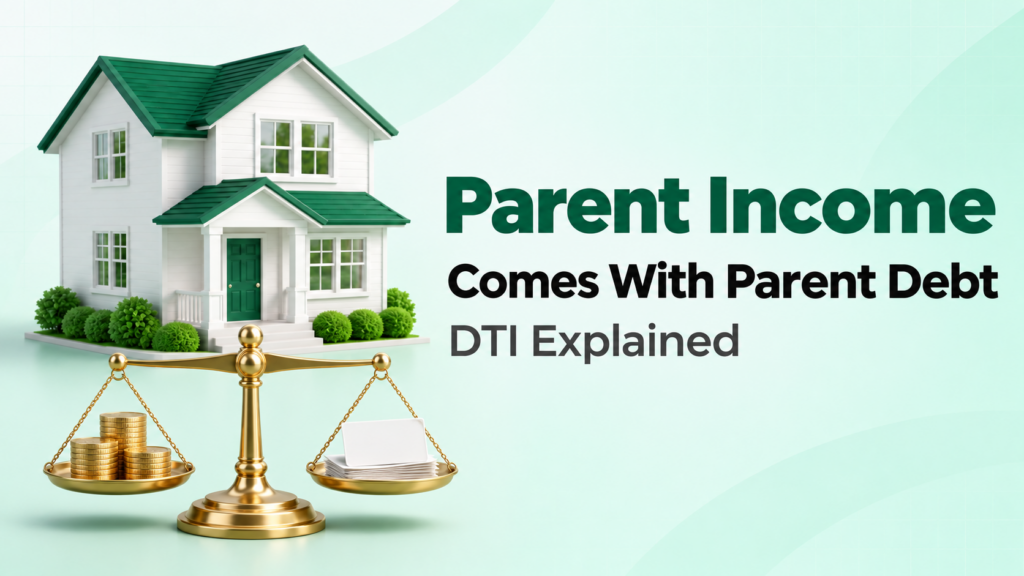
This is the key tradeoff. When a parent joins the loan as a borrower, the lender usually considers their debts as well as their income. A parent’s income comes with a parent’s debts. Extra income can help, but extra debt can also work against you.
Section 06
How Credit Works When Buying a Home With Parents
Whose Credit Does the Lender Review?
When more than one person is a borrower, the lender generally reviews the credit of each borrower.
Does a Parent’s Credit Score Affect the Mortgage?
It can. How a lender uses more than one credit score depends on the loan program and how the loan is underwritten. Different programs and approval systems handle multiple borrowers in different ways, so there is no single rule that applies to every loan.
Why Parents Should Review Their Credit Before Applying
Before you apply, it is smart for your parents to check their credit reports too. They can look for errors, recent late payments, new accounts, high balances, an existing mortgage, and how much of their available credit they are using.
Section 07
How DTI Works When Buying a Home With Parents
What Is DTI?
Your debt-to-income ratio, or DTI, compares your monthly debt payments to your gross monthly income. Lenders use it to judge whether you can take on a new mortgage payment.
How Parent Income and Debt Can Affect DTI
When a parent joins the loan, the basic formula still applies:
DTI = Monthly Debt Obligations ÷ Gross Monthly Qualifying Income
But now the lender may add up everyone’s income and everyone’s debts. Adding a parent can change both the income available for qualifying and the debts that may be counted. To learn more, read our guide on how debt-to-income ratio affects mortgage qualification.
Why Adding a Parent Is Not Always Automatically Better
Here is a quick example. Say a child earns $7,000 a month and has $1,000 in monthly debts. A parent earns $5,000 a month but has $3,500 in monthly debts, perhaps from their own mortgage. The new housing payment would be $2,500 a month.
- Child alone: ($2,500 + $1,000) ÷ $7,000 = 50% DTI
- Child and parent together: ($2,500 + $1,000 + $3,500) ÷ $12,000 = about 58.3% DTI
In this case, adding the parent actually raises the DTI, because the parent’s debts are large compared with their income.
Disclaimer: This is a simplified, hypothetical example for illustration only. It does not represent any lender’s DTI limits or approval standards. Actual qualifying income, debts that count, and DTI treatment vary by loan program, lender, and borrower circumstances.
Section 08
Down Payment Requirements When Buying a Home With Parents
Who Can Provide the Down Payment?
The down payment can come from you, from your parents, or from both. It can also include gift funds where the loan program allows them.
Can Parents Gift Money for a Down Payment?
Yes, in many cases. Parents are often allowed to give gift funds, but the rules depend on the loan program and your situation.
Gift Funds vs. Parent Becoming a Co-Borrower
This is an important difference.
- Gift: A parent gives you money but does not necessarily become a borrower. The lender mainly needs to confirm the gift.
- Co-borrower: A parent joins the loan, takes part in qualifying, and shares legal responsibility for paying it back.
Documentation for Gift Funds
If your parents give you money, you may need:
- A signed gift letter stating the money is a gift, not a loan
- Proof that your parents had the funds
- Records of the transfer to you
- Other proof of where the money came from
The exact rules vary by loan program. Before any money moves, talk with your lender so the paper trail is set up correctly.
Section 09
Can Parents Be Co-Borrowers If They Do Not Live in the Home?

What Is a Non-Occupant Co-Borrower?
A non-occupant co-borrower is someone who signs the loan but does not live in the home. A parent who helps their child qualify but keeps living in their own house is a common example.
Why Occupancy Matters
Lenders separate borrowers into those who live in the home and those who do not. For a primary residence loan, at least one borrower must live there. Loans with non-occupant borrowers can come with different limits.
Loan Program Rules Can Differ
Each program treats non-occupant borrowers differently. Here are two examples:
- Conventional (Fannie Mae): Fannie Mae’s guide says non-occupant borrowers are allowed on purchase transactions. When their income is used to qualify, the maximum loan-to-value ratio is generally 95% for loans run through its automated system. For manually underwritten loans, it is 90%. On manually underwritten loans, the borrower who lives in the home generally must pay the first 5% of the down payment from their own funds. There are some exceptions.
- FHA: According to HUD’s Single Family Housing Policy Handbook, loans with a non-occupying borrower are generally limited to a 75% loan-to-value ratio. That limit can rise to 96.5% when the borrowers are family members. There are some exceptions, such as when a family member sells the home to a relative who will be a non-occupying co-borrower.
Other programs, such as VA and USDA, have their own rules.
Why You Should Confirm This Before Making an Offer
Since these limits can change how much you need to put down, check the rules early. Finding out late could mean you need more cash than you planned.
Section 10
Mortgage Requirements for Parents Buying a Home With Their Adult Child
Parent and Adult Child as Co-Borrowers
When a parent and adult child borrow together, the lender reviews both of their incomes, debts, credit, and assets.
Parent and Adult Child as Co-Owners
When both own the home, both names usually appear on the title. Who is on the loan is a separate question.
Parent Helps With Cash but Does Not Borrow
When a parent only helps with money, the lender mainly reviews the child’s finances and the gift paperwork.
Parent Lives in the Home vs. Does Not Live in the Home
If the parent lives in the home, they are an occupant borrower. If not, they may be a non-occupant co-borrower, which can bring extra rules.
Here is a general way to think about each role. Keep in mind that this table is a simple guide, not a legal or underwriting rule.
| Parent’s Role | May Affect Income? | May Affect Debt? | On Mortgage? | Potentially On Title? |
|---|---|---|---|---|
| Gift donor | Usually no | Usually no | No | Not necessarily |
| Co-borrower | Yes, if qualifying | Yes, subject to rules | Yes | Depending on structure |
| Co-owner | Not necessarily | Not necessarily | Not necessarily | Yes |
| Non-occupant borrower | Potentially | Potentially | Yes | Depends |
Section 11
Does Your Parent Need to Be on the Title?

Mortgage and Title Are Not the Same Thing
The mortgage is the debt. It shows who owes the money. The title, or deed, shows who owns the home. Being on the loan and owning the home are not the same thing.
Can a Parent Be on the Mortgage but Not the Title?
Sometimes, but not always. Whether this is allowed depends on the loan program, the lender, state law, and how the deal is set up. Some programs require every borrower to also hold title.
Can a Parent Be on the Title but Not the Mortgage?
This also depends on the lender, the program, and how title is held. In some cases, a lender may still need that person to sign certain documents.
Why You Should Decide the Ownership Structure Before Closing
Changing who owns the home later can have legal, tax, estate, and financing effects. It is much easier to plan this before closing. If you have questions about ownership or inheritance, talk with a qualified attorney or tax professional.
Section 12
Mortgage Requirements by Loan Program
Each loan program has its own rules for family members, so it helps to know the basics.
Conventional Loans
Conventional loans can allow more than one borrower, including non-occupant borrowers, as covered above. Lenders review each borrower’s income, credit, and DTI. Gift funds are often allowed, and some lenders add their own extra rules.
FHA Loans
FHA loans allow more than one borrower and have special rules for family members. As noted above, a non-occupying family member co-borrower may allow up to 96.5% financing, while non-family non-occupant borrowers are generally limited to 75%. FHA also has its own rules for gift funds and occupancy.
VA Loans
VA loans are for eligible veterans, service members, and certain surviving spouses. Co-borrower rules for VA loans are more limited and differ from other programs, so check with a VA lender before you plan on adding a parent.
USDA Loans
USDA loans look at household income, not just the borrowers’ income. They also have property and occupancy rules. Adding a parent who lives in the home can affect household income limits, so review this early.
Since these rules change, always confirm the current guidelines for the program you are considering.
Section 13
Documents Needed When Buying a Home With Parents
Documents for You
- A government-issued ID
- Pay stubs
- W-2s
- Tax returns, where they apply
- Bank statements
- Job details
- Debt information
Documents for Your Parents
If your parents are borrowers, they may need:
- A government-issued ID
- Income documents
- Job or retirement records
- Bank statements
- Tax returns, where they apply
- Debt information
- Asset records
Additional Documents for Gift Funds
- A gift letter
- Proof of the donor’s funds
- Transfer records
- Proof of where the money came from
Why Multiple Borrowers Can Mean More Documentation
The more borrowers there are, the more financial information the lender needs to verify. So expect a longer document list than with a single-borrower loan.
Section 14
How Mortgage Underwriting Works When Buying With Parents
The Lender Reviews Each Borrower’s Financial Profile
Each borrower’s finances are reviewed, not just the person who will live in the home.
Income and Employment Verification
The lender confirms each borrower’s income and job or retirement status.
Credit and Liability Review
It reviews each borrower’s credit and debts.
Asset and Down Payment Verification
It confirms the source of the down payment, including any gift funds.
Property and Occupancy Review
It checks the home and confirms who will live there.
Conditions and Additional Documentation
The underwriter may ask for more documents before final approval. Our guide on how mortgage underwriting works walks through the full process.
Section 15
How Buying a Home With Parents Can Affect Mortgage Approval
Potential Advantages
Adding a parent can bring more qualifying income, more savings, a larger down payment, or shared housing costs.
Potential Challenges
It can also add more debt, credit issues, complex income records, occupancy questions, title complexity, and questions about who owns what in the future.
More Borrowers Do Not Automatically Mean a Better Application
More borrowers do not automatically mean a stronger application. Each new borrower brings both strengths and risks. The right structure is the one that fits your family’s full picture.
Section 16
Buying a Home With Parents and Retirement Income
Can Retirement Income Be Used?
If a retired parent is a borrower, their retirement income may count. This can include a pension, Social Security, or regular withdrawals from a retirement account. Still, not all retirement income automatically qualifies, and each type has its own rules.
Documentation May Differ From Employment Income
Retirement income is proven with different papers, such as award letters, pension statements, or account statements.
Age Alone Does Not Determine Mortgage Eligibility
Age does not decide whether someone can get a mortgage. Federal fair lending law generally prevents lenders from turning someone down because of age, as long as they can legally sign a contract.
Existing Mortgage or Housing Expense
If your parents already own a home, their current housing costs may count as debts in your loan review. This depends on the deal and the program’s rules.
Section 17
How Much Mortgage Can You Afford When Buying With Parents?
Qualification vs. Affordability
Qualifying for a loan is not the same as being able to afford it. A combined application may qualify for more, but the payment still has to fit everyone’s budget. Our guide on how much house you can afford can help.
Consider the Combined Monthly Housing Cost
Your monthly housing cost may include:
- Principal
- Interest
- Property taxes
- Homeowners insurance
- Mortgage insurance
- HOA dues
- Maintenance
- Utilities
- Other property expenses
Consider Who Will Actually Pay the Mortgage
Even if one person plans to make most of the payments, every borrower on the loan is legally responsible for it. If payments are missed, it can affect everyone’s credit.
Consider Future Changes
Life changes. A parent may retire, someone may change jobs or move, or the family may want to refinance or sell. Plans for inheritance can also come up. Talk through these “what ifs” before you buy.
Section 18
Calculate Your Potential Mortgage Payment
Adding parents does not change how a mortgage payment is calculated. But it may change how much you qualify for and how the purchase is set up.
What to Estimate
To estimate your payment, gather:
- The home price
- The down payment
- The loan amount
- The interest rate
- The loan term
- Property taxes
- Homeowners insurance
- Mortgage insurance, where it applies
Use the Wonder Rates Mortgage Payment Calculator
The Wonder Rates Mortgage Payment Calculator can help you estimate your monthly payment, including taxes, insurance, PMI, and HOA dues.
Section 19
Example: Buying a Home With Parents
Let’s walk through a made-up example.
Example Scenario
- Adult child income: $85,000 a year, or about $7,083 a month
- Parent income: $50,000 a year, or about $4,167 a month
- Child’s existing monthly debt: $600
- Parent’s existing monthly debt: $1,200
- Home price: $500,000
- Down payment: $100,000, with the parent paying part of it
- Loan amount: $400,000 at an assumed 6.5% fixed rate for 30 years
- Estimated housing payment: about $3,178 a month, including about $2,528 in principal and interest, $500 in taxes, and $150 in insurance
- The parent will not live in the home
Here is how the DTI might look:
- Child alone: ($3,178 + $600) ÷ $7,083 = about 53.3% DTI
- Child and parent together: ($3,178 + $600 + $1,200) ÷ $11,250 = about 44.3% DTI
In this case, adding the parent lowers the DTI, because the parent’s added income outweighs their added debt.
What the Lender Would Need to Review
The lender would review both incomes, both credit profiles, and both sets of debts. It would also check the source of the down payment, who will live in the home, the property, and the loan program. Since the parent will not live in the home, non-occupant borrower rules would also apply.
Why the Example Does Not Mean the Borrower Will Qualify
This example shows how the numbers can change, not whether the loan would be approved. Credit, documents, occupancy rules, and the program’s limits could all still affect the outcome.
Disclaimer: This scenario is hypothetical and is provided solely to illustrate the types of factors a lender may review when a parent and adult child apply for a mortgage together. It is not a pre-approval, loan quote, underwriting decision, or guarantee of eligibility. Actual qualifying income, debts, credit requirements, DTI limits, down payment requirements, occupancy rules, and loan terms vary by lender, loan program, property, location, and borrower circumstances.
Section 20
Common Mistakes When Buying a Home With Parents
Assuming Parent Income Can Be Added Without Parent Debt
When a parent joins the loan, their debts usually come with their income.
Assuming Parents Must Be on the Title
Parents can help without owning the home, depending on how the deal is set up.
Assuming Parents Must Be on the Mortgage
A parent can often help with a gift instead of borrowing.
Confusing a Gift With a Co-Borrower Arrangement
A gift and a co-borrower role lead to very different requirements.
Not Checking Occupancy Rules
Non-occupant borrowers can bring different down payment and loan-to-value limits.
Waiting Until Closing to Discuss Ownership
Ownership decisions are much easier before closing than after.
Moving Gift Funds Without Proper Documentation
Moving money without a paper trail can delay or derail your loan.
Assuming All Loan Programs Treat Parents the Same Way
Each program has its own rules for family members and non-occupant borrowers.
Focusing Only on Qualification and Not Long-Term Affordability
A loan you can qualify for still needs to fit your family’s budget for years to come.
Section 21
Questions to Ask Before Buying a Home With Your Parents
Before you move forward, talk through these questions as a family.
Who Will Be on the Mortgage?
Decide who will sign the loan and share responsibility for it.
Who Will Be on the Title?
Decide who will own the home and in what shares.
Who Will Live in the Property?
This affects occupancy rules and loan options.
Whose Income Will Be Used?
Decide whose income will help qualify for the loan.
Whose Debts Will Be Considered?
Remember that each borrower’s debts may count.
Who Provides the Down Payment?
Clarify where the down payment money will come from.
Is the Money a Gift or an Ownership Contribution?
A gift is different from money paid in exchange for a share of the home.
Who Will Make the Monthly Payments?
Agree on who pays, and what happens if that changes.
What Happens If Someone Moves Out?
Think about how a move would affect the loan and the home.
What Happens If the Home Is Sold?
Decide how sale money would be split.
What Happens If a Parent Dies or Needs to Move?
These are hard questions, but they matter. Talk with a qualified attorney or tax professional about the legal and estate effects of your plan.
Section 22
Mortgage Requirements Checklist When Buying With Parents
Borrower Checklist
- Identify every borrower
- Review credit
- Document income
- Document job or retirement income
- List all debts
- Review DTI
- Verify assets
- Decide on the down payment source
Parent Participation Checklist
- Gift donor or co-borrower?
- Living in the home or not?
- On the mortgage?
- On the title?
- Existing mortgage?
- Existing housing costs?
- Gift paperwork needed?
Property Checklist
- Purchase price
- Property taxes
- Insurance
- HOA
- Who will live there
- Property type
- Appraisal
Loan Checklist
- Conventional
- FHA
- VA
- USDA
- Other programs that may apply
Section 23
What to Know Before Buying a Home With Parents
Buying a home with parents can make homeownership possible when one person may not qualify alone. But adding a parent changes the financial structure of the mortgage. The lender may review more income, debts, credit history, assets, and occupancy details. How much this helps depends on whether the parent is a gift donor, co-borrower, co-owner, or another participant.
The most important step is to decide the structure before you make an offer. Know who will be on the mortgage, who will be on the title, who will live in the home, and who will provide the down payment. These choices can affect underwriting, documents, ownership rights, and future responsibilities. Loan program rules and state laws should also be reviewed before you lock in the plan.
Finally, qualifying is not the same as affording. A combined application may raise your qualifying income, but a parent can also bring debts into the review. Look at the expected payment, taxes, insurance, upkeep, and other costs alongside your family’s long-term plans. When ownership or estate questions come up, qualified legal and tax professionals can help.
Section 24
Explore Your Mortgage Options
Buying a home with parents can take more planning than a standard single-borrower loan. The lender may need to review several financial profiles and how borrowing, ownership, and occupancy fit together. Reviewing the structure early can show whether a parent’s income, assets, debts, or gift funds may help. A mortgage professional can also help you see which loan programs may fit your family’s plan before you make an offer.
Get Started to talk through your scenario, or explore home purchase options.
Section 25
Disclaimer
This article is provided for general educational and informational purposes only and should not be considered financial, mortgage, legal, tax, estate-planning, or investment advice. Mortgage requirements vary by lender, loan program, borrower circumstances, property, location, occupancy, and applicable federal, state, and local requirements.
When parents participate in a home purchase, the applicable mortgage requirements may depend on whether the parent is a gift donor, co-borrower, co-signer, co-owner, non-occupant borrower, or another participant in the transaction. These roles are not necessarily interchangeable, and the specific treatment of each person depends on the loan program, lender guidelines, underwriting requirements, and applicable law.
Any discussion of credit, income, debt-to-income ratios, down payments, gift funds, occupancy, title, loan limits, mortgage insurance, or other qualification factors is provided for general educational purposes. No particular credit score, income amount, DTI ratio, down payment, loan amount, interest rate, or other requirement mentioned in this article should be interpreted as a universal qualification standard.
Hypothetical examples are for educational purposes only and do not represent a mortgage quote, loan offer, pre-approval, underwriting decision, approval, or guarantee of eligibility. Actual requirements may differ based on the borrowers, property, loan program, lender, documentation, and current underwriting guidelines.
Ownership and title decisions may have legal, tax, estate-planning, and financial consequences that are outside the scope of this article. Buyers considering joint ownership with parents should consult appropriately qualified legal and tax professionals regarding their individual circumstances.
Mortgage guidelines, rates, fees, loan limits, program requirements, and lender policies may change over time. Final loan eligibility, terms, pricing, and approval are determined by the lender based on the completed application, underwriting, property review, applicable guidelines, and other transaction-specific factors.
Duc Pham, Mortgage Broker | NMLS# 844897, Wonder Rates, Inc. | NMLS# 1518655 | DRE# 02047445 | DFPI# 60DBO-59134 | Equal Housing Opportunity. Equal Housing Lender. | Licensed in: AL, AZ, CA, CO, FL, GA, LA, MI, NC, OH, OK, OR, PA, SC, TX, VA, WA.