Section 01
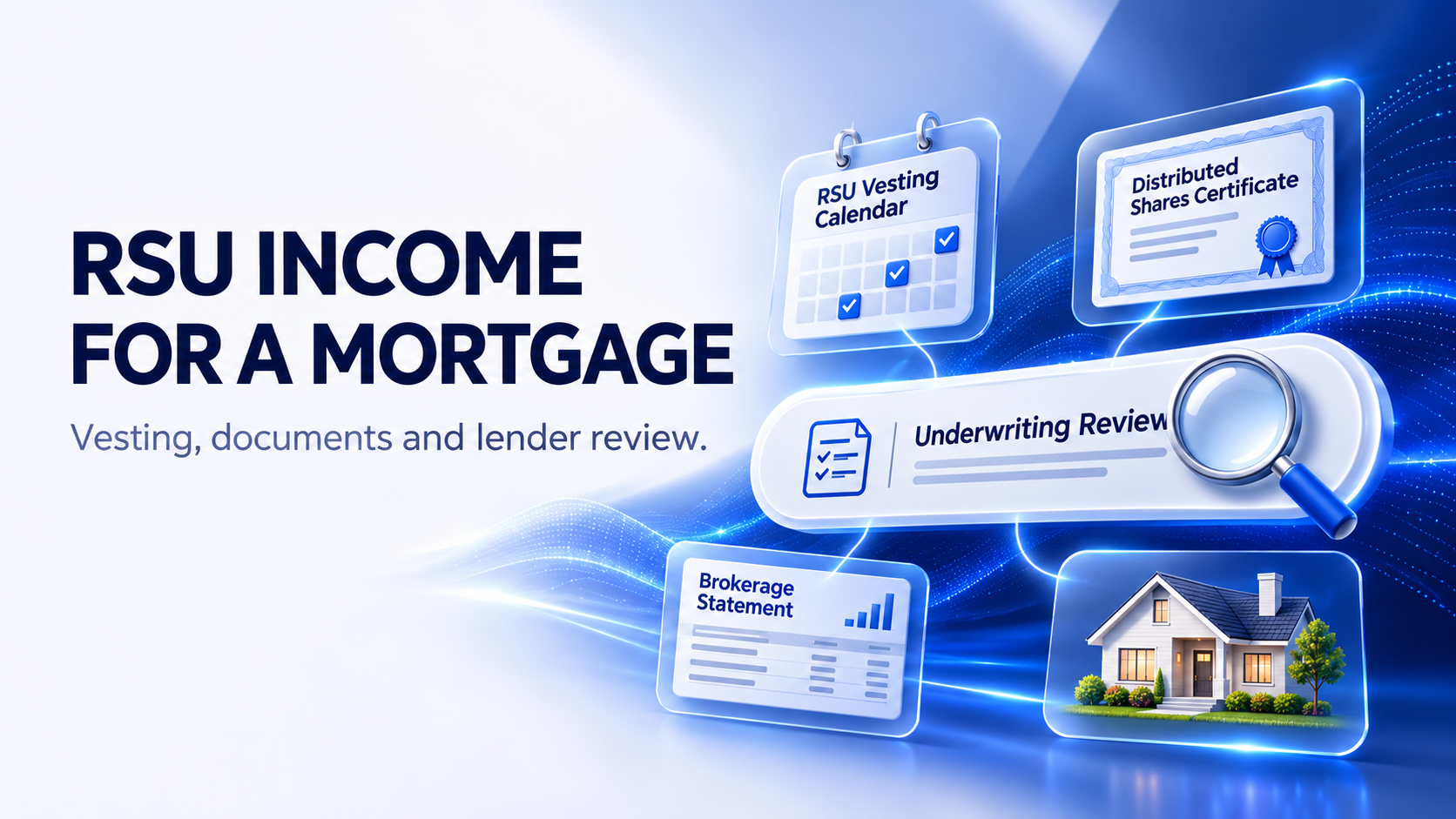
RSU income for mortgage qualification may be usable when the income is vested, documented, sufficiently established, and expected to continue under the applicable loan guidelines. A large unvested grant does not automatically become qualifying income, and the value shown in an employer portal is not necessarily the monthly amount an underwriter can use.
Borrowers who receive restricted stock units should prepare early. The lender may need employment records, W-2s, paystubs, vesting schedules, brokerage statements, evidence that the stock is publicly traded, and a calculation that addresses fluctuating share value.
Section 02
What Are Restricted Stock Units?
Restricted stock units, commonly called RSUs, are a form of employer compensation. The employer promises to deliver shares or a cash equivalent when specified conditions are met. Vesting may depend on time, performance, or both.
An RSU grant passes through several stages:
- The employer awards the grant.
- The units remain unvested during the required period or until performance conditions are met.
- The units vest.
- Shares or cash are distributed, often with withholding for taxes.
- The employee may hold or sell distributed shares, subject to company rules and securities law.
Mortgage underwriting distinguishes a future possibility from income already received. The grant’s headline value does not by itself establish stable qualifying income.

Section 03
Seven Facts About RSU Income for a Mortgage
1. Vested and distributed income matters
Under Fannie Mae’s current conventional guidance, restricted stock used as qualifying income must have vested and been distributed to the borrower without restrictions. The lender does not simply count all unvested awards shown in an account.
Review Fannie Mae’s official restricted stock income requirements. Other loan programs, investors, and lenders may use different rules.
2. The reason for the award can affect eligibility
An award based on time may be evaluated differently from a performance-based award. A one-time sign-on award may not receive the same treatment as recurring compensation.
Do not describe all equity compensation simply as “annual RSUs.” Give the lender the plan documents and grant history needed to identify the type of award.
3. History matters
The lender may review how long the borrower has received distributed RSU income and whether that history supports a stable calculation. The required or recommended history can differ based on the award type and applicable guideline.
A borrower who recently changed employers may have substantial future vesting but limited distribution history with the current employer. That does not automatically mean the income is unusable, but it can change the analysis.
4. Future vesting can matter without being counted dollar for dollar
The vesting schedule can help the lender evaluate continuance. It may show whether awards are recurring, whether a one-time grant ends soon, or whether future vesting supports the expected income stream.
Continuance requirements depend on the award and program. An underwriter may also consider whether employment is likely to continue and whether the vesting schedule has material conditions.
5. Stock price volatility affects the calculation
When income is paid in shares, a lender needs a method that does not simply use today’s market price. Fannie Mae’s current calculation uses a specified moving-average price and distributed vested shares over the applicable history.
This can produce a qualifying figure that differs from:
- The current value in a brokerage account
- The employee’s compensation statement
- The value at the original grant date
- The proceeds from one unusually strong vesting event
Do not plan a home price around a self-calculated RSU number. Ask the lender to complete the program-specific calculation.
6. Taxes and share withholding can confuse the documents
Employers often withhold or sell a portion of vested shares for taxes. The W-2, paystub, vesting statement, and brokerage account may present the transaction differently.
The lender needs documentation that reconciles the award, vesting, distribution, and reported income. Save grant notices and vesting confirmations rather than relying only on a year-end account screenshot.
7. RSUs can also be assets, but assets and income are different
Vested shares held in a brokerage account may be reviewed as assets for funds to close or reserves, subject to documentation, ownership, accessibility, valuation, and program requirements. Using an asset balance does not automatically mean the underlying awards can also be counted as monthly qualifying income.
If shares will be sold for closing funds, document the sale and transfer trail. Avoid large unexplained transfers shortly before underwriting.

Section 04
Documents a Lender May Request
The exact list depends on the loan and borrower, but prepare for requests such as:
- Recent paystubs showing RSU income or distribution
- W-2 forms
- Verification of employment
- Original grant agreements
- Current vesting schedule showing past and future vesting
- Brokerage or bank statements showing prior distributions
- Evidence that the stock is publicly traded
- Employer compensation statements
- Explanation of cash-paid versus share-paid awards
- Documentation of sales used for down payment or closing costs
The lender may request updated documents before closing. Wonder Rates’ guide to mortgage preapproval documents explains why an initial checklist can expand as the file is reviewed.
For the broader framework connecting income, assets, credit, and collateral, read what mortgage lenders look for.
Section 05
A Practical RSU Timeline Before Applying
Several months before home shopping
Download grant agreements, vesting schedules, paystubs, W-2s, and brokerage records while employer portals remain accessible. Review credit, debts, cash reserves, and the amount available for a down payment.
Before requesting preapproval
Tell the loan officer that compensation includes RSUs. Explain whether awards are time-based, performance-based, recurring, or one-time and whether distributions arrive in shares or cash.
Do not present total compensation as base salary. Separate base pay, bonus, commission, RSU income, and other sources.
During underwriting
Respond to reconciliation questions promptly. If a new vesting event occurs, ask whether updated documentation is needed. Do not move or sell shares needed for reserves or closing without preserving a clear record.
The guide to what happens during mortgage underwriting explains why additional documents do not necessarily mean the file is being denied.
Before closing
Tell the lender about employment changes, leave, a revised compensation plan, canceled grants, or a change in expected vesting. Material changes can affect the income analysis even after preapproval.
Section 06
Common RSU Qualification Mistakes
Treating unvested grants as cash
Unvested units may be canceled or changed and are not the same as distributed income or accessible assets.
Using current market value as monthly income
Underwriting calculations may use historical distributions and a defined valuation method rather than today’s share price.
Ignoring employer changes
A new employer, new award type, or reset vesting schedule can affect history and continuance. Provide both prior and current compensation documents if requested.
Spending all vested stock on the down payment
Using every accessible share can reduce reserves and expose the borrower to market movement or taxes. Build a complete cash plan before deciding what to sell.
The Wonder Rates Down Payment Calculator can help organize purchase cash estimates. Results are educational and do not determine qualification.
Section 07
RSU Income vs. Bonus and Commission Income
RSU, bonus, and commission income are all forms of variable compensation, but they are not documented or calculated identically. A lender may analyze each source separately and then determine which amounts, if any, can be used.
For example, recurring cash bonus history does not replace missing proof of RSU vesting. Likewise, RSU distributions do not automatically prove that a cash bonus will continue.
The useful question is not “Does this lender count variable income?” It is “How does this program evaluate each income source shown in my file?”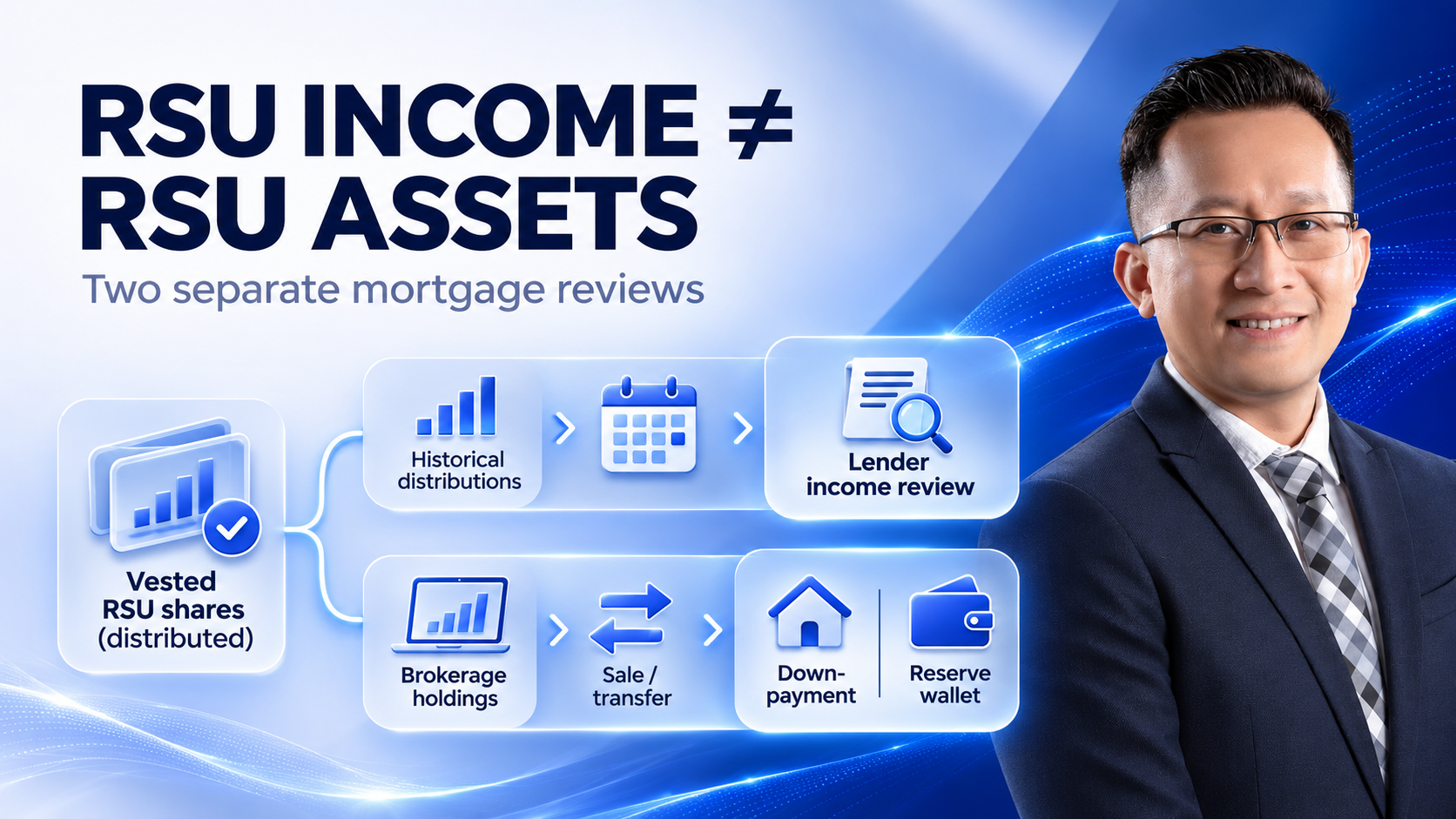
Section 08
Frequently Asked Questions
Can unvested RSUs be used as mortgage income?
Do not assume so. Under Fannie Mae’s current guidance, restricted stock used as qualifying income must have vested and been distributed without restrictions. Other programs may differ.
How much RSU income will a lender count?
The amount depends on the award type, history, continuance, distribution method, stock-price calculation, documentation, program, and lender. A total grant value is not a qualifying-income calculation.
Can vested shares be used for a down payment?
Potentially, if the shares are owned, accessible, documented, and acceptable under the loan requirements. The lender may need evidence of liquidation and transfer.
What if I changed technology companies recently?
The lender will review the new compensation arrangement, history, vesting schedule, and applicable guideline. A job change does not create one automatic result.
Will a falling stock price reduce qualifying income?
It may affect a calculation that uses share value. The exact effect depends on the program’s method, distribution history, and timing.
Section 09
Prepare the RSU File Before Shopping for a Home
RSU compensation can support mortgage qualification when the income meets applicable requirements and the documents tell a consistent story. Start with the vesting history, distribution records, and future schedule rather than the largest number in the employer portal.
Get started with Wonder Rates to review base salary, RSU compensation, assets, debts, and purchase goals as one complete mortgage scenario.
Duc Pham, Mortgage Broker | NMLS# 844897
Wonder Rates, Inc. | NMLS# 1518655
Equal Housing Lender.
AZ, CA, CO, FL, GA, LA, MI, OK, PA, SC, TX, VA, WA, OH, AL, OR, NC
This article is for educational purposes only and is not a commitment to lend, tax advice, investment advice, or a guarantee that RSU income will qualify. Income calculations, documentation, eligibility, and underwriting requirements vary by borrower, employer, award, lender, investor, and loan program and may change.