
Section 01
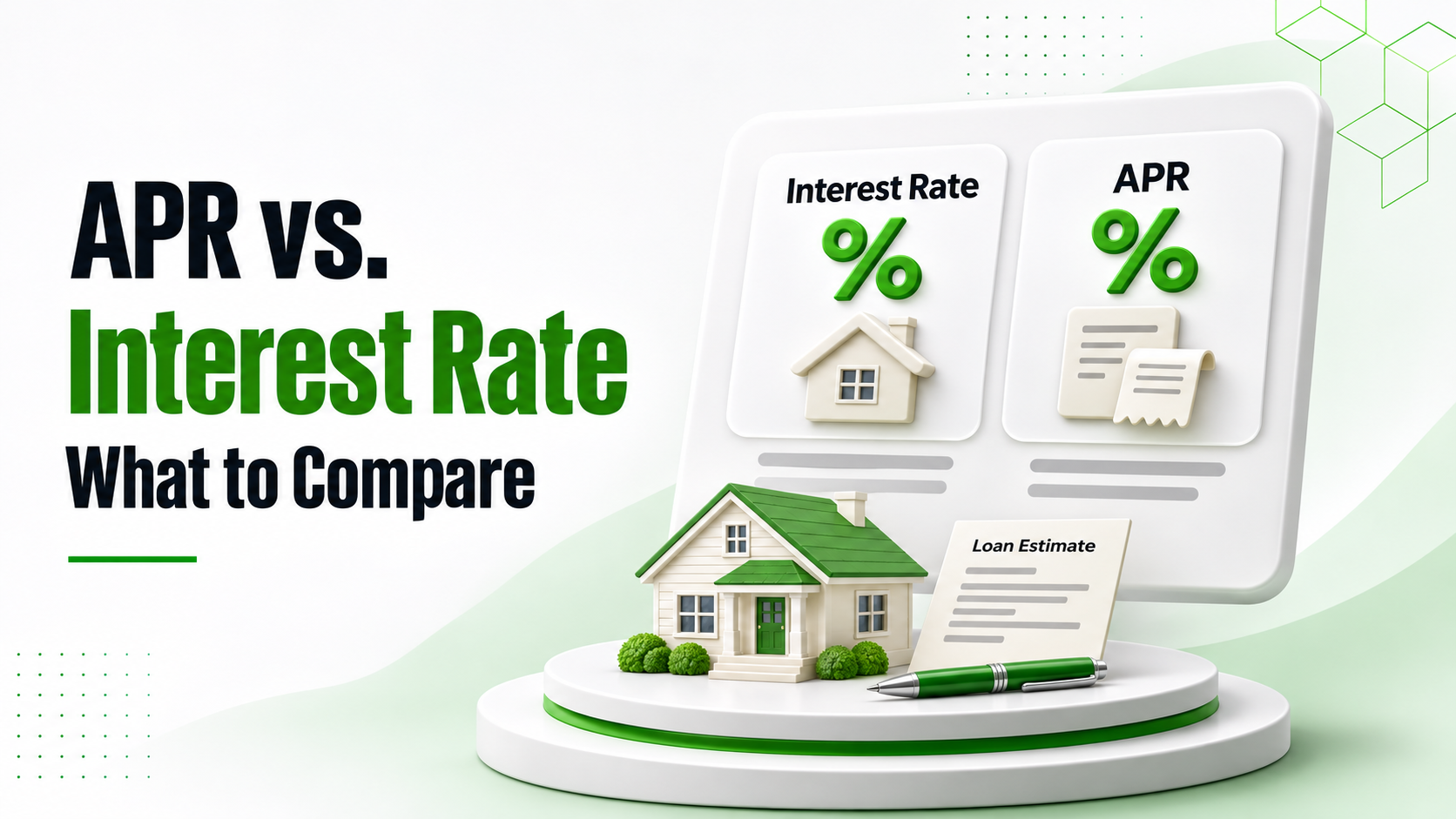
APR vs interest rate on a home loan is not a choice between one useful number and one useless number. The interest rate helps determine the principal and interest portion of the payment, while the annual percentage rate, or APR, reflects the interest rate plus certain costs of obtaining credit, expressed as an annual rate.
Use both numbers, but do not compare either in isolation. Compare Loan Estimates for the same loan structure and market window, then review the rate, APR, points, fees, credits, payment, cash to close, and expected holding period.
Section 02
APR vs. Interest Rate on a Home Loan at a Glance
| Number | What it helps explain | Where to find it on the Loan Estimate | What it does not show by itself |
|---|---|---|---|
| Interest rate | The stated annual rate used to calculate interest on the loan balance | Page 1, Loan Terms | Points, lender fees, other qualifying finance charges, and complete cash to close |
| APR | A broader annualized measure that incorporates the interest rate and certain credit costs | Page 3, Comparisons | Whether the loan fits your expected holding period or whether every closing cost is reasonable |
| In 5 Years | Scheduled payments, loan costs, and principal reduction during the first five years | Page 3, Comparisons | What happens if an adjustable rate changes or the loan ends earlier |
| Total Interest Percentage | Scheduled interest over the entire term as a percentage of the loan amount | Page 3, Comparisons | Most upfront fees and your likely ownership timeline |
The Consumer Financial Protection Bureau explains that the APR is a broader measure of borrowing cost than the interest rate. It may include points, mortgage broker fees, and other charges used in the APR calculation.
Section 03
What Does the Mortgage Interest Rate Tell You?
The mortgage interest rate is the stated annual cost of borrowing the principal balance. On a fixed-rate mortgage, it does not change during the term, although taxes, insurance, and other housing expenses can.
The rate affects:
- The principal and interest portion of the monthly payment
- The amount of scheduled interest paid over time
- Comparisons between loan structures
- Break-even calculations involving points or credits
However, a rate does not reveal what the borrower must pay to obtain it. Two offers may show the same interest rate while carrying different origination charges, discount points, or lender credits. Conversely, one offer may have a lower rate because the borrower is paying more at closing.
Do not evaluate an advertised rate without its assumptions. Wonder Rates explains why a personalized mortgage rate may differ from a rate seen online.
Section 04
What Does Mortgage APR Include?
APR converts the interest rate and certain finance charges into an annualized percentage. Under Regulation Z, a finance charge generally includes charges imposed as an incident to or condition of extending credit, subject to specific inclusions and exclusions. The CFPB provides the current Regulation Z definition of a finance charge.
Depending on the transaction, APR calculations may account for items such as:
- Discount points
- Certain origination charges
- Mortgage broker fees
- Certain mortgage insurance costs
- Other charges treated as finance charges under applicable rules
APR does not add every closing cost. Some property, settlement, government, or third-party charges may be excluded when regulatory conditions are met. Do not try to recreate APR by totaling every fee on page 2.
For many fixed-rate mortgages, APR is higher because it reflects qualifying costs in addition to interest. Review which charges created the gap.
Section 05
Where to Find Rate, APR, and Fees on a Loan Estimate
The Loan Estimate places related information on different pages because each number answers a different question.
Page 1: Loan Terms and Projected Payments
Page 1 shows the rate, loan amount, principal and interest payment, whether terms can change, applicable mortgage insurance, and estimated escrow amounts.
Check whether the rate is locked. If it is not, pricing may change. If it is locked, review the expiration date and conditions. The guide to mortgage rate locks and closing delays explains what to verify.
Page 2: Loan Costs and Credits
Page 2 shows origination charges, services, other costs, lender credits, and estimated cash to close. Section A may show discount points and other origination fees.
Also review Sections B and C, lender credits in Section J, and cash to close. The guide to closing costs when buying a home explains the categories.
Page 3: Comparisons
Page 3 includes the In 5 Years disclosure, APR, and Total Interest Percentage, or TIP. Regulation Z requires these figures in the Comparisons table so consumers can evaluate loan offers. The CFPB publishes the official Loan Estimate disclosure requirements.
APR is not TIP. APR annualizes interest and qualifying credit costs. TIP shows scheduled interest over the full term as a percentage of the amount borrowed and assumes scheduled payments.

Section 06
Five Smart Ways to Compare Mortgage Offers
1. Make the loan structures match
Compare the same loan amount, term, program, property, occupancy, down payment, and rate-lock period. An offer for a fixed-rate loan should not be treated as directly interchangeable with an adjustable-rate offer merely because one APR is lower.
If one quote includes points and another uses lender credits, request comparable alternatives before ranking them.
2. Compare offers from the same market window
Mortgage pricing can change as bond markets move. Loan Estimates issued on different days may reflect different market conditions, which can obscure real differences in lender pricing.
Gather estimates within a short period. Confirm whether each rate is locked or floating and whether the lock periods match.
3. Read the rate and APR together
If comparable fixed-rate offers have the same rate, different APRs may indicate different qualifying loan costs. Review page 2 to identify the source.
If one offer has a lower rate but higher upfront charges, determine whether the lower payment is likely to recover those added costs during the period you expect to keep the loan. The guide to mortgage points and break-even timing explains that trade-off.
4. Review costs over your realistic timeline
APR assumes the loan follows its payment schedule. A borrower who sells, pays off, or refinances earlier may not recover the added cost of a lower-rate option.
The In 5 Years disclosure offers another comparison point. The CFPB explains how to use page 3 to compare Loan Estimates and calculate a five-year borrowing cost. Five years may not match your actual plan, so adjust the analysis to the period you reasonably expect to keep the loan.
5. Compare cash to close and liquidity
A lower rate may not justify using cash needed for reserves, repairs, or moving. Review complete cash to close, not only points or origination charges.
Lender credits can reduce eligible upfront costs, but they may be associated with different pricing. Discount points can increase upfront cost in exchange for a lower rate. Neither choice is automatically better.
Use the Wonder Rates Rate Comparison Calculator to organize two scenarios side by side. Calculator results are educational estimates and do not replace a Loan Estimate or a personalized quote.
Section 07
When APR Needs Extra Context
Adjustable-rate mortgages
An adjustable-rate mortgage, or ARM, can change after its initial period. The APR calculation uses required assumptions and does not represent the maximum possible future rate. The CFPB cautions borrowers against relying only on APR when comparing an ARM with a fixed-rate loan or different ARM structures.
Review the index, margin, adjustment schedule, caps, initial period, and maximum possible payment. Wonder Rates’ guide to ARM versus fixed-rate mortgages explains these differences.
Different loan types or terms
APR is most useful for similar offers. Different terms or programs may have different payments, insurance, fees, total interest, and APRs.
Choose the program and term first, then compare similar offers.
Short expected holding period
A borrower expecting to move or refinance soon may emphasize upfront cost and break-even timing. A lower APR over the full term does not guarantee the lowest cost over a shorter timeline.
Refinancing later is not guaranteed. Future eligibility, property value, market pricing, costs, and underwriting requirements may differ.

Section 08
Questions to Ask Before Choosing an Offer
Ask the loan officer to answer these questions in writing:
- Is this rate locked or floating, and for how long?
- Does the rate include discount points?
- Which charges contribute to the APR?
- Are lender credits included, and what pricing trade-off is associated with them?
- What are the total origination charges in Section A?
- What is the estimated cash to close?
- How do the options compare over the period I expect to keep the loan?
- Could a change in my application or transaction affect the quoted terms?
If you are still choosing whom to work with, use these questions to ask a loan officer before applying.
Section 09
Frequently Asked Questions
What is the difference between APR and interest rate on a mortgage?
The interest rate is the stated annual rate used to calculate interest on the loan balance. APR is a broader annualized measure that reflects the interest rate plus certain costs of obtaining credit. Neither number includes every financial consideration involved in owning a home.
Is the lowest APR always the best mortgage?
No. A lower APR can be useful when comparing similar offers, but it does not determine whether the loan structure fits your budget, holding period, cash needs, or risk tolerance. Review the Loan Estimate and compare complete scenarios.
Why is APR usually higher than the interest rate?
APR often exceeds the interest rate because its calculation includes certain finance charges in addition to interest. The exact difference depends on the loan and which charges are included under applicable rules.
Where is APR shown on the Loan Estimate?
APR appears on page 3 in the Comparisons table. The interest rate appears on page 1 under Loan Terms, while points and origination charges generally appear in Section A on page 2.
Can two loans have the same rate but different APRs?
Yes. Comparable loans can have the same interest rate but different APRs when qualifying finance charges differ. Review points, origination charges, broker fees, mortgage insurance, lender credits, and other relevant terms to understand the difference.
Section 10
Compare the Complete Loan, Not One Number
Interest rate explains an important part of payment. APR adds context about certain borrowing costs. The Loan Estimate brings those figures together with points, credits, cash to close, and other terms needed for a meaningful comparison.
Get started with Wonder Rates to review your Loan Estimates and compare options using a consistent loan structure and realistic timeline.
Duc Pham, Mortgage Broker | NMLS# 844897
Wonder Rates, Inc. | NMLS# 1518655
Equal Housing Lender.
AZ, CA, CO, FL, GA, LA, MI, OK, PA, SC, TX, VA, WA, OH, AL, OR, NC
This article is for educational purposes only and is not a commitment to lend, a rate quote, or financial or legal advice. Loan approval is subject to creditworthiness, income verification, property eligibility, and current underwriting guidelines. Rates, APRs, points, credits, fees, and loan programs vary by lender, market conditions, transaction, and borrower circumstances and may change without notice. Always review your official Loan Estimate before making a financing decision.