Section 01
Buying a home with leased solar panels requires more than confirming that the panels work. The buyer, seller, solar provider, lender, appraiser, title company, insurer, and closing team may need to determine who owns the system, what agreement applies, whether the contract transfers, and whether any payment or lien affects the mortgage.
The word “solar” does not describe one financing structure. Panels may be owned free and clear, financed with a loan, leased from a third party, provided under a power purchase agreement, or connected to a property-assessed financing obligation. Each structure can affect underwriting and closing differently.
Section 02
Start by Identifying Who Owns the Solar System
Ask the seller for the complete solar agreement before relying on a listing description. The most common structures include:
| Solar arrangement | Who generally owns the system? | Key mortgage question |
|---|---|---|
| Owned free and clear | Homeowner | Is ownership documented and included with the property? |
| Solar loan | Homeowner, subject to financing terms | Is there a lien or required payoff? |
| Solar lease | Third-party provider | Can the buyer assume or qualify for the lease? |
| Power purchase agreement | Third-party provider | What payment obligation and transfer terms apply? |
| PACE assessment | Depends on program structure | Does the obligation have lien priority or require payoff? |
Do not assume panels are owned because they are attached to the roof. Ask for the contract, current statement, transfer instructions, payoff information, amendments, warranties, and evidence of any recorded financing interest.

Section 03
Why the Solar Agreement Matters to the Mortgage
The lender must understand both the property and the borrower’s obligations. A solar agreement may affect:
- Property eligibility
- Appraisal treatment
- Debt-to-income analysis
- Title and lien review
- Homeowners insurance
- Transfer timing
- Cash needed at closing
Fannie Mae’s official guidance on properties with solar panels and other special eligibility considerations distinguishes among ownership and financing structures. Other programs and lenders may apply different requirements.
The practical lesson is simple: send the solar documents to the loan officer early, preferably before making an offer or during the inspection and financing-contingency period.
Section 04
Leased Panels and Power Purchase Agreements
With a lease, the homeowner generally pays for the right to use a third party’s system. With a power purchase agreement, the homeowner generally pays for electricity produced under the contract. The exact terms vary.
The buyer may need to apply with the solar provider, satisfy transfer requirements, sign an assumption or replacement agreement, and accept the remaining term. The provider may require financial information or a processing period that does not match the purchase contract’s closing date.
Questions to ask include:
- How many years remain?
- Is the payment fixed, variable, or subject to an escalator?
- Does the agreement include a purchase option?
- Is there a transfer fee?
- What happens when the roof needs repair?
- Who is responsible for maintenance and removal?
- What insurance is required?
- What happens if the provider or equipment manufacturer changes?
Do not evaluate the contract only by the current monthly bill. Review the entire remaining obligation and transfer process.
Section 05
Appraisal Treatment May Surprise the Buyer
Solar panels do not automatically add their purchase price to the home’s appraised value. Fannie Mae’s appraisal guidance states that leased or third-party-owned solar panels are treated as personal property and are not included in the appraised value under that guidance.
Owned systems may receive different consideration, but value still depends on market evidence, property characteristics, appraisal requirements, and the applicable loan program. Buyers should not increase an offer solely because a salesperson estimated that the system adds a particular amount of value.
Wonder Rates’ guide to a low appraisal after an accepted offer explains why contract price, improvement cost, and appraised value are separate concepts.
Section 06
Solar Payments Can Affect Qualification
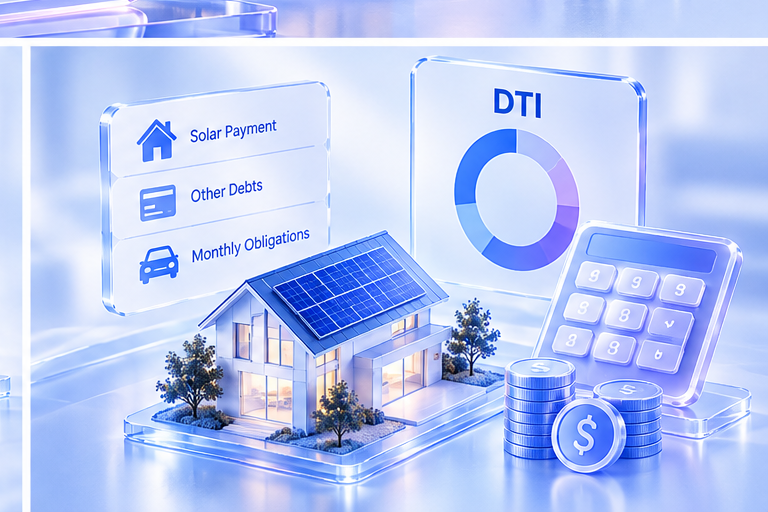
Depending on the agreement and program, a required solar payment may need to be included in the borrower’s recurring obligations. The lender must review the contract rather than rely only on the seller’s description.
If the payment must be counted, it can affect the borrower’s debt-to-income ratio and available purchasing room. Use the Wonder Rates DTI Calculator to explore how a documented monthly obligation may affect the ratio, but confirm the actual underwriting treatment with the loan officer.
A solar transfer should never be left until the final week of closing. If the buyer cannot assume the agreement or the lender cannot approve the structure, the parties may need to renegotiate, arrange a payoff, change financing, or extend the closing date.
Section 07
Title, Liens, and PACE Financing
Some solar financing creates a recorded lien, a Uniform Commercial Code filing, or another interest that must be reviewed. The title company and lender determine whether the interest can remain, must be subordinated, or must be paid and released.
PACE financing deserves special attention because repayment may be connected to the property-tax assessment. Fannie Mae’s official PACE loan eligibility guidance addresses lien-priority concerns. Do not assume that every assessment transfers cleanly to a new buyer.
Ask the title company to identify any recorded solar-related interest and obtain payoff, release, or subordination instructions early.
Section 08
Insurance and Roof Condition Still Matter
The lender may need acceptable property insurance covering the home and relevant improvements. The insurer may ask whether the panels are owned or leased, who is responsible for damage, and how replacement cost is handled.
The roof should also be reviewed. A newer solar system on an aging roof may create future removal and reinstallation costs. Ask:
- How old is the roof?
- Was the roof inspected before installation?
- Who pays to remove and reinstall panels for repairs?
- Does roof work affect the solar warranty?
- Are penetrations and mounting components covered?
Insurance problems can delay funding even when the borrower’s credit and income are already approved. Wonder Rates’ guide to home insurance delays at closing explains what buyers should verify before the final days.
Section 09
Documents to Request From the Seller
Request these items as early as possible:
- Complete lease, loan, or power purchase agreement
- Current solar statement
- Transfer and assumption instructions
- Payoff quote, if applicable
- Installation contract and permits
- Equipment and roof warranties
- Maintenance and repair history
- Utility production or billing history
- Evidence of ownership
- Information about liens, assessments, or UCC filings
- Contact information for the solar provider
The lender may not need every item, but collecting the documents early prevents the buyer from discovering the contract structure after underwriting or title review is nearly complete.
Section 10
A Better Offer and Closing Timeline
Before making the offer
Ask whether the system is owned, financed, leased, or under a power purchase agreement. Request the contract immediately.
During the contingency period
Send the documents to the lender, title company, insurer, and appropriate real estate or legal professionals. Confirm whether the buyer must qualify with the provider.
Before final loan approval
Complete the transfer process, document any required payment, and resolve lien or title conditions.
Before signing
Review the final solar agreement, remaining term, payment structure, transfer confirmation, and responsibility for future repairs.
At the final walkthrough
Confirm that the panels, monitoring equipment, electrical components, and any included records remain with the property as required by the contract. Wonder Rates’ final walkthrough checklist can help organize the broader property review.
Section 11
Frequently Asked Questions
Can a leased solar system stop mortgage approval?
It can create an eligibility, payment, title, appraisal, insurance, or transfer issue if the agreement does not satisfy the applicable requirements. The result depends on the contract, program, lender, and property.
Does the buyer have to assume the solar lease?
That depends on the purchase agreement and solar contract. The buyer should not assume responsibility without reviewing the complete terms and receiving required approvals.
Do leased solar panels increase appraised value?
Under Fannie Mae guidance, leased or third-party-owned panels are treated as personal property and are not included in the appraised value. Other circumstances and programs should be confirmed separately.
Should the seller pay off the solar system?
Possibly, but payoff is a negotiated and program-specific decision. The parties should obtain a written payoff amount and confirm how the lien or agreement will be released.
Section 12
The Bottom Line
Buying a home with leased solar panels can work, but the agreement must be treated as part of the real estate and mortgage transaction. Identify ownership, read the transfer terms, confirm payment treatment, review title and insurance, and complete the provider’s process before closing.
If you are considering a property with solar financing, ask Wonder Rates to review the mortgage implications before you remove contingencies.
Duc Pham, Mortgage Broker | NMLS# 844897
Wonder Rates, Inc. | NMLS# 1518655
Equal Housing Lender.
AZ, CA, CO, FL, GA, LA, MI, OK, PA, SC, TX, VA, WA, OH, AL, OR, NC
This article is for educational purposes only and is not a commitment to lend, legal advice, tax advice, insurance advice, or an interpretation of a specific solar contract. Loan approval is subject to creditworthiness, income verification, property eligibility, insurance, title review, and current underwriting requirements.