Section 01
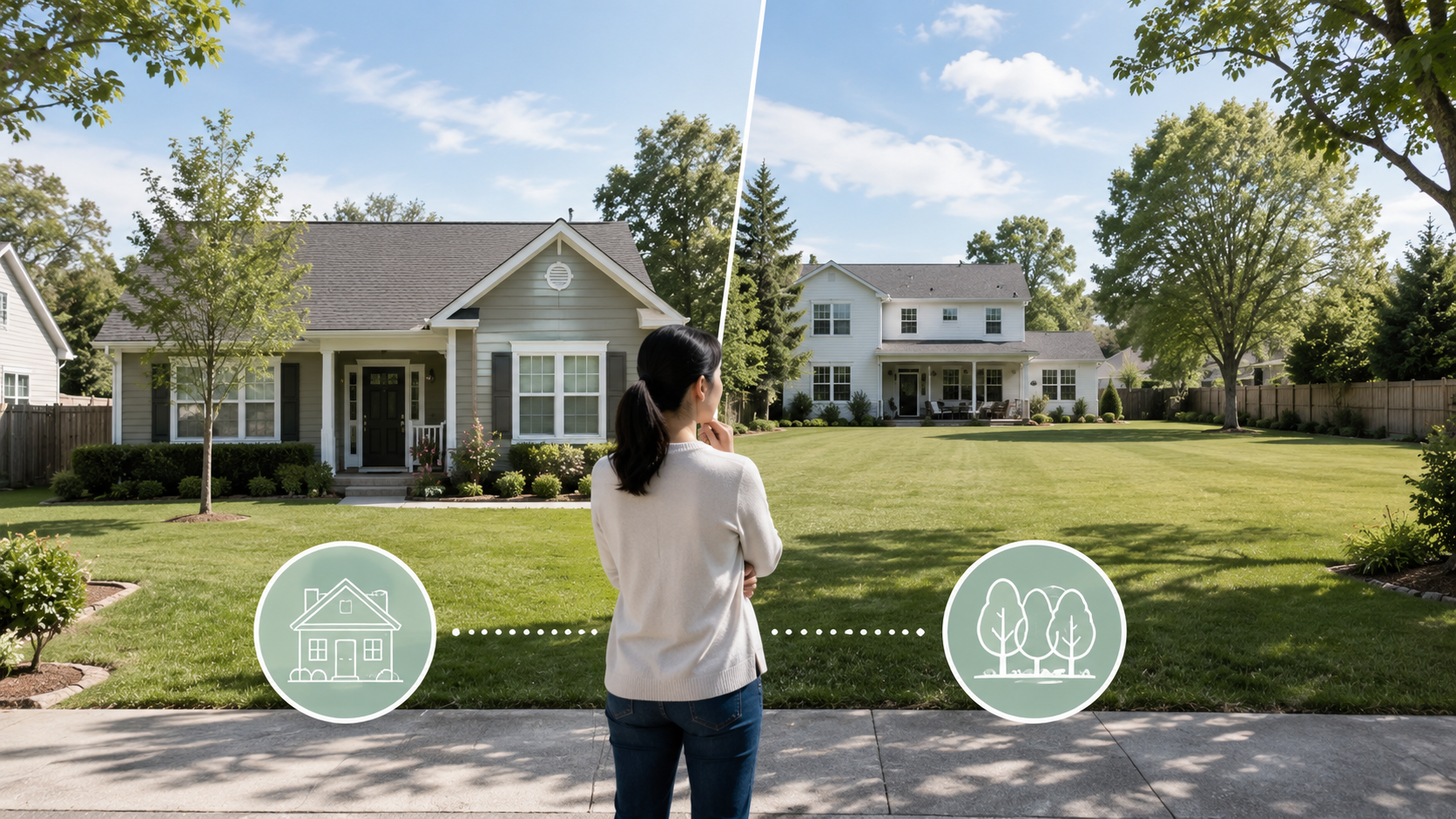
When you’re shopping for a home, you might compare a house with 1,800 square feet sitting on a 5,000 square foot lot against an identical 1,800 square foot house sitting on a 10,000 square foot lot. At first glance, the second one might seem like the obvious winner. Twice the land must mean twice the value, right? Not necessarily.
Lot size matters, but bigger does not automatically mean better or more valuable. The value of a lot depends on much more than the number of square feet. Location, zoning, usability, privacy, access, topography, neighborhood characteristics, development potential, and buyer demand can all matter.
For a homebuyer, the better question is not simply how big the lot is. It is what this lot actually allows you to do, how much it costs you to own, and how much that extra land really adds to the property’s price.
Section 02
What Is Lot Size?
Lot size is the total land area associated with a property, usually expressed in square feet or acres. A listing showing a 7,500 square foot lot means the property sits on approximately 7,500 square feet of land. A larger property might instead be described in acres, such as 0.25 acres. Since one acre equals 43,560 square feet, a quarter acre works out to 43,560 divided by 4, or 10,890 square feet. This is simply a unit conversion, not a statement about what constitutes a “standard” residential lot, since standard varies enormously by area.
Lot Size Is Not the Same as House Size
This distinction matters quite a bit. A listing might show a living area of 2,000 square feet and a lot size of 8,000 square feet. The 2,000 square feet describes the home’s interior living space. The 8,000 square feet describes the land the property sits on. These are two completely different measurements. A larger house does not automatically mean a larger lot, and a larger lot does not automatically mean a larger house.
Section 03
How Lot Size Is Measured
Lot dimensions can be described in several ways. A rectangular property might be listed as 60 feet by 125 feet, giving an approximate area of 60 times 125, or 7,500 square feet. Another property might be listed as 75 feet by 100 feet, which also works out to 75 times 100, or 7,500 square feet. Both properties have the same approximate lot area, but they are not necessarily equally useful, because shape matters just as much as raw square footage.
Section 04
Lot Size Is More Than Just a Number
Two properties can share the exact same lot size while offering very different real-world experiences. Consider a 7,500 square foot lot that is rectangular and relatively flat, compared with another 7,500 square foot lot that is irregularly shaped, has a steep slope, and offers a limited usable backyard. On paper, they’re identical. In real life, they’re not. The first lot might provide substantially more usable outdoor space, while the second might have portions of land that are difficult or expensive to develop. This is exactly why buyers should look beyond the headline number on a listing.
Section 05
Why Lot Size Can Matter to Homebuyers
A larger lot can potentially provide more outdoor space, privacy, landscaping opportunities, parking options, recreation space, distance between neighboring homes, and flexibility for certain future improvements. But these benefits depend heavily on local regulations and the physical characteristics of the property itself.
Having 12,000 square feet of land, for example, does not automatically mean you can build another house, an ADU, a detached garage, or a swimming pool. Land area and development rights are two entirely different things, and conflating them is one of the more common mistakes buyers make.
Section 06
Does a Bigger Lot Mean a More Valuable Home?
Not automatically, and this is one of the most important points in this entire article. Real estate value is not determined by lot size alone.
According to Fannie Mae, a home appraisal is an independent assessment of the value of the property by a trained professional, based on the condition and characteristics of the home itself, as well as external factors like location and market trends. That assessment considers the property as a whole, using comparable properties to help establish value, rather than pricing land as a simple standalone line item.
Example: Imagine three homes in the same general neighborhood. Home A has a 2,000 square foot house on a 6,000 square foot lot, priced at $650,000. Home B has the same size house on a 10,000 square foot lot, priced at $675,000. Home C again has the same size house on a 15,000 square foot lot, priced at $690,000. You cannot conclude from this that every additional 5,000 square feet of land adds exactly $25,000. Real estate does not work like a fixed price-per-square-foot calculator for land. The market may value the additional land differently depending on location, zoning, usability, and buyer demand. This example uses simplified, hypothetical numbers for illustration only and does not represent actual market pricing or a formula for valuing land.
Section 07
Lot Size and Location Matter Together
A large lot in a highly desirable neighborhood can be very different from a large lot in an area where buyers place little value on additional land. An extra 5,000 square feet might be highly desirable in a dense suburban market where larger lots are scarce, while in a market where large lots are common, that same additional land may have far less impact on the property’s relative value.
Rather than asking whether 10,000 square feet is objectively a big lot, it is far more useful to ask how this lot compares with other homes buyers are actively considering in this specific market.
Section 08
Large Lot vs. Small Lot: What Are You Actually Getting?
A larger lot can offer meaningful lifestyle benefits, but it can also introduce additional responsibilities that are easy to underestimate before you actually own the property.
On the benefit side, a larger backyard could accommodate a patio, garden, or play area, subject to local rules. Greater distance between homes can make a property feel more private. Additional land may provide more parking options, although driveway and parking rules still apply regardless of lot size. A larger lot may also provide more physical space for future improvements, subject to zoning, setbacks, permits, and HOA rules where applicable.
On the trade-off side, more lawn and landscaping can require more time, water, and money to maintain. A larger yard may need additional irrigation, mowing, and seasonal upkeep. Drainage, retaining walls, fencing, trees, and other site conditions become more important to inspect closely on a larger property. Insurance or other property-related costs may also run higher, though this depends heavily on the specific property and location, so buyers should obtain property-specific estimates rather than assume a larger lot automatically means a particular cost increase.
Section 09
How Lot Size Can Affect Your Homeownership Budget
The lot itself does not create a single universal monthly fee. But the characteristics of a larger property can genuinely affect your ownership costs over time. It is worth budgeting beyond principal and interest for property taxes, insurance, utilities, maintenance, and repairs, since these costs can vary significantly based on the specific property and its location.
Example: Imagine two homes with similar mortgage payments. Home A sits on a 6,000 square foot lot, and Home B sits on a 12,000 square foot lot. Suppose Home B requires an additional $120 per month in landscaping and yard maintenance. That equals $1,440 per year, and over five years, $7,200. This is only a hypothetical example. Actual landscaping and maintenance costs vary enormously by location, climate, landscaping design, and how much of the work the homeowner does personally. The point is to include maintenance in your comparison, not to assume the extra land comes free to maintain.
Section 10
Does Lot Size Affect Property Taxes?
Potentially, but there is no universal formula where double the lot size means double the property tax. Property taxation is determined by state and local rules along with the property’s assessed value. A larger or more valuable property may carry a different assessed value, but the exact relationship between lot size and taxes depends heavily on the specific jurisdiction and property.
If you’re comparing two homes, it is worth reviewing the property’s current tax information directly and asking the appropriate local tax authority or your real estate professional about applicable taxes, rather than estimating based on lot size alone. It is also worth remembering that property taxes, like other homeownership costs, can change over time regardless of what you paid at closing.
Section 11
Lot Size and Mortgage Qualification
Lot size itself is generally not a simple, standalone mortgage qualification factor. A lender is primarily evaluating the borrower’s ability to repay and the property as collateral under the applicable loan program and underwriting rules, not the lot size as an isolated number.
That said, the property’s characteristics can still matter to the appraisal and to overall property eligibility, since the appraisal considers the property as a whole alongside comparable properties in the area.
Example: A buyer finds a $700,000 home on a very large lot and assumes the extra land must make it worth $700,000. But if comparable properties in the area do not support that value, the appraisal could become an important part of the transaction, potentially affecting how the loan is structured. This does not mean a large lot is a bad thing. It means a buyer should not assume that extra land automatically translates into dollar-for-dollar appraised value. This example is illustrative only and does not represent a guaranteed appraisal outcome for any specific property.
Section 12
Lot Size and Appraisal: Why Comparables Matter
This deserves its own attention because it is one of the more misunderstood parts of buying a home. An appraisal is not simply house square footage times price per square foot, plus land. Real estate valuation is considerably more nuanced than that, and comparable properties help the appraiser understand how the local market actually treats differences between properties.
Example: Suppose your property has an 8,000 square foot lot, while comparable homes nearby range from 6,000 to 9,000 square feet. Those properties can help provide useful context for how the local market values different lot sizes within a similar range. But if your property instead has a 30,000 square foot lot while every comparable home nearby sits between 5,000 and 8,000 square feet, the valuation question becomes considerably more complicated, since there is less direct market evidence to draw from. The additional land may well have value. But the amount of that value is not automatically equal to the land’s raw size. This example is illustrative only and does not represent an actual appraisal methodology or outcome.
Section 13
Does Lot Size Affect Resale Value?
It can, but again, there is no universal premium attached to a larger lot. A larger lot may appeal to buyers who prioritize privacy, gardening, children, pets, outdoor entertaining, parking, or future improvements. Other buyers may prefer less yard maintenance, lower landscaping costs, a smaller property footprint, or more lock-and-leave convenience overall.
If you’re buying today, it is worth asking who might want this property when you eventually decide to sell. A large lot can be a major selling point in one neighborhood and a relatively minor feature in another, depending entirely on local buyer preferences.
Section 14
Lot Shape Can Matter as Much as Lot Size
Two lots can both measure 10,000 square feet, yet one might be wide and rectangular while the other is narrow and deep. A lot measuring 100 feet by 100 feet and a lot measuring 50 feet by 200 feet both equal 10,000 square feet on paper, but the usable outdoor experience can be completely different between them. The first might provide a broad backyard, while the second might provide a long, narrow yard instead. Neither shape is inherently better. The important question is whether the shape actually works for what you want to do with the property.
Section 15
Usable Lot Size vs. Total Lot Size
This is where buyers need to be especially careful. A listing may advertise a large total lot, but part of that land might be steep, flood-prone, protected, subject to easements, difficult to access, restricted by setbacks, covered by drainage infrastructure, or otherwise unsuitable for your intended use.
That does not mean the land has no value at all. It means total acreage is not the same thing as usable space, and the two should never be treated as interchangeable when you’re evaluating a property.
Example: A property has 20,000 square feet of total lot area, but a significant portion of that land sits on a steep slope. A buyer who specifically wants a large, flat backyard should not evaluate this property as if all 20,000 square feet were equally usable for that purpose. This example is illustrative only and does not represent every sloped or irregular lot.
Section 16
Lot Size, Zoning, and What You Can Build
One of the biggest mistakes buyers make is assuming that owning the land means they can build whatever they want on it. Not necessarily. Local zoning and building regulations may control setbacks, building coverage, height, access, parking, ADUs, additional structures, fences, pools, driveways, and even lot subdivision. HOA rules, where applicable, can add another layer of restrictions on top of local zoning.
Example: A buyer sees a 12,000 square foot lot and assumes there’s plenty of room for an ADU. Physical space is only one part of that question. The buyer would also need to investigate whether an ADU is actually permitted, what the setback requirements are, whether there are lot coverage limitations, whether parking requirements apply, whether an HOA imposes additional restrictions, and whether any utility or access limitations exist. The answer depends entirely on the property’s specific jurisdiction and circumstances, and should be verified before assuming a project is possible. This example is illustrative only and does not represent guaranteed ADU eligibility for any property.
Section 17
Lot Size and Easements
An easement is a legal right allowing another party to use part of a property for a specified purpose, such as utilities, access, drainage, or a shared driveway. An easement does not necessarily make a property undesirable, but it can meaningfully affect how a buyer is able to use certain portions of the lot.
Example: A property has 15,000 square feet of land, but a utility easement runs through the rear portion. The buyer may still own that land, but the easement could limit what they’re able to build or place there. This is exactly why buyers should review the relevant title and property documents directly, rather than relying solely on the lot-size number shown in a listing. This example is illustrative only and does not represent every easement scenario.
Section 18
Lot Size and Outdoor Lifestyle
Sometimes the most important value of a larger lot isn’t financial at all. It’s lifestyle. A family with young children may value a large backyard. A gardener may value space for planting. A dog owner may value room for outdoor activity. Someone who genuinely dislikes yard work may prefer a smaller, easier-to-maintain property instead.
Example: Two buyers share the same budget. One says they want as much land as possible. The other says they don’t want to spend their weekends maintaining a huge yard. They could look at the exact same property and reach completely different conclusions about whether it’s a good fit. There is no objectively correct lot size that applies to everyone. There is only a lot size that fits the individual buyer. This example is illustrative only and reflects general preferences, not a universal standard.
Section 19
How to Compare Lot Sizes When Shopping for Homes
It helps to avoid comparing lot size in isolation, and instead build a simple side-by-side comparison across the properties you’re considering.
| Property | House Size | Lot Size | HOA | Condition | Main Advantage |
|---|---|---|---|---|---|
| Home A | 1,800 sq. ft. | 5,000 sq. ft. | $0 | Updated | Lower maintenance |
| Home B | 1,800 sq. ft. | 10,000 sq. ft. | $150/mo. | Updated | Larger yard |
| Home C | 2,000 sq. ft. | 7,500 sq. ft. | $0 | Needs work | Larger house |
Laying the numbers out this way helps prevent one attractive figure, like a large lot size, from dominating the entire decision on its own.
Section 20
A $50,000 Price Difference Is Not Just About Lot Size
Imagine Home A is listed at $600,000 and Home B is listed at $650,000, with the seller explaining that Home B costs more because it has a much larger lot. Before assuming that extra $50,000 is fully justified, it is worth comparing lot size, lot shape, house size, condition, location, school district, HOA, property taxes, insurance, comparable sales, development potential, privacy, and maintenance requirements together.
The extra land may absolutely contribute to the price difference. But you need to determine whether the broader market actually supports the overall price gap, rather than assuming more land alone explains it.
Section 21
Questions to Ask Before Buying a Home With a Large Lot
Before making an offer, it helps to work through a few categories of questions.
About the land itself, ask what the exact lot size is, how that figure was determined, whether the lot is regular or irregular in shape, and whether the land is flat or sloped.
About restrictions, ask whether there are easements, what the setback requirements are, what local zoning actually permits, and whether HOA restrictions apply.
About costs, ask how much landscaping is likely to cost, whether irrigation requirements exist, whether insurance will be significantly different because of the lot, and whether property taxes are based on an assessed value that may change.
About future plans, ask whether you can add an ADU, build a pool, add a detached garage, or subdivide the property. Never assume the answer is yes simply because the lot happens to be large.
Section 22
How to Find a Property's Lot Size
Buyers can often find lot-size information through the MLS listing itself, county property records, assessor records, survey documents, title documents, and property disclosures. Different sources can sometimes show different measurements for the same property, which can be confusing if you’re not expecting it.
If lot size is genuinely important to your purchase decision, particularly for a major development plan, it is worth asking your real estate professional or the appropriate local authority to help verify the relevant property records rather than relying on a single listing figure alone.
Section 23
The Biggest Lot Size Mistakes Buyers Make
One common mistake is assuming bigger automatically means better, when a large lot can also mean more maintenance, more expenses, and more restrictions than a buyer initially expects. Another is looking only at square footage, when shape, slope, access, and usability all matter just as much to the actual living experience.
Some buyers assume they can build on a large lot without checking first, when zoning, setbacks, easements, permits, and HOA rules can all change what is actually possible on that land. Others assume lot size directly determines appraised value, when an appraisal considers the property as a whole alongside relevant market evidence, not land size in isolation. Finally, it is easy to forget maintenance entirely in the excitement of touring a beautiful, spacious yard, when a large lot that feels like a lifestyle benefit on day one can quietly become a recurring expense over time.
Section 24
A Practical Lot Size Decision Framework
Before deciding whether a lot is genuinely “big enough” for your needs, it helps to answer a handful of questions in order. How much land do you actually need, realistically, rather than aspirationally? There’s no reason to pay for 10,000 square feet if you only want a small patio and a low-maintenance yard.
What will you actually use the extra space for, specifically? A garden, children, pets, a pool, an ADU, or simply privacy all point toward different answers. Is the land actually usable, once you account for slope, drainage, easements, setbacks, and access? What will the extra land genuinely cost you, factoring in maintenance, landscaping, irrigation, and other property-specific expenses? And finally, does the local market actually value the extra land, based on comparable properties and the input of qualified professionals, rather than your own assumptions about what land “should” be worth?
Section 25
The Bottom Line: Bigger Isn't Always Better
Lot size can be one of the most meaningful features of a property, but the number alone doesn’t tell the whole story. A 5,000 square foot lot might be perfect for one buyer. A 10,000 square foot lot might be ideal for another. And a 20,000 square foot lot might be more land than someone actually wants to maintain.
The right lot is not necessarily the largest one you can afford. It is the one that gives you the space, privacy, flexibility, and lifestyle you actually want, without paying for land you cannot use or never really needed in the first place.
Before making an offer, look beyond the listing’s lot-size number. Ask how usable the land really is, what you can legally do with it, what it will cost to maintain, how it compares with similar properties nearby, and whether the additional land genuinely justifies the additional price. Those questions will tell you far more than the number of square feet alone ever could.
Section 26
Sources
- Fannie Mae, Understanding Home Appraisals
- Consumer Financial Protection Bureau (CFPB), Mortgages resources
This article is for educational and informational purposes only and does not constitute financial, mortgage, legal, tax, real estate, zoning, appraisal, or investment advice. Lot size, property value, property taxes, zoning restrictions, development rights, easements, setbacks, HOA restrictions, insurance costs, and maintenance expenses vary by property, jurisdiction, neighborhood, loan program, and market conditions. All dollar amounts and calculations shown in examples are hypothetical illustrations only and are not estimates, guarantees, appraisals, or predictions of actual costs or property values. A larger lot does not automatically result in a higher appraised or market value. Buyers considering construction, subdivision, an ADU, a pool, or another property improvement should verify applicable zoning, permitting, title, easement, HOA, and building requirements with the appropriate local authorities and qualified professionals. Mortgage qualification and property eligibility are determined based on the borrower’s circumstances, applicable underwriting requirements, and the specific property.
Duc Pham, Mortgage Broker | NMLS# 844897 | 408-600-1900 | dp@wonderrates.com Wonder Rates, Inc. | NMLS# 1518655 | DRE# 02047445 | DFPI# 60DBO-59134 Equal Housing Opportunity. Equal Housing Lender. Licensed in: AL, AZ, CA, CO, FL, GA, LA, MI, NC, OH, OK, OR, PA, SC, TX, VA, WA