

Section 01
A non-occupant co-borrower signs the mortgage and accepts responsibility for the debt without using the property as a primary residence. Adding a parent may allow their qualifying income and financial profile to be considered, but it also places the mortgage on the parent’s financial record and can affect future borrowing.
This arrangement is not simply a signature or a family favor. Before applying together, the occupying buyer and parent should understand how the lender will evaluate both financial profiles, whether the parent will hold title, and how the family expects to end the arrangement later.
Section 02
What Is a Non-Occupant Co-Borrower?
A non-occupant co-borrower is a borrower who signs the note but does not occupy the financed home as a primary residence. In a typical family scenario, an adult child lives in the property while a parent applies with them.
Borrowers who sign the note generally have joint liability for the debt. If the occupying borrower misses a payment, the lender may seek payment from the other borrower, and the delinquency may affect every borrower associated with the loan.
Title is a separate issue. Under Fannie Mae’s definitions, a non-occupant borrower may or may not have an ownership interest in the property. A guarantor or co-signer does not have an ownership interest as shown on title, even though that person signs the note and shares liability. Because lenders and programs may use these terms differently in conversation, ask how each person will be listed on the application, note, security instrument, and title.
Fannie Mae’s official guidance explains the distinctions among guarantors, co-signers, and non-occupant borrowers.
| Role | Lives in the home? | Responsible for the loan? | Ownership interest? |
|---|---|---|---|
| Occupying borrower | Yes | Yes | Generally yes |
| Non-occupant borrower | No | Yes | May or may not be on title |
| Co-signer or guarantor | No | Yes | Generally no under the applicable program definition |
| Gift donor | Not relevant | No, unless also a borrower | Not created by giving a gift |

Section 03
Why a Buyer Might Add a Parent to the Mortgage
Some buyers have stable employment and savings but cannot qualify based on their income and monthly obligations alone, especially in high-cost markets.
Debt-to-income ratio, or DTI, compares qualifying monthly debt payments with qualifying gross monthly income. Adding an eligible parent may change that calculation because the lender can evaluate the income, debts, assets, and credit profile of all borrowers under the applicable program and underwriting method.
Adding income does not automatically improve the file. The parent’s housing expense and recurring debts may also be included, and their credit history can affect eligibility or loan terms.
Use the Wonder Rates DTI calculator to organize the numbers before speaking with a loan officer. The calculator provides an estimate, not an underwriting decision.
Section 04
A simplified DTI example
Assume an occupying buyer has $6,000 in qualifying gross monthly income, a proposed housing expense of $3,500, and a $500 auto payment. Their simplified total DTI would be:
($3,500 + $500) ÷ $6,000 = 66.7 percent
Now assume the parents have $7,000 in qualifying monthly income and $1,500 in recurring monthly obligations. If all income and listed debts can be used as shown, the combined calculation would be:
($3,500 + $500 + $1,500) ÷ ($6,000 + $7,000) = 42.3 percent
This example only demonstrates the arithmetic. It is not a universal approval threshold or an indication that a particular loan will qualify. Automated underwriting findings, manual underwriting rules, credit, assets, reserves, property type, occupancy, loan-to-value ratio, and lender requirements can all change the result.

Section 05
How Lenders Evaluate the Parent and Child Together
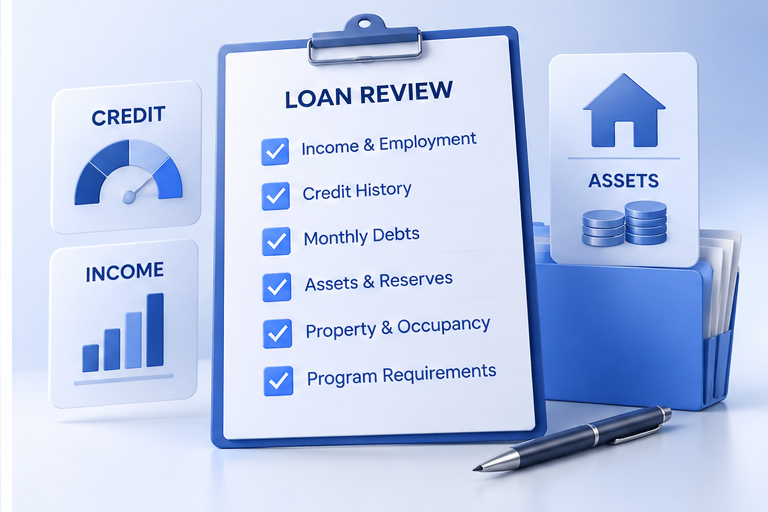
The lender evaluates more than the parent’s income. A review may include:
- qualifying income and employment documentation for each borrower;
- credit history and recurring debts for each borrower;
- the parent’s current housing expense;
- assets used for down payment, closing costs, or reserves;
- the relationship between the borrowers when required by the program;
- the occupancy and property type;
- automated underwriting findings or manual underwriting requirements; and
- title and loan-document requirements.
For conventional loans delivered to Fannie Mae, Desktop Underwriter considers the income, assets, liabilities, and credit of the non-occupant borrower. Manually underwritten files can have different down-payment, DTI, and loan-to-value requirements.
FHA also permits certain transactions involving non-occupying co-borrowers or co-signers, but family relationship, occupancy, property, maximum financing, citizenship or residency, and underwriting requirements matter. The current FHA Single Family Housing Policy Handbook is the controlling source. Ask the lender to identify the exact FHA provision being applied rather than relying on a general online summary.
Understanding what happens during mortgage underwriting can help the family anticipate why both borrowers will be asked for extensive documentation.
Section 06
The Financial Risk to the Parent
The benefit to the buyer is easy to see. The cost to the parent deserves equal attention.
The mortgage can affect the parent’s future DTI
The new mortgage may appear on the parent’s credit report and may be considered when the parent later applies for another mortgage, refinance, or other credit. This can interfere with plans to move or help another child.
The parent is responsible if the child cannot pay
A family agreement about who will make the payment does not change the lender’s rights under the note. Job loss, illness, divorce, or another financial disruption can turn the parent’s backup responsibility into an immediate monthly obligation.
Late payments can affect both borrowers
Delinquency may damage the parent’s credit. Families should arrange account access or payment alerts so every borrower can monitor the loan.
Ownership can create separate legal and tax questions
If the parent is added to title, that decision may affect property rights, estate planning, inheritance, and taxes. Consult a qualified attorney or tax professional before deciding how title should be held.
For families purchasing a home that several generations will use, review the additional considerations involved in planning a multigenerational home purchase.
Section 07
Can the Mortgage Be Excluded From the Parent's DTI Later?
Possibly, but it is not automatic. Under current Fannie Mae guidance, a mortgage debt may be excluded from a borrower’s recurring monthly obligations when the party making the payments is also obligated on the mortgage, the most recent 12 months show no delinquencies, the lender documents the payment history using canceled checks or bank statements from the paying party, and rental income from that property is not being used to qualify.
This rule is narrower than saying, “The child paid for 12 months, so the debt disappears.” The mortgage still exists, the parent remains legally liable, the property may still count as a financed property when applicable, and another loan program or lender may use different requirements. Fannie Mae provides the complete conditions in its guidance on debts paid by others.
To preserve a clear record, the occupying borrower should make each payment from their own documented account and keep complete statements. Before relying on this strategy, ask the future lender what documentation and program rules will apply.
Section 08
Build an Exit Plan Before Closing
The family should decide how the arrangement is expected to end before signing the loan.
Define the target
The occupying buyer may plan to qualify alone after income growth, debt reduction, or another financial change. Set a review date, but do not promise that refinancing will be possible by a certain year. Future qualification, property value, loan terms, and market conditions cannot be guaranteed.
Understand the removal options
Refinancing into the occupying borrower’s name is a common way to remove a parent. In limited circumstances, a servicer may permit an assumption or release of liability. A deed change by itself does not remove liability from the note.
If the parent is also on title, removing them from title is a separate legal action. Review possible transfer-tax, property-tax, estate, and ownership consequences before recording a deed. The principles discussed in removing a borrower from a mortgage after divorce also illustrate why loan liability and title ownership must be handled separately.
Coordinate the parent’s plans first
If the parent expects to buy, refinance, or retire soon, ask a loan officer to evaluate that plan before the parent joins the child’s mortgage. Completing the parent’s transaction first may be worth considering, depending on timing and financial goals.
Put family expectations in writing
Discuss who pays the mortgage, taxes, insurance, association dues, and emergency costs. A family agreement does not modify the lender’s rights, but it can reduce misunderstandings.
Section 09
Questions to Ask Before Adding a Parent
- Which loan programs allow this borrower and occupancy structure?
- How will each person’s income, debts, credit, and housing expense be evaluated?
- Will the parent be on title or only obligated on the loan?
- What down-payment, reserve, or loan-to-value requirements apply?
- Could the mortgage affect the parent’s planned purchase or refinance?
- What documentation could support excluding the payment from a future DTI calculation?
- What realistic options may remove the parent from the loan later?
- Should the family obtain legal, tax, or estate-planning advice before closing?
Section 10
Frequently Asked Questions
Is a non-occupant co-borrower the same as a co-signer?
Not necessarily. Both may share liability for the note, but title treatment can differ. Under Fannie Mae’s definitions, a non-occupant borrower may or may not have an ownership interest, while a co-signer or guarantor does not have an ownership interest. Confirm the terminology and documents for the actual program.
Can a parent help without becoming a borrower?
Depending on the loan program and the family’s circumstances, a parent may be able to provide eligible gift funds instead. Gift funds help with permitted cash needs but do not add the parent’s income to the qualification calculation. Review Fannie Mae’s official gift-fund requirements and ask the lender what documentation applies.
Will adding a parent guarantee approval?
No. The lender evaluates the complete file under the chosen loan program and underwriting method. Adding a parent can introduce income and assets, but it also introduces that parent’s debts, credit, housing expense, and documentation.
Can the parent be removed after 12 months?
Twelve months of qualifying payment history may support excluding the payment from DTI under certain guidelines, but it does not remove the parent from the note. Removing legal liability usually requires an approved refinance, assumption, release, or another process permitted by the loan holder.
Section 11
Considering a Parent as a Co-Borrower?
A Wonder Rates loan officer can compare the file with and without a non-occupant co-borrower, explain which program rules apply, and show how the proposed mortgage may affect both generations. The family can then review the legal and tax questions with the appropriate professionals before committing.
Talk with Wonder Rates about a co-borrower scenario.
Duc Pham, Mortgage Broker | NMLS# 844897
Wonder Rates, Inc. | NMLS# 1518655
Equal Housing Lender.
AZ, CA, CO, FL, GA, LA, MI, OK, PA, SC, TX, VA, WA, OH, AL, OR, NC
This article is for educational purposes only and is not a commitment to lend. It is not legal, tax, or estate-planning advice. Loan approval is subject to creditworthiness, income verification, property eligibility, applicable program requirements, and current underwriting guidelines. Loan programs, interest rates, and lender fees may change without notice. Always review your official Loan Estimate before making a financing decision.