
Section 01
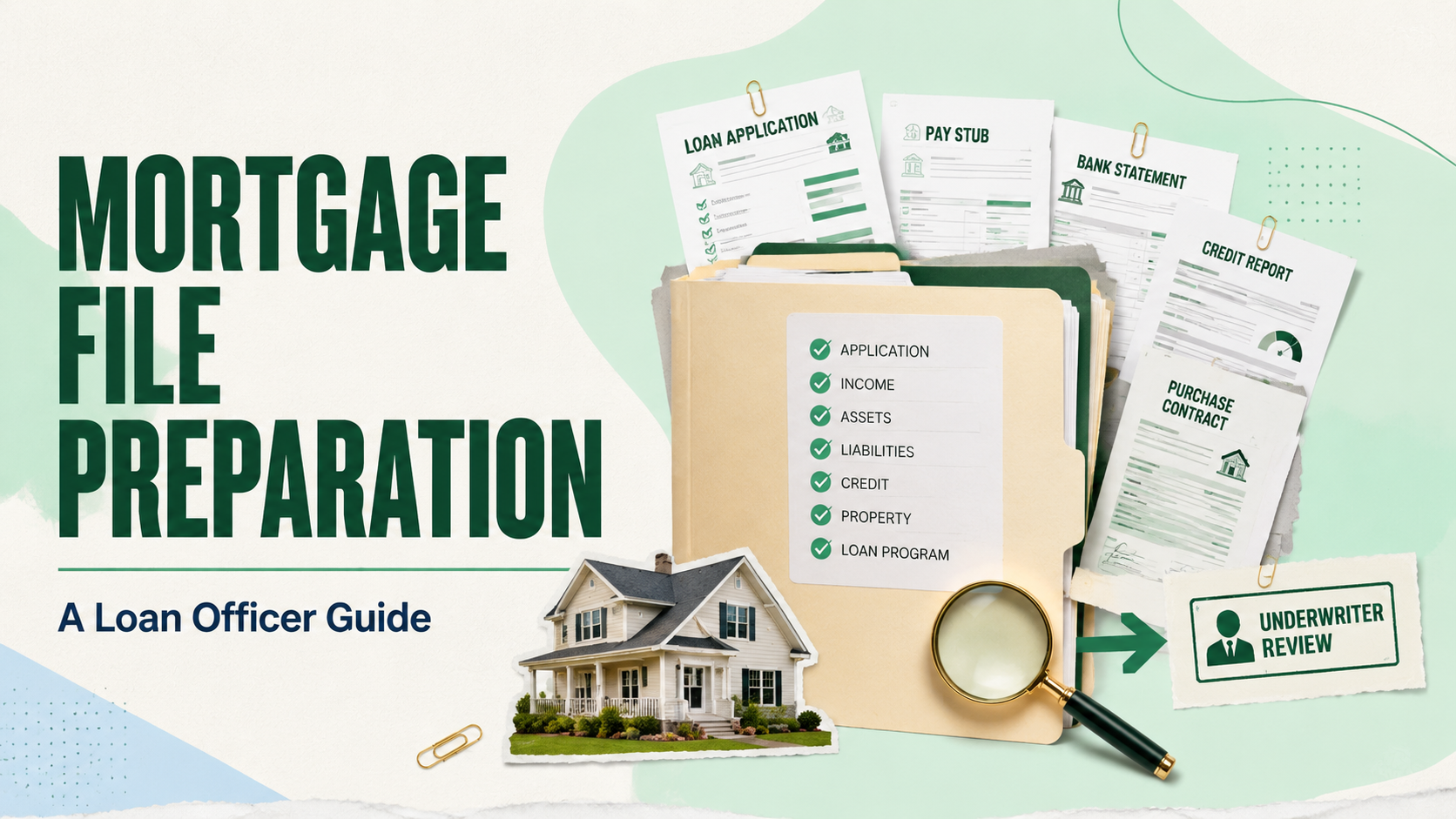
Mortgage file preparation for underwriting means reviewing the application, documents, credit, assets, liabilities, property details, and selected loan program as one connected file before submission. A clean submission does not guarantee approval, but it can reduce avoidable conditions, prevent conflicting information from reaching the underwriter, and make genuine eligibility questions easier to identify.
The loan officer’s job is not to make the underwriting decision. It is to collect accurate information, recognize gaps, document the selected scenario, and submit a file that clearly tells the same story across every document.
This guide provides a practical framework, not a universal underwriting checklist. Requirements vary by lender, investor, loan program, property, occupancy, borrower profile, automated underwriting findings, and applicable law. Always follow the current guidelines and procedures for the specific transaction.
Section 02
Mortgage File Preparation for Underwriting Starts With the Application
A file can contain many documents and still be incomplete. Before checking pay stubs or bank statements, review the loan application from beginning to end.
Confirm that names, addresses, employment, income, assets, real estate owned, debts, occupancy, declarations, and transaction details are complete and internally consistent. Then compare the application with the documents already received.
Common inconsistencies include an employer missing from the work history, an asset with no supporting statement, an undisclosed obligation, conflicting occupancy information, or a borrower reporting salary while other records indicate business ownership.
Do not quietly change material information to make the file look consistent. Confirm the facts with the borrower, update the application through the approved process, and retain required documentation.
Section 03
Review Income for Stability, Source, and Documentation
Income review is more than adding current earnings. Determine which income sources the borrower wants considered and what documentation the program requires to evaluate them.
For a W-2 employee, review the employment history, pay structure, year-to-date earnings, base pay, and any overtime, bonus, commission, shift differential, or leave. Look for unexplained changes, declining earnings, gaps, inconsistent employer names, or figures that do not reconcile.
Self-employed income may require a different review of ownership, business history, tax returns, profit and loss information, balance sheets, bank statements, or other program-specific records. A gross deposit total or business revenue figure is not automatically qualifying income.
Fannie Mae’s current income assessment guidance, for example, addresses income stability, adequacy, and likelihood of continuance for loans delivered under its requirements. Other programs and lenders may use different documentation or calculations.
If a borrower requests a supporting letter, explain the limited role of a CPA letter in a mortgage file. A letter may address a specific question, but it does not replace the underwriter’s analysis or automatically establish qualifying income. This income review is a core part of mortgage file preparation for underwriting because the application and supporting records must tell the same story.

Section 04
Reconcile Credit and Liabilities
Compare the liabilities on the application with the credit report, pay stubs, bank activity, divorce or support documents when applicable, real estate owned, and borrower disclosures.
Review installment and revolving accounts, student loans, leases, recently opened credit, other-property expenses, co-signed debts, business-paid obligations, support obligations, judgments, collections, and inquiries that may indicate new debt.
Do not assume an account can be excluded because the borrower says another person pays it. Exclusion requirements and acceptable evidence vary by program and lender.
If the borrower plans to pay down or pay off debt, confirm how the selected program treats the obligation and what proof will be required. Do not promise that paying one account will produce approval or a particular credit score.
Consistent mortgage file preparation for underwriting requires every disclosed liability to be reviewed against the available credit and financial records.
Section 05
Trace Assets and Funds to Close
The assets section should answer three questions: Does the borrower have enough eligible funds, where did the funds come from, and can the movement of money be documented?
Review the required down payment, closing costs, prepaids, reserves, credits, deposits already paid, and any debt payoff. Then compare the total need with eligible verified assets.
Look for large deposits, untraced transfers, cash deposits, new accounts, business funds, gifts, grants, borrowed funds, and assets that are restricted, volatile, jointly owned, or not readily available.
When gift funds are involved, review donor eligibility, the gift letter, evidence of transfer, and other applicable requirements before the funds move. The Wonder Rates guide to gift fund documentation explains why an undocumented deposit can delay underwriting.
Never suggest moving money between accounts simply to make statements look cleaner. The transfer may create another documentation trail and does not change the true source of funds.
Section 06
Match the Borrower to the Correct Income Documentation Path
A common submission problem is collecting documents for one underwriting path while structuring the loan under another. A borrower with tax-return income, bank-statement income, rental income, and W-2 wages may have several possible sources, but each must be evaluated under the selected program.
Before submission, identify:
| Question Why it matters | |
|---|---|
| Which income sources are needed? | Unnecessary sources can add complexity without helping qualification. |
| Which program is being used? | Documentation and calculations can differ. |
| What time period is required? | A partial history may not support the analysis. |
| Are earnings stable or changing? | Trends and interruptions may require explanation. |
| Does the application match the documents? | Conflicts create conditions and credibility concerns. |
For borrowers whose tax returns do not fully reflect current business cash flow, a bank statement loan may be worth evaluating when available. It is a different documentation method, not a way to ignore expenses, undisclosed obligations, or program requirements.
Section 07
Check the Property and Transaction Early
A strong borrower profile does not solve a property eligibility problem. Review the transaction before underwriting for issues that may affect the selected program.
Confirm the property type, occupancy, number of units, contract terms, concessions, interested-party contributions, title, insurance, appraisal status, and any known HOA or project details. Condominiums, manufactured homes, investment properties, new construction, mixed-use properties, and properties with repairs may require additional review.
Compare the contract and application, including the purchase price, deposit, credits, closing date, and parties. Escalate unusual terms rather than interpreting legal documents beyond the loan officer’s role.
Good mortgage file preparation for underwriting also means identifying property or transaction issues before they become last-minute conditions.
Section 08
Separate Missing Documents From Underwriting Decisions
Loan officers can identify a missing bank statement, incomplete page, unexplained transfer, or inconsistent address. They should not present a judgment call as though underwriting has already approved it.
Use three categories:
- Missing: A required item has not been provided.
- Inconsistent: Two or more parts of the file do not agree and need clarification.
- Decision required: The documentation is present, but an authorized underwriter or other reviewer must determine acceptability.
This distinction improves communication. It also prevents statements such as “that income is definitely fine” or “the underwriter will not care about this deposit.”
Borrowers who want to understand the next stage can review what happens during mortgage underwriting.
Section 09
Build a Pre-Underwriting Red Flag Table
Use a short table in the file notes so the processor and underwriter can see what was identified and how it was handled.
| Area Example red flag Pre-submission action | ||
|---|---|---|
| Employment | Recent job or pay-structure change | Verify dates, terms, and required documentation |
| Income | YTD earnings do not reconcile | Obtain clarification and supporting records |
| Assets | Large deposit or undocumented transfer | Trace the source under applicable requirements |
| Credit | Recent inquiry or new payment | Confirm whether new debt exists |
| Property | Condo, mixed use, repairs, or unusual title | Request program-specific review early |
| Occupancy | Facts conflict with stated intent | Clarify and document accurately |
| Contract | Credit or concession differs from application | Update the file and confirm eligibility |
A red flag is not automatically a reason for denial. It is an item that needs accurate documentation or an authorized decision.
Section 10
Communicate With the Borrower Without Creating Panic
When requesting documents, explain what is needed, which dates or pages are required, how the borrower should submit it securely, and when the team needs it. Avoid sending a vague message such as “underwriting needs more documents” when the file has not yet reached underwriting.
A clearer request is:
Before we submit the file, we need the complete statement for the account ending in 1234, including all pages, and documentation showing the source of the transfer dated August 18. Please upload the documents through the secure portal. The documents will be reviewed under the selected program and do not guarantee approval.
Do not request sensitive records through unapproved email, text, or social media channels. Follow company privacy and information-security procedures.
If the borrower reveals information that conflicts with the application, correct and document it. Never encourage omission. The article on mortgage application accuracy and fraud risk explains why incomplete or false information can create serious consequences.
Section 11
Update the Realtor Without Sharing Private Information
The Realtor usually needs to know whether the financing timeline is on track, what transaction-level item is outstanding, who owns the next step, and when another update may be available. The Realtor generally does not need the borrower’s income, credit score, account balances, tax documents, medical information, or private explanation.
An appropriate update may say:
We are completing the pre-underwriting document review and have requested one additional borrower item. We expect to submit after it is received and reviewed. Approval and closing timing remain subject to underwriting and completion of all loan and property requirements.
Obtain the borrower’s authorization and follow company policy before sharing nonpublic information. Do not use the Realtor to pressure a borrower into supplying documents.
Section 12
The Realtor usually needs to know whether the financing timeline is on track, what transaction-level item is outstanding, who owns the next step, and when another update may be available. The Realtor generally does not need the borrower's income, credit score, account balances, tax documents, medical information, or private explanation. An appropriate update may say: We are completing the pre-underwriting document review and have requested one additional borrower item. We expect to submit after it is received and reviewed. Approval and closing timing remain subject to underwriting and completion of all loan and property requirements. Obtain the borrower's authorization and follow company policy before sharing nonpublic information. Do not use the Realtor to pressure a borrower into supplying documents.
A repeatable mortgage file preparation for underwriting workflow gives the loan team one final opportunity to catch gaps before submission.
Before submitting, confirm:
- The application is complete, current, and consistent with the file.
- Identity, employment, income, assets, liabilities, and real estate owned have been reviewed.
- Required document pages and relevant time periods are included.
- Large deposits, transfers, gifts, and funds to close have a documented path.
- Credit inquiries, new debts, and omitted obligations have been addressed.
- The loan program matches the documentation and borrower objective.
- Property type, occupancy, contract, title, insurance, and project issues have been flagged.
- Automated underwriting findings or program-specific requirements have been reviewed when applicable.
- Open questions are labeled as missing, inconsistent, or requiring a decision.
- Material conversations and updates are documented.
- No one has promised approval, conditions, pricing, or closing timing.
Using this mortgage file preparation for underwriting checklist helps the team verify the file consistently without treating a general checklist as a substitute for current program rules.
Fannie Mae’s Origination Through Closing guide illustrates how extensive the requirements can be for loans within its scope. Use the exact current rules for the actual lender and program rather than treating any general checklist as complete.
Section 13
Frequently Asked Questions
Can a loan officer clear underwriting conditions?
Loan officers may collect documents, but only an authorized reviewer can determine whether a condition is satisfied.
Does a complete file guarantee fewer conditions?
No. It can reduce avoidable requests, but underwriting may identify new questions during the full review.
The Bottom Line
Good mortgage file preparation for underwriting is not about making a file appear perfect. It is about making it accurate, consistent, documented, and easy to evaluate.
The strongest loan officers identify gaps before submission, distinguish facts from underwriting decisions, protect borrower information, and communicate uncertainty honestly. That work cannot guarantee approval, but it can reduce preventable delays and create a more professional experience for everyone involved.
Duc Pham, Mortgage Broker | NMLS# 844897
Wonder Rates, Inc. | NMLS# 1518655
Equal Housing Lender.
AZ, CA, CO, FL, GA, LA, MI, OK, PA, SC, TX, VA, WA, OH, AL, OR, NC
This article is for educational purposes only and is not a commitment to lend. Loan approval is subject to creditworthiness, income verification, property eligibility, and current underwriting guidelines. Loan programs, interest rates, lender fees, documentation standards, and underwriting requirements may change without notice. Always follow the applicable lender, investor, program, compliance, and company requirements for the specific transaction.