Section 01
Most buyers start their search by checking mortgage interest rates online. They see a number, write it down, and expect a lender to offer something close. Then the quote comes back half a percent higher, and the first thought is that the lender is overcharging.
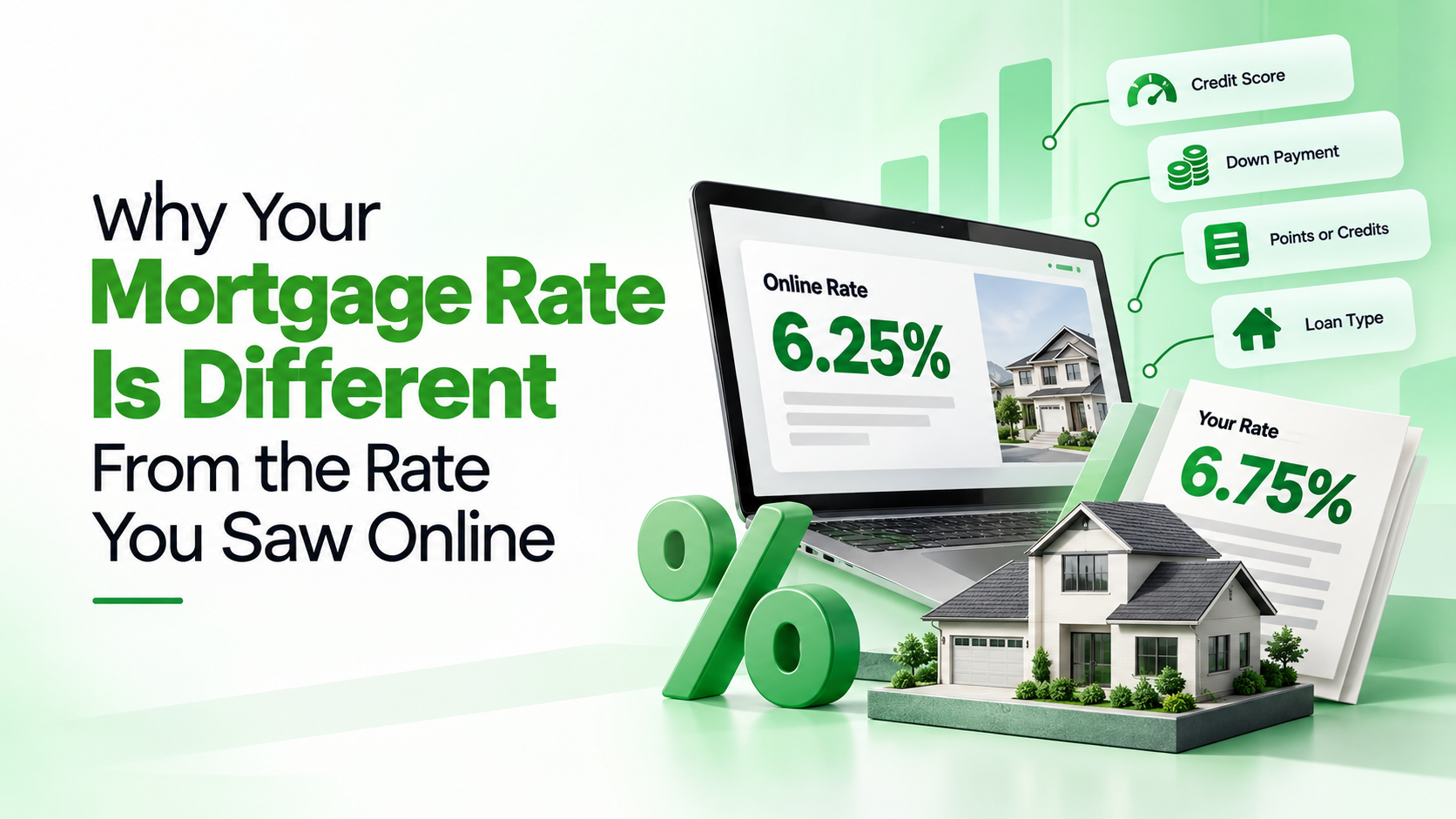
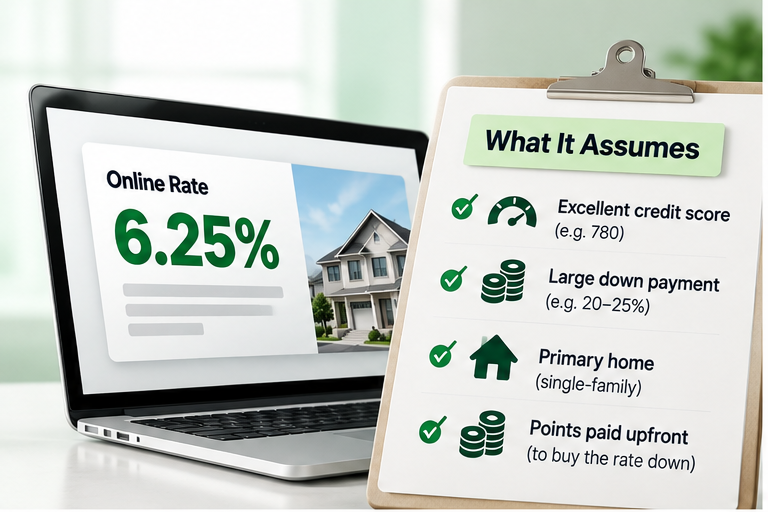
Usually, that is not what happened. The rate you saw online was real, but it was built for a specific borrower: excellent credit, a large down payment, a single-family primary home, and often a fee paid upfront to buy the rate down. If any of those details differ from your situation, your rate will differ too.
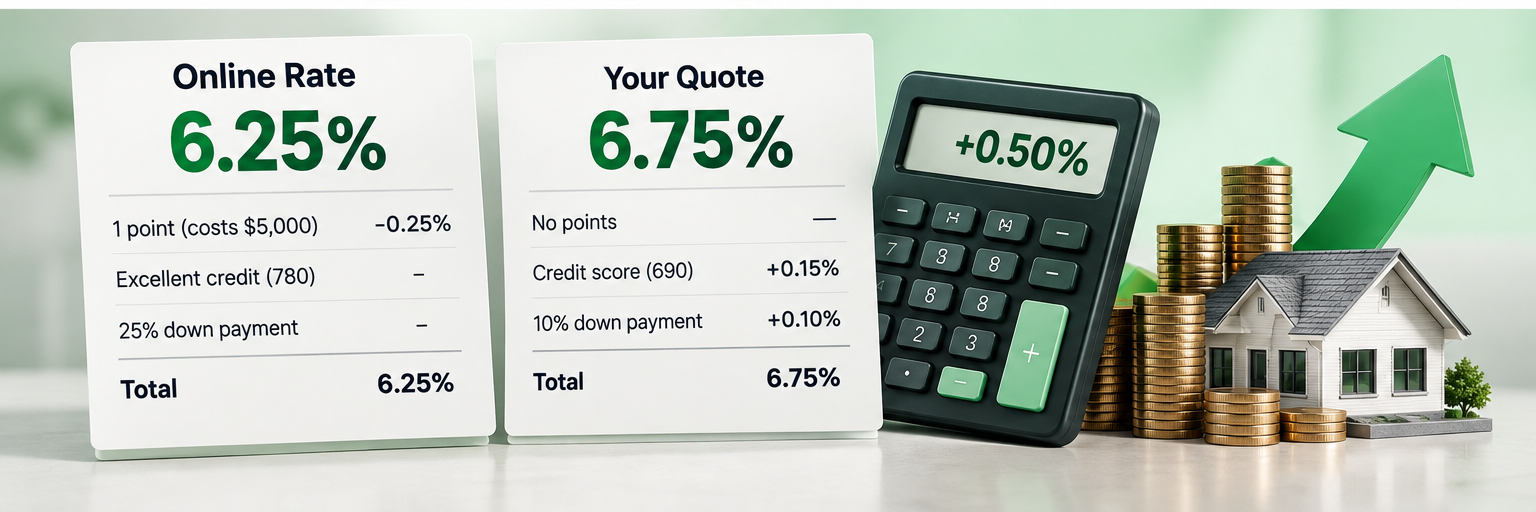
Here is a situation we see. A buyer finds an ad for 6.25% and calls a lender. The quote comes back at 6.75%. He assumes he is being treated unfairly. When the two are compared line by line, the ad included a point paid at closing, assumed a 780 credit score, and assumed 25% down. He has a 690 score and plans to put 10% down. Most of the gap is explained before anyone talks about the lender’s margin.
This article explains what online rates assume, the factors that move your rate up or down, and how to compare offers so you can tell a fair quote from an expensive one.
Section 02
The Problem: Online Rates Describe an Ideal Borrower
The rates you see online usually come from two places: lender advertisements and national rate surveys.
Advertised rates are designed to catch your attention. To show the lowest possible number, they often assume a very high credit score, a large down payment, a purchase rather than a refinance, and one or more discount points paid at closing. Those assumptions are usually listed in small print near the rate, and they matter as much as the number itself.
National averages, such as Freddie Mac’s weekly survey, describe typical rates for borrowers with strong profiles, such as excellent credit and 20% down on a conventional loan. They are useful for tracking whether rates are rising or falling. They are not a quote for any one person.
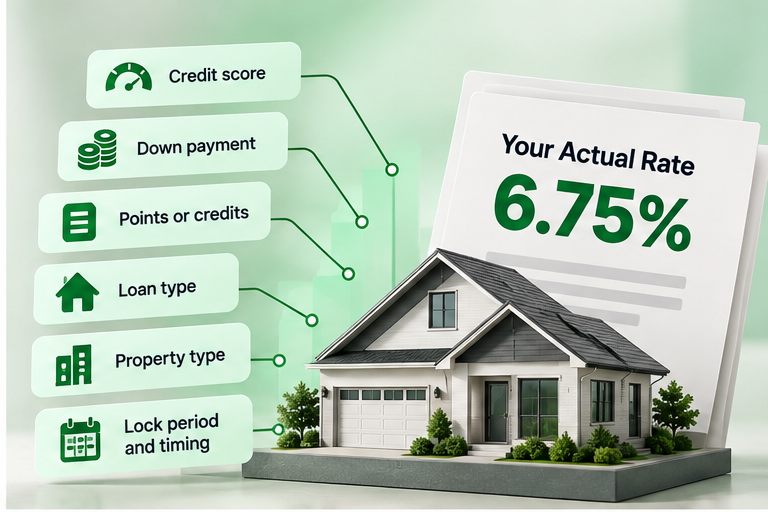
Your actual rate is priced for you. Lenders start with a base rate for that day, then adjust it based on the details of your loan and your file. Two people can apply on the same day with the same lender and get different rates, and both can be fair.
Section 03
The Causes: Six Factors That Change Your Rate
1. Your credit score. On conventional loans, lenders apply pricing adjustments based on credit score tiers. A lower score usually means either a higher rate or a higher fee for the same rate. Moving up even one tier can make a noticeable difference.
2. Your down payment. Your loan-to-value ratio, the loan amount compared with the home’s value, also affects pricing. Larger down payments generally earn better pricing, and credit score and down payment work together. A lower score with a small down payment usually carries the biggest adjustment.
3. Points or lender credits. You can pay discount points upfront to lower your rate, or accept a slightly higher rate in exchange for a lender credit toward closing costs. Many online rates include points. A quote with no points will naturally show a higher rate.
4. Loan type and size. Conventional, FHA, VA, jumbo, and non-QM loans are each priced differently. Loan size can matter too, especially near or above the conforming limit.
5. Property type and how you use it. Condos, two- to four-unit homes, and manufactured homes can carry pricing adjustments. A second home or investment property is usually priced higher than a primary home, and a cash-out refinance usually costs more than a purchase.
6. Your lock period and timing. A longer rate lock, such as 60 days instead of 30, often costs a bit more. Rates also move daily. An ad from last week may no longer match today’s market.
Section 04
Example: Breaking Down a Half-Point Gap
Example for educational purposes only. The rates and adjustments below are simplified assumptions chosen to show how the pieces add up. Real pricing varies by lender and changes daily.
The buyer from the introduction wants a $500,000 loan.
The online rate: 6.25%, assuming a 780 credit score, 25% down, and 1 point paid at closing.
His quote: 6.75%, with a 690 credit score, 10% down, and no points.
Step 1. Remove the point from the comparison. In this example, assume 1 point lowers the rate by about 0.25%.
Cost of 1 point: $500,000 × 1% = $5,000
The online rate without the point: 6.25% + 0.25% = 6.50%
Step 2. What is left of the gap. 6.75% − 6.50% = 0.25%
That remaining 0.25% reflects his lower credit score and smaller down payment. It is the normal cost of his profile, not an unfair markup.
Step 3. What the full gap means in dollars. Monthly principal and interest at 6.25%: $3,078.59 Monthly principal and interest at 6.75%: $3,242.99
Monthly difference: $3,242.99 − $3,078.59 = $164.40
Yearly difference: $164.40 × 12 = $1,972.80
Remember that the 6.25% option also costs $5,000 more at closing. A fair comparison looks at both the rate and the upfront cost together. If you want to understand when paying for points makes sense, compare the monthly savings with the upfront cost and how long you expect to keep the loan.
Section 05
Solutions: How to Compare Offers and Lower Your Rate
Compare Loan Estimates, not ads. A Loan Estimate is a standard three-page form every lender must use, so it makes side-by-side comparison much easier. Ask each lender for one on the same day, because rates change daily.
Match the assumptions. Ask each lender to quote the same loan amount, loan type, lock period, and number of points. Then compare the interest rate together with Section A of page 2, Origination Charges, where points and lender fees appear. A low rate with high fees is not always the better deal.
Look at the APR as a cross-check. The APR includes the rate plus certain loan costs, so two offers with the same rate but different fees will show different APRs.
Ask what would improve your price. A good loan officer can tell you whether a slightly higher credit score, a larger down payment, or a different loan program would move you into a better pricing tier. Our article on a 12-month plan to raise your credit score shows how to prepare.
Decide on points with real numbers. Ask for pricing with no points, with one point, and with a lender credit. Then choose based on how long you expect to keep the loan.
Ask direct questions about pricing. What does this rate assume? How long is the lock? What happens if rates fall before closing? Our list of questions to ask a loan officer about pricing can help.
Section 06
Checklist before you compare
- Know your credit score and planned down payment
- Request Loan Estimates from at least two or three lenders on the same day
- Ask each lender for the same lock period and number of points
- Compare the rate, Section A fees, and APR together
- Ask what would move you into a better pricing tier
Section 07
Frequently Asked Questions
Why is my mortgage rate higher than the advertised rate? Advertised mortgage interest rates usually assume an ideal borrower: a very high credit score, a large down payment, a single-family primary home, and often discount points paid at closing. If your credit score, down payment, property type, or loan program differs, your rate will be priced differently. Comparing the assumptions behind the ad usually explains most of the gap.
Are online mortgage rates accurate? They are accurate for the borrower and loan they describe, but they are not a quote for you. National averages, such as Freddie Mac’s weekly survey, track market trends for borrowers with strong profiles. Lender ads often include points. To know your actual rate, you need a Loan Estimate based on your own credit, income, down payment, and property.
How much does my credit score affect my mortgage rate? On conventional loans, it can matter a lot. Lenders apply pricing adjustments by credit score tier, and those adjustments combine with your down payment. A lower score with a small down payment usually carries the largest cost. Moving up a tier, even by a few points, can lower your rate or your fees. Ask your loan officer where the next tier starts.
What is the difference between the interest rate and the APR? The interest rate determines your monthly principal and interest payment. The APR includes the interest rate plus certain loan costs, such as points and lender fees, spread over the life of the loan. Because it captures those costs, the APR is useful for comparing offers. Two loans with the same rate but different fees will show different APRs.
How do I compare mortgage offers fairly? Request Loan Estimates from several lenders on the same day, with the same loan amount, loan type, lock period, and number of points. Then compare the interest rate, the fees in Section A, Origination Charges, and the APR together. The lowest rate is not always the best deal if it comes with much higher upfront costs.
Section 08
Want to Know What Rate Fits Your Actual Profile?
A Wonder Rates loan officer can price your loan based on your real credit score, down payment, and property, show you options with and without points, and explain exactly what is driving your rate.
[Get a personalized rate quote from a loan officer →]
Duc Pham, Mortgage Broker | NMLS# 844897 Wonder Rates, Inc. | NMLS# 1518655 Equal Housing Lender. AZ, CA, CO, FL, GA, LA, MI, OK, PA, SC, TX, VA, WA, OH, AL, OR, NC
This article is for educational purposes only and is not a commitment to lend. Rates shown are for illustration only and are not an offer or a quote. Loan approval is subject to creditworthiness, income verification, property eligibility, and current underwriting guidelines. Loan programs, interest rates, and lender fees may change without notice. Always review your official Loan Estimate before making a financing decision.